
The Essential Guide to Perfective Maintenance in Software Development
November 05, 2025 / Bryan ReynoldsWhat is Perfective Maintenance? A Guide for Leaders Beyond Bug Fixes
Is Your “Working” Software Holding You Back?
Imagine a scenario familiar to many technology and sales leaders. Your company’s core software application—the one that runs your business, manages customer data, or powers your service delivery isn’t broken. It boots up every morning, processes transactions, and generates reports. By all traditional measures, it works . Yet, there’s a nagging friction. Reports that should be instant take minutes to load, frustrating your sales team. The UI is dated and clunky and the lack of a user friendly design means a constant stream of low-grade complaints from customers and extensive training for new hires. Worst of all, when your marketing director proposes a brilliant new feature to get ahead of the competition, your dev team quotes months and says it’s too complex because of the existing code.
This isn’t a bug crisis; it’s a potential crisis. Your software isn’t failing, it’s actively holding you back. This common business problem arises from a fundamental blind spot in how leaders view their technology assets. We’re conditioned to think in a binary: software is either “up” and working or “down” and broken. This misses the vast, critical spectrum between functional and optimal. It’s in this spectrum that a hidden drag accumulates—the opportunity cost of slow processes, poor adoption, dev friction and missed market windows.
The discipline to address this blind spot is perfective maintenance . It’s the proactive and continuous process of evolving a software asset to make it better, faster, more intuitive and more valuable even when nothing is technically “broken”. It’s the shift from “Does it work?” to “How well does it work and how much value is it creating for the business?” Perfective maintenance is the difference between owning a functional car that gets you from A to B and owning a performance car that wins races. It’s about turning a passive operational tool into an active strategic engine for growth and competitive advantage.
Clarifying the Confusion: The Four Types of Software Maintenance
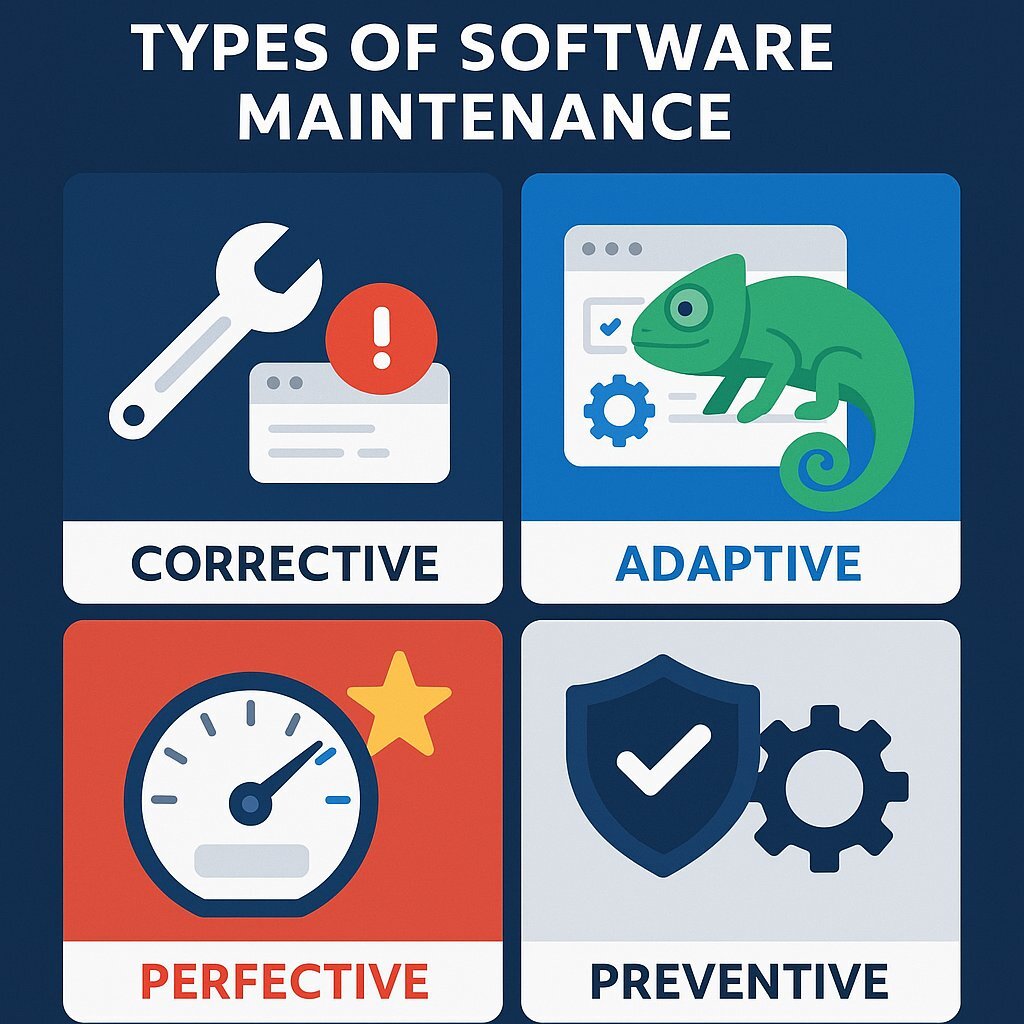
For non-technical executives, the word “maintenance” brings to mind costly, reactive fire-fighting—late-night calls to fix a system crash or urgent patches for a security flaw. While that’s one aspect, it’s a very incomplete picture. A mature software management strategy includes four types of maintenance, each with a different purpose, trigger and business impact. Understanding these types of software maintenance—corrective, adaptive, perfective and preventive—is critical as each plays a vital role in keeping software functional, reliable and adaptable over time. Understanding this “maintenance mix” is key for any leader who wants to make informed decisions about their technology budget and strategy.
- Corrective Maintenance: This is the classic “fire-fighting” most people associate with the term. A bug is discovered by a user or a system monitoring tool and the development team is called in to fix it. Corrective software maintenance is about bug fixing, fixing bugs and responding to bug reports to get the system back to a stable state and user satisfaction. This work is purely reactive, necessary for stability but adds no value to the software. It simply gets the system back to where it was before.
- Adaptive Maintenance: This type of maintenance is about keeping up with the world. When a new version of an operating system is released, a new data privacy regulation like GDPR is enacted or a critical third-party service changes its API, the software must be updated to remain compatible and functional. Like corrective maintenance, this is necessary for survival but is fundamentally reactive and doesn’t, in itself, create a competitive advantage.
- Perfective Maintenance: This is the proactive pursuit of excellence. Driven by user feedback, performance data and strategic business goals, perfective maintenance is about making the software better. This includes adding new user requested features, optimizing slow database queries to improve performance, and refactoring code to make it more efficient and easier to change in the future. This is where business value and competitive advantage is built.
- Preventive Maintenance: This is the “ounce of prevention” that avoids a “pound of cure.” It includes activities like code optimization, documentation improvement and security protocols to prevent future problems from occurring. Preventive maintenance and preventive software maintenance are proactive approaches that detect and address issues before they hit the system, extend software life and improve stability. It’s a forward looking discipline that reduces the likelihood of future corrective maintenance needs.
Smart leaders are now looking beyond bug counts and asking their technology teams for a “maintenance mix” report. This breakdown shows whether valuable engineering time is being spent creating future value (perfective) or merely patching past mistakes (corrective). The distribution of effort across these four categories is a powerful key performance indicator (KPI) for the health of a company’s core software asset. In well-managed systems perfective maintenance can account for 50-60% of the total maintenance effort. A high percentage of time spent on corrective maintenance is a red flag indicating significant technical debt. Systems with frequent issues will require corrective maintenance and the software maintenance process should balance all types to maintain stability and performance.
To illustrate these differences consider the following breakdown:
| Maintenance Type | Goal | Trigger | Business Impact (Analogy) |
|---|---|---|---|
| Corrective | Fix bugs & errors | System failures, user reports | Mechanic: Fixing a flat tire Note: Application maintenance often involves software changes to address issues as they arise. |
| Adaptive | Adapt to new environments | OS updates, new laws, API changes | Chameleon: Changing colors to blend in |
| Perfective | Enhance features & performance | User feedback, strategic goals | Performance Tuner: Upgrading the engine |
| Preventive | Prevent future problems | Code analysis, documentation review | Health Check-up: Changing the oil |
The Business Case: Why Perfective Maintenance is an Investment, Not an Expense
To really get perfective maintenance you need to move the conversation out of the IT department and into the boardroom. This isn’t about technical housekeeping; it’s about aligning software improvements with business requirements and the needs of an evolving business to ensure the software continues to meet user expectations. It’s about making strategic investments that directly impact revenue, cost, risk and growth. The business case rests on three pillars.

The $2.41 Trillion Problem: How Perfective Maintenance Pays Off Technical Debt
"Technical debt" is a term coined by software developer Ward Cunningham to describe the long-term cost of taking the easy way out instead of using a better approach that would take longer. Every time a development team takes a shortcut to meet a deadline they are accumulating this debt. While invisible on a balance sheet this debt is very real and its "interest payments" come in the form of slower development cycles, more bugs and higher maintenance costs.
The scale of this problem is massive. According to recent industry research unaddressed technical debt costs US companies an estimated $2.41 trillion annually in operational failures, cybersecurity incidents and maintenance of outdated systems. The cost to fix this debt is $1.52 trillion. This is not a hypothetical risk it’s a quantifiable drag on the economy and your P&L. Over a 5 year period the cost of unaddressed technical debt for a single project with one million lines of code can be $1.5 million.
The tool for paying off technical debt is code refactoring , a core discipline of perfective maintenance. Refactoring is the process of restructuring existing computer code—changing the factoring—without changing its external behavior. It’s about cleaning, simplifying and optimizing the internal structure of the software. This makes the code easier for developers to understand, maintain and enhance in the future.
The payoff is direct and big. By investing in refactoring companies reduce the time their highly skilled, expensive developers waste untangling convoluted code, freeing them to focus on innovation and building new features. This accelerates time-to-market, lowers total cost of ownership and turns a brittle, expensive liability into a resilient, agile asset. To learn more strategies for bridging the IT execution gap and maximizing business ROI, see our guide on aligning your IT roadmap with business goals.
From Clicks to Conversions: The ROI of User Experience (UX) Enhancement
While refactoring addresses the internal health of your software, another pillar of perfective maintenance focuses on its external value: the user experience (UX). A poor user experience—a confusing interface, a slow loading page, a convoluted checkout process—is a silent revenue killer. It creates friction, frustration and ultimately customer abandonment.
The business case for investing in UX improvements is one of the strongest in the technology world. The data is clear:
- Massive ROI: Every $1 invested in UX can result in a return of $100—a staggering 9,900% return on investment.
- Conversion Boost: A well-designed UI can increase website conversion rates by up to 200%, with some studies showing lifts of 400%.
- Customer Loyalty: The cost of a bad experience is severe. 88% of online users are less likely to return to a site after a poor experience. For brands that customers already love 32% will walk away after just one bad experience.
Perfective maintenance is the way to capture this value. Activities like redesigning a confusing data-entry form, streamlining a multi-step process based on user feedback or optimizing a mobile app’s navigation are not “bug fixes.” They are targeted, high-ROI performance enhancements for the most important part of your business: the customer journey. For a practical executive perspective on transforming software development through AI and UX, explore our executive guide to B2B software transformation with AI.
| Metric | The Impact of UX-Driven Perfective Maintenance | Source(s) |
| Return on Investment (ROI) | Every $1 invested in UX yields a return of $100 . | 18 |
| Conversion Rate Lift | A well-designed UI can increase conversion rates by up to 200% . | 19 |
| Customer Retention | 88% of online consumers are less likely to return after a bad UX. | 18 |
| Brand Loyalty | 32% of customers will leave a brand they love after just one bad experience. | 18 |
Developer Velocity and Innovation
A messy, debt-ridden codebase has a third, often overlooked, cost: it kills the morale and productivity of your development team. When engineers have to spend most of their time untangling poorly documented, overly complex legacy code they aren’t innovating. They are doing technical archaeology. This is a huge waste of expensive, highly skilled talent and a direct path to employee burnout and turnover.
This is where the value of a partner with a philosophy of technical excellence becomes clear. At firms like Baytech Consulting the emphasis is on leveraging highly skilled engineers who understand that their job isn’t just to write code but to cultivate a clean, maintainable and scalable codebase. They view perfective maintenance not as a chore but as a professional discipline essential for achieving the kind of Rapid Agile Deployment that modern businesses demand. The strategic benefit is speed. A healthy codebase, maintained through continuous perfective maintenance, allows an organization to respond to market changes with confidence. Need to integrate with a new partner’s API? Want to launch a new feature to counter a competitor’s move? In a clean system these changes are faster, cheaper and less risky to implement. In a system burdened by technical debt they can be too slow and expensive. This ability to evolve quickly is the ultimate competitive advantage in a digital-first world. In fact teams that use modern enhancement tools and practices see productivity gains of over 25% and ship working software faster.
From Theory to Practice: What Does Perfective Maintenance Look Like in Your Industry?
To make these concepts concrete it’s helpful to see the core activities of perfective maintenance and how they apply in real-world business scenarios. Perfective maintenance is relevant across various software environments, web app and enterprise systems where ongoing improvements are key to long term success.
The main activities are:
- Code Refactoring: Think of this as a master mechanic reorganizing a messy engine bay. The car’s external behavior doesn’t change—it still drives—but under the hood everything is now clean, logically organized and easy to service. This makes future upgrades (like adding a turbocharger) simpler and reduces the chance of unexpected breakdowns.
- Performance Optimization: This is about making the software faster and more efficient. It’s like a logistics expert finding a more efficient route for a delivery truck. The destination is the same but you get there in half the time using less fuel. This could be optimizing a database query, compressing images or refining a complex algorithm.
- Feature Enhancement & Usability Redesigns: This involves modifying and improving the software based on direct user feedback to make it more capable and intuitive. It’s like an aircraft manufacturer redesigning a cockpit based on pilot feedback to make the controls more ergonomic, reduce the chance of error and improve mission effectiveness.
- Application Maintenance: Ongoing application maintenance efforts are crucial to optimize performance and improve software functionality, ensuring the system adapts to evolving business needs and remains competitive.
Here are how these activities translate into strategic wins across different industries:
- For the Finance/Mortgage CFO: An online mortgage application platform is seeing high user drop-off rates. A perfective maintenance initiative is launched to analyze user behavior and feedback. The team finds that a complex multi-page application form is the point of friction. They refactor it into a single-page wizard with clear steps and helpful tooltips. Result: Application abandonment rates drop 30% and the simplified data entry reduces internal processing time 15% directly impacting top-line revenue and operational efficiency.
- For the Healthcare CTO: Clinicians using an Electronic Health Record (EHR) system complain about “click fatigue” and the risk of errors during medication ordering. The perfective maintenance team works with clinical staff to implement usability enhancements. They bold drug names in lists for easier scanning, implement a color-coded system for patient allergies and pre-populate common prescription dosages. Result: The number of clicks to place a medication order is reduced 40%. This saves clinician time and reduces burnout and demonstrably lowers the risk of life-threatening prescribing errors—a huge operational and patient safety win. Ongoing improvements like these keep user trust and ensure the software remains stable and software relevant in a changing environment.
- For the Gaming/Advertising Head of Sales: A mobile gaming company’s revenue is limited by a slow in-game ad-serving platform. Ads take too long to load and disrupt the player experience causing many users to close them. A perfective maintenance project focuses on performance optimization. The engineering team rewrites inefficient database queries and refactors the ad delivery logic to be more streamlined. Result: Average ad load times decrease 50%. This creates a smoother player experience, higher ad completion rates and 10% increase in ad revenue. The refactored code also makes it much easier to integrate new, more lucrative ad formats in the future.
Database Performance Optimization: The Secret Engine of Perfective Maintenance
When it comes to perfective software maintenance database performance optimization is often the unsung hero driving real business results. In modern software systems the database is the engine that powers everything from real-time analytics to seamless user experiences. If that engine sputters so does your business. Proactive database performance optimization is more than just occasional tuning. It’s a continuous process of analyzing query efficiency, indexing high-traffic data and refining storage strategies to make sure your software systems run at peak performance. By addressing slow queries, eliminating redundant data access and optimizing schema design maintenance teams can reduce latency and improve throughput—delivering the speed and reliability users expect.
The results are immediate and measurable: faster load times, smoother transactions and a more responsive user interface all contribute to higher user satisfaction and engagement. Regular database optimization also prevents performance bottlenecks that can bring down mission-critical applications so your software remains scalable as user demand grows.
Incorporating database performance optimization into your perfective maintenance strategy is not just about technical excellence—it’s about unlocking the full potential of your software to drive business growth, support evolving user needs and stay competitive in a fast moving market.

A Leader’s Playbook: How to Implement and Prioritize Perfective Maintenance
Understanding the “why” is the first step. The next is implementing the “how”. Shifting from a reactive, break-fix mentality to a proactive, continuous improvement culture requires leadership and a structured software maintenance process. Take inspiration from our insights on custom software solutions overtaking off-the-shelf software and see how future-focused organizations prioritize forward-looking change.
A typical perfective maintenance workflow follows a clear, logical sequence:
- Identification: Needs are identified from various sources—user feedback from support tickets and surveys, direct requests from business stakeholders or performance bottlenecks detected by monitoring tools. Performance analysis is used to identify bottlenecks and areas for improvement.
- Analysis: Each identified item is analyzed to understand its root cause, business impact and estimated cost or effort to implement.
- Design: A solution is designed, whether it’s a UI mockup for a usability improvement or a technical plan for a code refactor.
- Implementation: The development team writes the code and makes the changes, which may involve updating software to address identified needs.
- Testing: The changes are tested to ensure they work as expected and have not introduced any new bugs (regressions). Bug fixing and software changes are validated before release.
- Delivery: The improvement is deployed to users.
System optimization is a key goal of this process to ensure ongoing improvements to performance, usability and functionality. The biggest challenge in this process is prioritization. With limited resources and an endless list of possible improvements deciding what to work on first is a critical strategic exercise. Improvements should be aligned with business requirements not just based on who yells the loudest or which department has the most political clout.
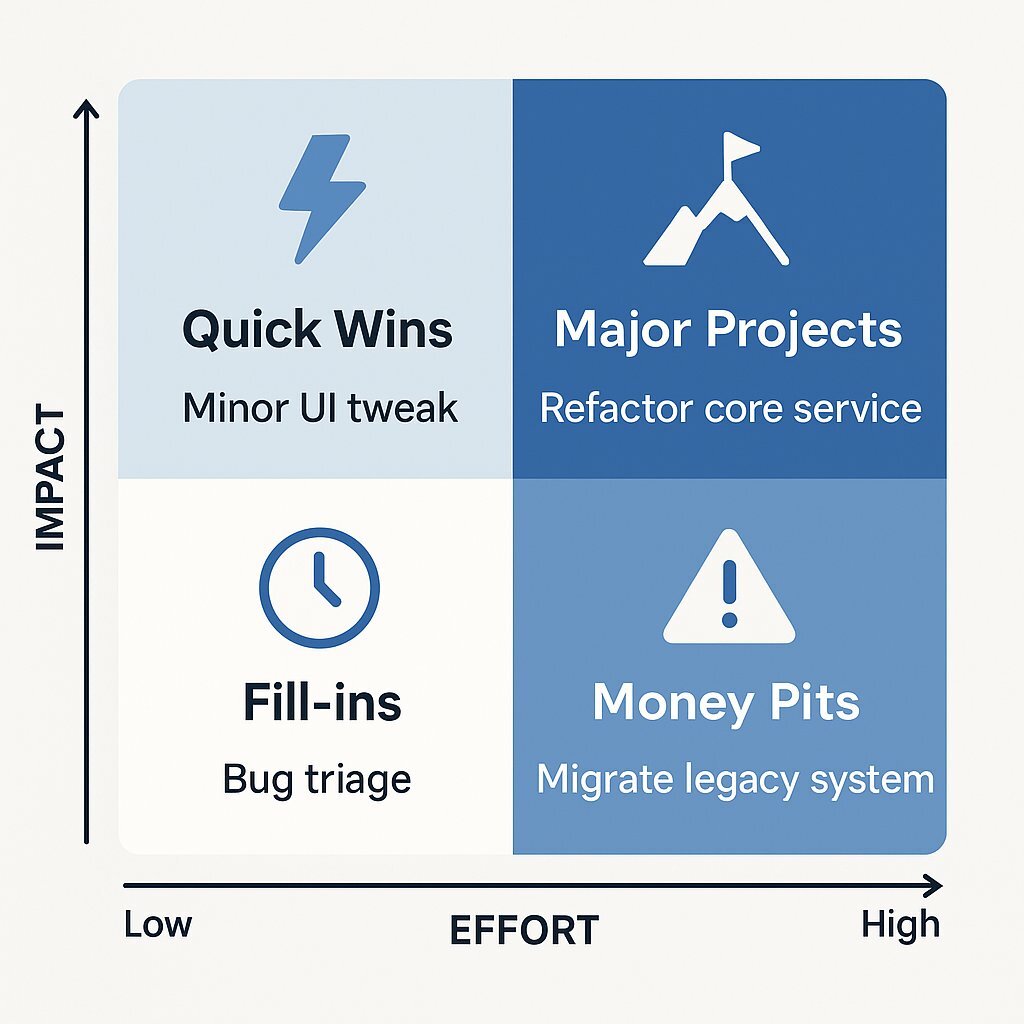
A simple but powerful tool for bringing clarity to this process is the Impact/Effort Prioritization Matrix. This framework turns a potentially contentious debate into a structured, strategic conversation about value and trade-offs. It allows business leaders to participate in technical planning without needing to understand the code, focusing instead on business outcomes.
| Low Effort | High Effort | |
|---|---|---|
| High Impact | Quick Wins (Do It Now): Example: Rewording a confusing call-to-action button that is depressing sign-ups. | Major Projects (Plan Strategically): Example: Refactoring a core monolithic service into microservices to improve scalability. |
| Low Impact | Fill-ins (Do When Time Permits): Example: Minor UI tweaks to a rarely used admin page. | Money Pits (Avoid/Re-evaluate): Example: A complete aesthetic redesign of an internal tool that has no impact on efficiency. |
Using a framework like this does more than just organize a backlog; it shapes the decision-making culture of the organization. A system where the “loudest voice wins” reinforces internal politics. A data-driven, value-focused framework reinforces a culture of objectivity, transparency and strategic alignment. By championing such a tool a leader is not just managing a to-do list; they are fostering a more effective and results-oriented organization.
Perfective Maintenance in an Agile World: Balancing New Features with Long-Term Health
In many organizations there is a natural tension between the drive to ship new features and the need to maintain the health of the codebase. Product managers are often incentivized by new releases that drive revenue and user acquisition while engineers are acutely aware of the growing technical debt that makes each new feature harder to build than the last. This isn’t a conflict to be won by one side but a strategic balance that must be managed continuously. Perfective maintenance is part of the software development life cycle and software development lifecycle to ensure software development remains focused on long-term stability and adaptability. Agile methodologies provide the ideal framework for managing this balance.
- In Scrum: Perfective maintenance should not be treated as a separate, out-of-band activity. User stories for UX improvements, performance optimizations and code refactoring should be added to the product backlog alongside new features. The Product Owner, in collaboration with the development team, can then prioritize these items during backlog refinement and sprint planning meetings and ensure that health-focused work is included in sprints. Feedback from the Sprint Review where stakeholders see the latest increment is a crucial input for identifying new perfective maintenance needs.
- In Kanban: For teams using a continuous flow model like Kanban the balance can be managed by dedicating a portion of the team’s capacity to improvement work. This can be done by setting specific Work-in-Progress (WIP) limits for different types of tasks (e.g. “New Feature”, “Improvement”, “Bug Fix”). This ensures a steady stream of perfective and preventive maintenance including application maintenance and software updates is always flowing through the system and prevents debt from accumulating.
To achieve this balance leading agile teams follow these best practices:
- The 15-20% Rule: A common and effective approach is to formally allocate a fixed percentage of each sprint or development cycle’s capacity—typically 15-20%—to paying down technical debt and other refactoring tasks. This ensures codebase health is treated as non-negotiable part of the development process.
- The Boy Scout Rule: This simple mantra, “Always leave the code cleaner than you found it,” is a powerful cultural tool. It encourages developers to make small incremental refactoring improvements as part of their daily work and prevent small issues from becoming big problems.
- Tie Refactoring to New Features: Instead of viewing them as separate activities integrate them. When planning a new feature proactively identify the refactoring required in adjacent parts of the codebase to support that feature cleanly. This “preparatory refactoring” ensures new functionality is built on a solid foundation not a shaky one. For complex systems this is especially important as maintaining system performance requires careful attention to technical debt and ongoing updates.
Measuring Success: KPIs and Metrics for Perfective Maintenance Initiatives
To get the most out of your perfective software maintenance investment you need to track the right key performance indicators (KPIs) and metrics. These metrics will give you a clear view of how maintenance activities are impacting your software systems, user satisfaction and the bottom line.
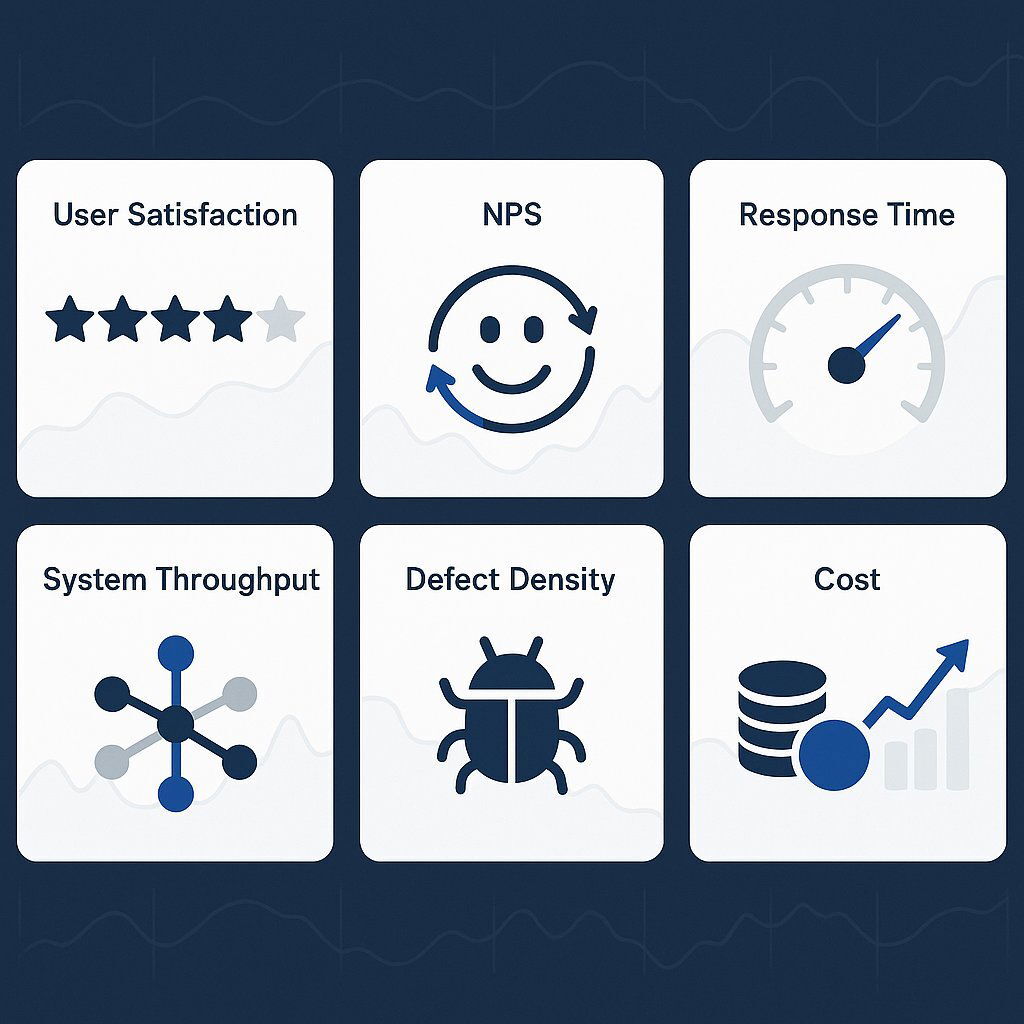
Start with user-centric metrics such as satisfaction ratings, Net Promoter Score (NPS) and customer retention rates. These will show you how improvements in software performance and usability are resonating with your audience. Technical KPIs—like response times, system throughput and defect density—will give you insight into how well your maintenance is working to optimize software performance and reduce errors. For advanced strategies on how IT leaders can demonstrate real-world ROI from AI investments and practical modernization, see our CFO's Playbook for pragmatic AI investment and ROI.
Financial metrics including maintenance costs and cost per improvement will help you evaluate the efficiency of your maintenance and identify opportunities to maximize ROI. Operational metrics such as mean time to recover (MTTR) and mean time between failures (MTBF) will give you a window into the stability and resilience of your software systems.
By tracking and analyzing these KPIs consistently your maintenance team can make data-driven decisions, prioritize high-impact initiatives and refine your perfective maintenance strategy. This will ensure your software stays aligned with business objectives, delivers measurable value and supports long-term growth.
Overcoming Common Challenges: Pitfalls and How to Avoid Them
Perfective software maintenance is a powerful driver of software evolution but it’s not without its challenges. Maintenance teams often struggle with technical debt, outdated technologies, complex software dependencies and shifting user requirements. Left unchecked these can undermine even the best laid maintenance plans.
To overcome these pitfalls organizations must adopt a proactive agile mindset. Prioritizing code refactoring reduces technical debt and improves software maintainability while continuous testing ensures enhancements don’t introduce new issues. Regularly soliciting and analyzing user feedback keeps your maintenance focused on real-world needs so your software evolves in step with user expectations. Learn how organizations are combining low-code and custom development approaches for maximum agility amidst rapid digital change.
Staying current with industry trends and using modern tools—like automated testing, performance monitoring and dependency management—will enable your team to tackle outdated technologies and complex integrations with confidence. Fostering close collaboration between development and maintenance teams will break down silos, accelerate problem solving and ensure evolving user requirements are addressed holistically. Finally, building a culture of continuous learning and knowledge sharing will enable your maintenance engineers to stay ahead of the curve. Ongoing training and support will give your team the skills to tackle complex maintenance tasks, adapt to new technologies and drive sustained software evolution. By following these strategies you can turn perfective maintenance from a source of frustration into a driver of innovation and long term success.
Frequently Asked Question: How Much of Our IT Budget Should We Allocate to Perfective Maintenance?
This is the question every CFO or CTO is asking when planning for the long term. While the exact figure will vary, industry research has given us a data-backed benchmark. Analysis from firms like Accenture suggests companies should aim to allocate about 15% of their IT budgets to remediating technical debt which is a key component of perfective and preventive maintenance.
But this 15% should be seen as a starting point for a strategic conversation not a hard and fast rule. The "right" allocation for your organization will depend on:
- System Age and Health: A modern well-architected system might need less, while a critical legacy system with years of neglect might need a higher allocation initially to address the debt and make it maintainable.
- Business Goals: A company in hyper-growth might strategically invest more in perfective maintenance focused on performance and scalability to ensure the platform can handle future demand.
- Industry and Compliance: Organizations in highly regulated industries like finance or healthcare might need to allocate more budget to both adaptive and perfective maintenance to keep pace with evolving security and compliance requirements.
Ultimately the goal is not to hit a magic number. It’s to have an informed ongoing dialogue between business and technology leaders. The question should evolve from "Are we spending 15%?" to the more strategic question: "Is our current investment in software health and evolution sufficient to support our business goals for the next three to five years?" For further reading on minimizing long-term risk, explore third-party and supply chain risk management for software.
Conclusion: Evolve or Expire — Your Software’s Future is in Your Hands
In today’s digital economy software is no longer a back-office utility; it’s the primary interface between a company and its customers. In this environment stasis is decline. Perfective maintenance should therefore be seen not as an IT expense line item but as a core business strategy for growth, efficiency and sustainable competitive advantage. Not evolving your software is a choice to accumulate technical debt—a debt that will slow your innovation, increase your costs, frustrate your users and delight your competitors. Investing in the performance, usability and underlying health of your digital assets is one of the highest return activities a modern business can do.
For leaders ready to act the path is clear:
- Measure Your "Maintenance Mix": Ask your technology leadership for a simple breakdown of how engineering time is spent. Is your team building future value through perfective maintenance or are they stuck in a reactive cycle of firefighting?
- Run a Health Check: Do a formal assessment of your core application’s technical debt and key user experience bottlenecks. Quantify the problem so you can manage it.
- Introduce a Prioritization Framework: Bring in a tool like the Impact/Effort matrix into your next product planning session. Drive a conversation that is about business value not technical tasks.
The digital landscape doesn’t reward those who stand still. Evolving your software is non-negotiable. For organizations that want to transform their software from a functional tool into a strategic weapon partnering with experts in custom application management and modernization is the fastest way to unlock its potential.
Sources
- Accenture. (2024). What is tech debt? Retrieved from https://www.accenture.com/us-en/insights/what-is-tech-debt
- Forrester Research, cited by UXCam. (n.d.). UX Statistics . Retrieved from https://uxcam.com/blog/ux-statistics/
- Swanson, E. B. (1976). The dimensions of maintenance. Proceedings of the 2nd international conference on Software engineering , 492-497. Cited in: Kurhila, J., et al. (2015). Transition of Software Maintenance Teams from Scrum to Kanban. 2015 IEEE/ACM 8th International Workshop on Cooperative and Human Aspects of Software Engineering . Retrieved from https://www.researchgate.net/publication/283266440_Transition_of_Software_Maintenance_Teams_from_Scrum_to_Kanban
About Baytech
At Baytech Consulting, we specialize in guiding businesses through this process, helping you build scalable, efficient, and high-performing software that evolves with your needs. Our MVP first approach helps our clients minimize upfront costs and maximize ROI. Ready to take the next step in your software development journey? Contact us today to learn how we can help you achieve your goals with a phased development approach.
About the Author

Bryan Reynolds is an accomplished technology executive with more than 25 years of experience leading innovation in the software industry. As the CEO and founder of Baytech Consulting, he has built a reputation for delivering custom software solutions that help businesses streamline operations, enhance customer experiences, and drive growth.
Bryan’s expertise spans custom software development, cloud infrastructure, artificial intelligence, and strategic business consulting, making him a trusted advisor and thought leader across a wide range of industries.