
PropTech 2026: Reclaim NOI with Strategic Automation
August 12, 2026 / Bryan Reynolds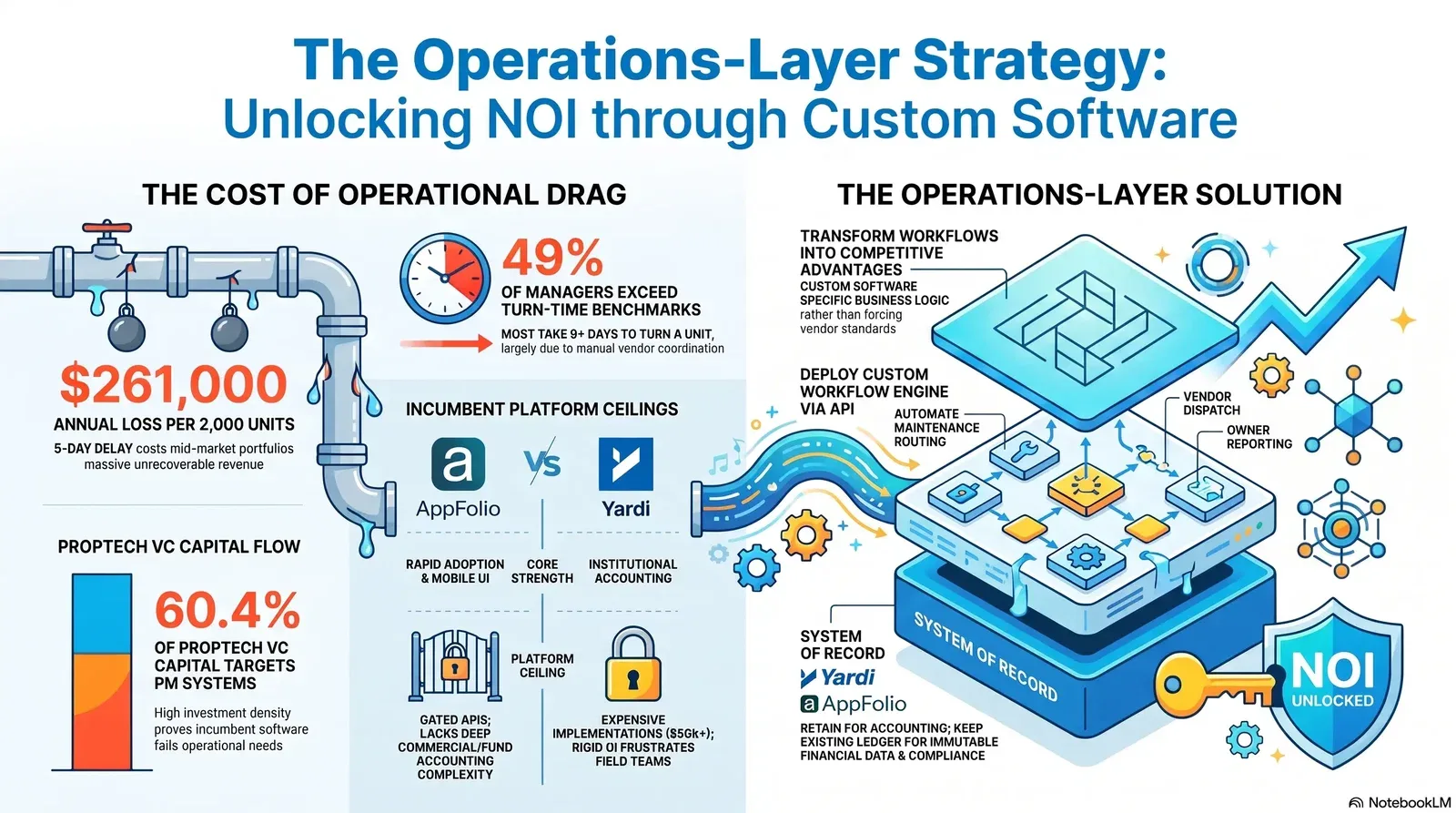
Over the past twelve months, six of every ten PropTech dollars went to a single category: property management systems. Venture capitalists do not concentrate capital at that density when incumbent software is working perfectly. For mid-market operators, this funding surge perfectly answers a lingering question: Is it just us, or is our software slowing us down? It is not just you. The market data proves that the daily operational grind—maintenance routing, rent workflows, tenant communication, owner reporting, and unit turns—is exactly where software leverage is currently concentrated.
Custom property management software is no longer a luxury for enterprise giants; it has become the strategic answer for mid-market operators who realize their incumbent platforms leave too much unmet need. By reading the PropTech investment 2026 data as a buyer's map, operators can identify exactly where established platforms fall short, which workflows generate the most financial drag, and how building a custom operations layer alongside an existing system of record unlocks immediate Net Operating Income (NOI). Thoughtful upfront planning and a disciplined discovery process, like the one outlined in our rigorous discovery phase checklist for engineering teams, make that custom build far less risky.
Reading the Funding Map: A Diagnosis of Incumbent Shortfall
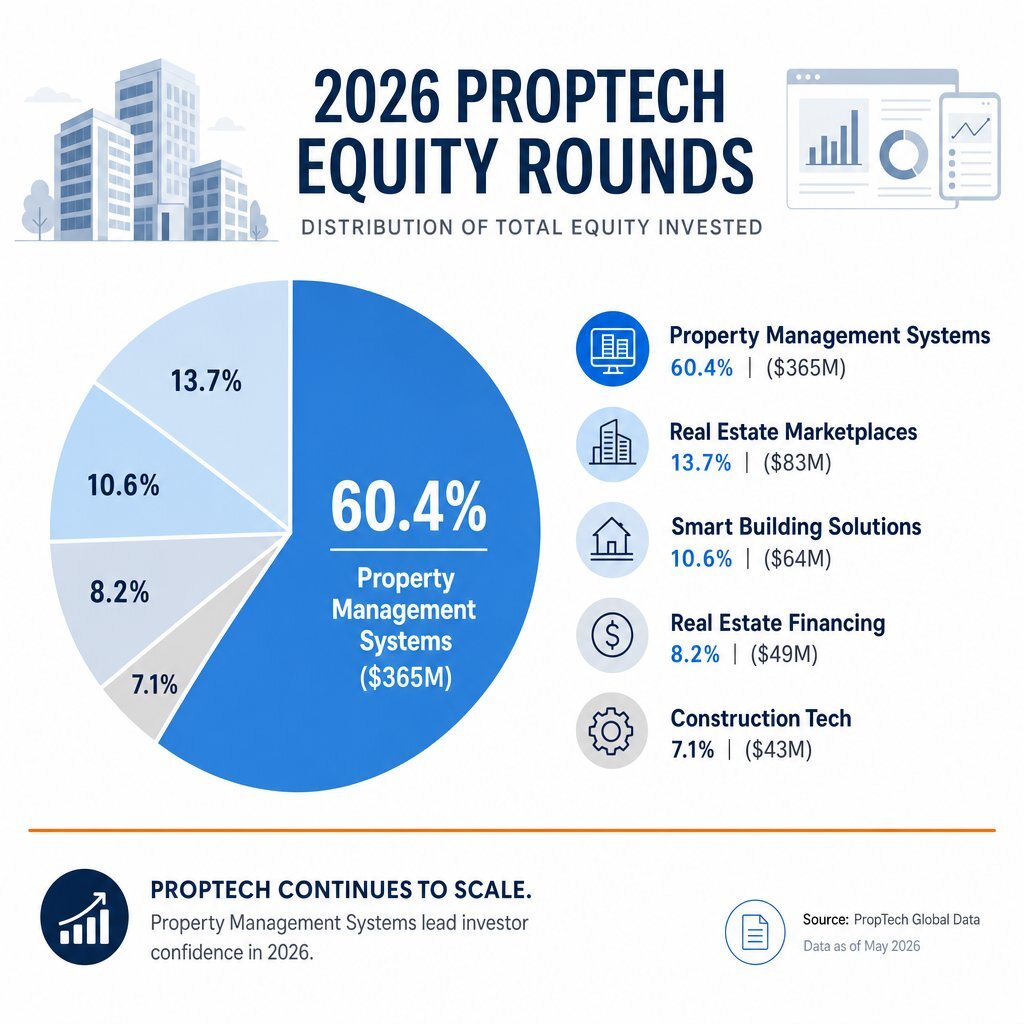
Venture capital flows to categories where enterprise buyers are actively dissatisfied. According to New Market Pitch, over the twelve months ending in July 2026, pure-play PropTech companies raised $604.8 million across 28 publicly disclosed equity rounds. Of that total, property management systems captured $365.0 million—an overwhelming 60.4% of all disclosed PropTech capital.
This concentration acts as a direct diagnosis of incumbent shortfall. While the broader global PropTech market is projected by Fortune Business Insights to reach $44.59 billion in 2026, the equity dollars reveal that buyers are specifically spending to fix the operations layer. The $365 million was distributed across just eight deals, yielding an average round size of 45.6 million but a median of only 4.0 million. This bimodal distribution indicates that investors are funding both scaled platforms attempting to consolidate the market and smaller, AI-native entrants attacking specific, unresolved workflow gaps.
For operators, this venture concentration is market evidence that property management operations are underserved. Startups are attacking the exact friction points that frustrate site teams: maintenance operations, payments, tenant communication, and compliance-adjacent document handling. But operators do not have to wait for a venture-backed startup to mature and ship their exact workflow. They can read the signal today and engineer their own leverage, using a phased legacy modernization roadmap that lets them modernize the operations layer without putting the core ledger at risk.
Property management software limitations
The operational drag does not live inside the system of record. Incumbent property management software excels at storing financial data, processing ledgers, and maintaining a chart of accounts. The hours leak across the gaps between systems, where data must be translated into physical work.
When analyzing where property management operations software fails, the friction is heavily concentrated in unit turnover management, maintenance routing, and reporting.
The Unit Turn Bottleneck
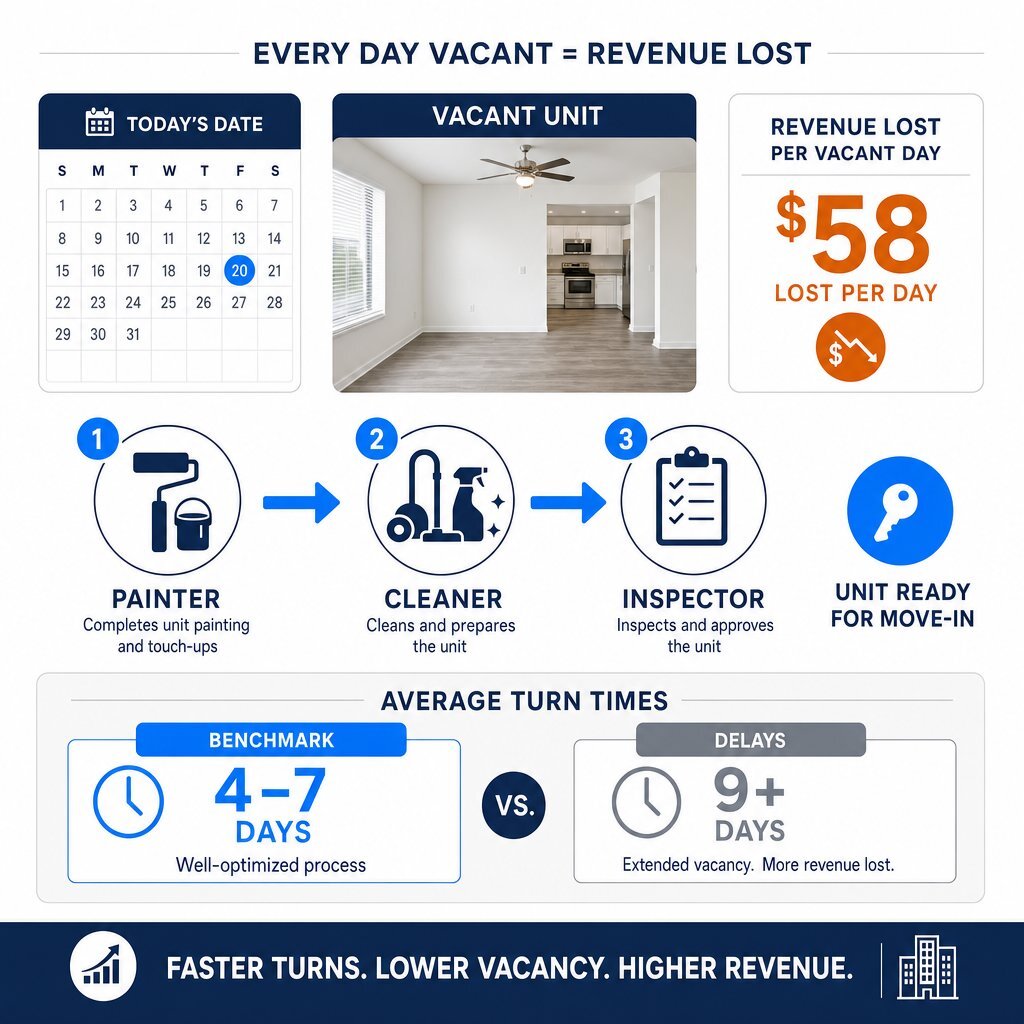
Every vacant day is an unrecoverable expense. With the national average apartment rent sitting at roughly $1,750 per month, an operator loses approximately $58 for every single day a unit sits empty. The industry benchmark for a highly optimized unit turn is four to seven days.
However, the software managing these turns routinely fails to coordinate the vendors required to hit that benchmark. Recent data from Property Meld indicates that 49% of management companies take nine days or longer to complete a turn, contributing to median list-to-lease times stretching to 41 days in early 2026. Delays rarely occur because a single task takes too long; they happen because a unit sits idle while site staff manually text a painter to follow up on a cleaner's finished work.
Maintenance and Reporting Leaks
Most incumbent systems successfully log a tenant's maintenance request and create a static work order. They fail to automate the multi-step execution. Matching the job to an approved vendor based on zip code, verifying capacity, tracking vendor acceptance, syncing the final invoice back to the ledger, and updating the tenant still require constant human intervention.
Similarly, owner reporting automation is notoriously rigid. Lenders and limited partners expect customized variance commentary, complex Common Area Maintenance (CAM) reconciliations, and tailored portfolio roll-ups. When the core software cannot autonomously generate these outputs, analysts export raw data and manually format spreadsheets, introducing human error and slowing down quarterly reporting cycles. Ensuring customer data deduplication and data quality is critical here, yet manual exports constantly threaten data integrity. Robust data architecture and enterprise application architecture help keep these reporting flows clean, auditable, and much easier to automate.
The Platform Ceiling: Where Yardi and AppFolio Stop
Established property management suites are highly capable enterprise resource planning (ERP) systems. However, like all ERPs, they enforce standardized assumptions about how a business should operate. When an operator's portfolio mix or service model diverges from those assumptions, they hit a platform ceiling.
The two dominant mid-market platforms—AppFolio and Yardi—illustrate where these ceilings exist.
| Dimension | AppFolio Property Manager | Yardi (Voyager / Breeze Premier) |
|---|---|---|
| Ideal Portfolio | Residential and growth portfolios under 5,000 units. | Complex commercial, mixed-use, and enterprise portfolios. |
| Core Strengths | Fast onboarding, exceptional mobile UI, rapid adoption, and intuitive native workflows. | Deep commercial lease logic, institutional accounting, GAAP/SOX compliance, and intricate expense recoveries. |
| Platform Ceilings | Lacks deep commercial complexity; struggles with multi-entity fund accounting and highly bespoke reporting. | Steep learning curve, expensive implementations (50,000–150,000+), and a rigid UI that frustrates field teams. |
| API Accessibility | Gated. Requires the Plus or Max premium pricing tier for essential API read access. | Gated. Requires a Professional Services agreement or specific interface modules for SOAP/REST access. |
AppFolio users often hit a ceiling on commercial lease complexity, forcing manual offline math for CAM reconciliations. Yardi users frequently hit a ceiling on usability and agility, resulting in poor field adoption and data entry bottlenecks. Neither platform is designed to be an open sandbox; both aggressively gate their APIs, protecting their ecosystem but limiting the operator's ability to orchestrate custom work. A flexible UX design layer on top can soften those ceilings for your teams, but it still cannot change how these platforms fundamentally behave.
The Operations-Layer Pattern: Keep the Ledger, Build the Workflow
The realistic pattern for mid-market operators is not to rip out their incumbent ERP. Migrating accounting systems carries immense risk, massive data translation costs, and months of disruption. The pragmatic architectural approach is to retain the system of record for accounting and leasing, and build a custom operations layer strictly for workflow execution.
This "operations-layer pattern" isolates the financial ledger from the daily friction of field operations. It relies on a distinct architectural split:
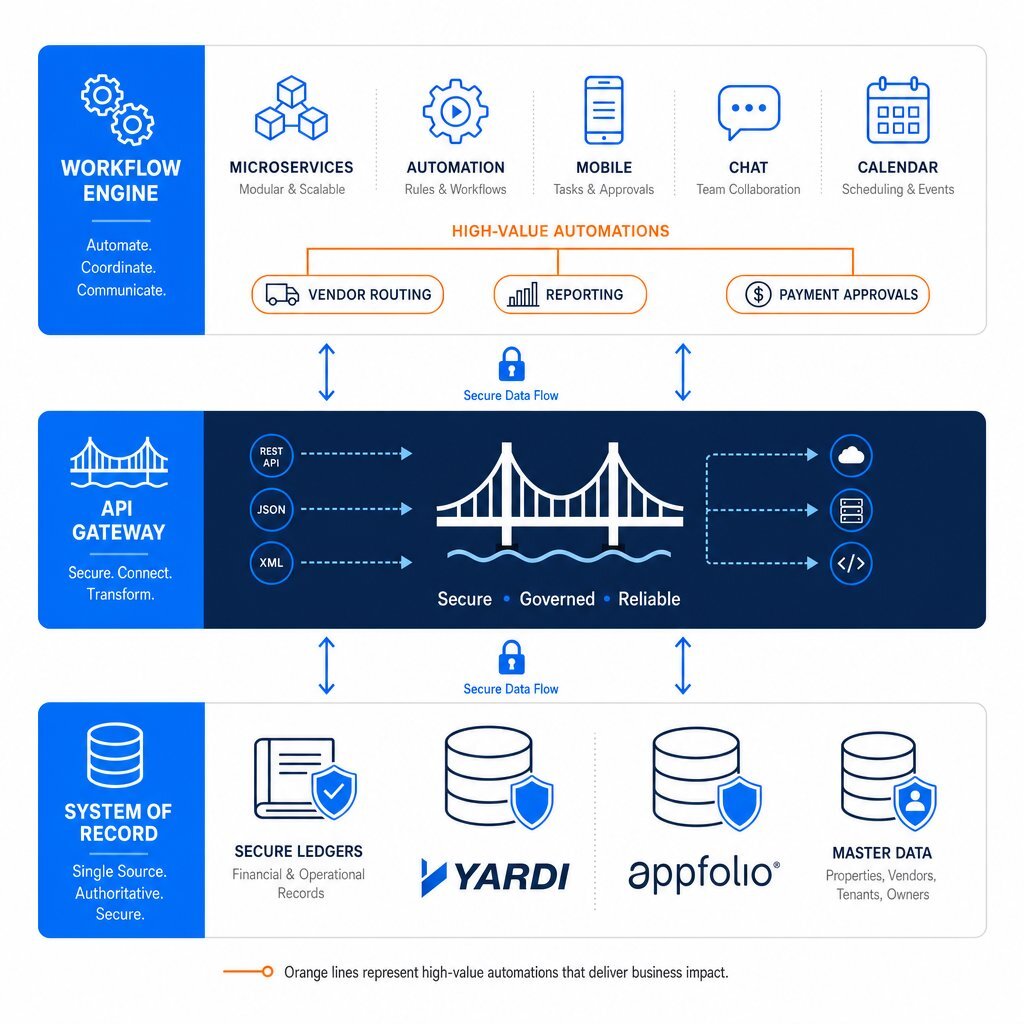
- The System of Record (The Foundation): Yardi or AppFolio serves as the immutable database. It holds the chart of accounts, active lease agreements, baseline property data, and final general ledger postings.
The API Gateway (The Bridge): Custom middleware connects the two environments. Building against Yardi involves handling their specific SOAP/REST web services and ensuring compliance with interface protocols. Building against AppFolio requires utilizing the AppFolio Stack API.
The Workflow Engine (The Custom Build): This is where custom logic lives. Applications engineered with PostgreSQL databases and scalable microservices handle conditional vendor routing, automated rent escalation sequences, bespoke owner reporting, and omnichannel tenant communications.
By pushing operational logic into a custom layer, the system intercepts a move-out notice from the ledger, triggers a dynamic inspection workflow, queries vendor availability via SMS, dispatches the make-ready crew, and syncs the finalized expense back to the accounting software. The operator keeps their compliant ledger but gains absolute control over how work gets done. Modern DevOps practices and DevOps efficiency keep that operations layer reliable, secure, and easy to update as your portfolio evolves.
When custom property management software beats the platform
Building custom technology requires capital, technical discipline, and operational focus. It is not the correct answer for every firm. Navigating the build-vs-buy framework comes down to a ruthless assessment of standardization versus differentiation. A clear-eyed view of your AI and automation maturity, like the one in our AI productivity gap analysis, also helps you avoid overestimating what off-the-shelf tools can actually do in your environment.
| Operator Characteristic | Recommended Software Strategy | Rationale |
|---|---|---|
| Standardized Residential Portfolio | Configure and Rent | If your portfolio consists entirely of standard multi-family units and utilizes standard vendor practices, off-the-shelf platforms are highly effective. Pay for the premium tier and use native automation. |
| Localized, Specific Pain Points | Adopt a Challenger | If your primary friction is an isolated issue—such as after-hours maintenance triage—adopt third-party, "bolt-on" tools that specialize deeply in that single vertical. |
| Distinctive Mix or Reporting Needs | Build Custom Software | When managing a complex blend of asset classes, executing massive batch unit turns, or delivering highly bespoke institutional reporting, platforms break down. Custom software beats the platform by conforming to your workflows rather than forcing you to conform to the vendor's. |
Custom operations software beats the platform when your workflow defines your competitive advantage. If your ability to turn a unit three days faster than the market standard is core to your firm's profitability, you cannot rely on the exact same off-the-shelf software your competitors use. In practice, that often means treating your operations layer like a living product, guided by an agile methodology so you can experiment, measure, and continuously improve instead of waiting years between big-bang upgrades.
The NOI Translation: Funding the Build
Custom application development must translate directly to Net Operating Income (NOI). Software leverage in real estate operations appears on the balance sheet through recovered hours and accelerated cycle times. As explored in our NOI Wins: The Real Places AI Delivers in Commercial Real Estate analysis, true leverage is measurable.
Consider the economics of unit turns. A mid-market operator managing a 2,000-unit portfolio with a standard 45% annual turnover rate executes 900 turns per year. If poor vendor coordination and manual routing extend the average turn by just five days beyond the benchmark, the portfolio bleeds 4,500 vacant days annually. At $58 of lost rent per day, that operational drag costs the firm $261,000 in unrecoverable revenue every year.
A custom operations layer that automatically routes vendors, triggers sequential inspections, and updates field teams instantly reclaims those lost days. The software development cycle pays for itself purely through vacancy reduction. This does not even account for the administrative headcount saved by automating late fee escalations, integrating real estate brokerage AI tools for faster leasing, or stripping hours out of the quarterly reporting cycle. For firms juggling multiple software initiatives, a grounded view of AI-driven technical debt and long-term maintenance costs ensures these NOI gains are durable, not a one-time spike.
Yet, execution remains the hurdle. JLL's 2025 Global Real Estate Technology Survey found that while 92% of corporate real estate teams are piloting advanced technologies, a staggering 95% have failed to achieve their program goals. The gap between experimentation and financial return is integration. Firms that successfully embed custom automation directly into their core workflows widen the competitive gap, lowering operating expenses and dramatically improving margins.
The Mandate for Operators
The concentration of 2026 PropTech capital confirms a stark reality: incumbent property management platforms have hit a ceiling in operational workflow execution. The smart money is funding solutions that address maintenance routing, unit turns, and complex reporting because those workflows hold the highest density of trapped value.
Mid-market operators do not have to wait for the venture market to crown a winner. By retaining their existing accounting platforms and building a custom operations layer, firms can eliminate manual drag, accelerate cycle times, and directly improve Net Operating Income. Software leverage belongs to the operators willing to build exactly what their portfolios demand. Pairing that custom work with a strong ongoing support model also keeps critical workflows stable as your properties, vendors, and regulations change.
For real estate firms ready to bridge the gap between their system of record and their daily operations, Baytech Consulting delivers rapid agile deployment of enterprise-grade custom applications. By engineering tailored middleware and bespoke workflow engines utilizing robust tech stacks—including SQL Server and PostgreSQL—Baytech transforms rigid platforms into agile operational advantages.
FAQ
What belongs in the system of record vs. the operations layer?
The system of record (like Yardi or AppFolio) should act as the immutable database, strictly handling the chart of accounts, general ledger, core lease agreements, and compliance data. The custom operations layer should house dynamic workflows—such as vendor routing, multi-channel tenant communications, automated rent escalation sequencing, and bespoke operational reporting—keeping daily friction out of the financial ledger. When you introduce AI into those workflows, a clear integrating AI strategy makes sure automation stays safe, explainable, and firmly under your control.
Supporting Links
- Fortune Business Insights: PropTech Market Size, Share, Trends
- JLL: Real Estate's AI Reality Check
Lessen: Apartment Turnover: A Complete Guide for Property Managers
About Baytech
At Baytech Consulting, we specialize in guiding businesses through this process, helping you build scalable, efficient, and high-performing software that evolves with your needs. Our MVP first approach helps our clients minimize upfront costs and maximize ROI. Ready to take the next step in your software development journey? Contact us today to learn how we can help you achieve your goals with a phased development approach.
About the Author

Bryan Reynolds is an accomplished technology executive with more than 25 years of experience leading innovation in the software industry. As the CEO and founder of Baytech Consulting, he has built a reputation for delivering custom software solutions that help businesses streamline operations, enhance customer experiences, and drive growth.
Bryan’s expertise spans custom software development, cloud infrastructure, artificial intelligence, and strategic business consulting, making him a trusted advisor and thought leader across a wide range of industries.