In this article
- What Happened at Johns Hopkins Bayview
- What a Shadow AI Incident Costs
- How Common Shadow AI Is in Healthcare
- Why Blocking Public AI Does Not Work
- The Workflow Friction Behind Shadow AI
- The Rules That Apply in 2026
- Why a BAA Alone Does Not Make an AI Tool Compliant
- What an AI Sidecar Is
- Self-Hosted or API: What It Costs
- How Three Health Systems Run Governed AI
- A Practical Plan for CTOs and Compliance Officers
- Conclusion
- FAQ
- Supporting Links
- About Baytech
- About the Author
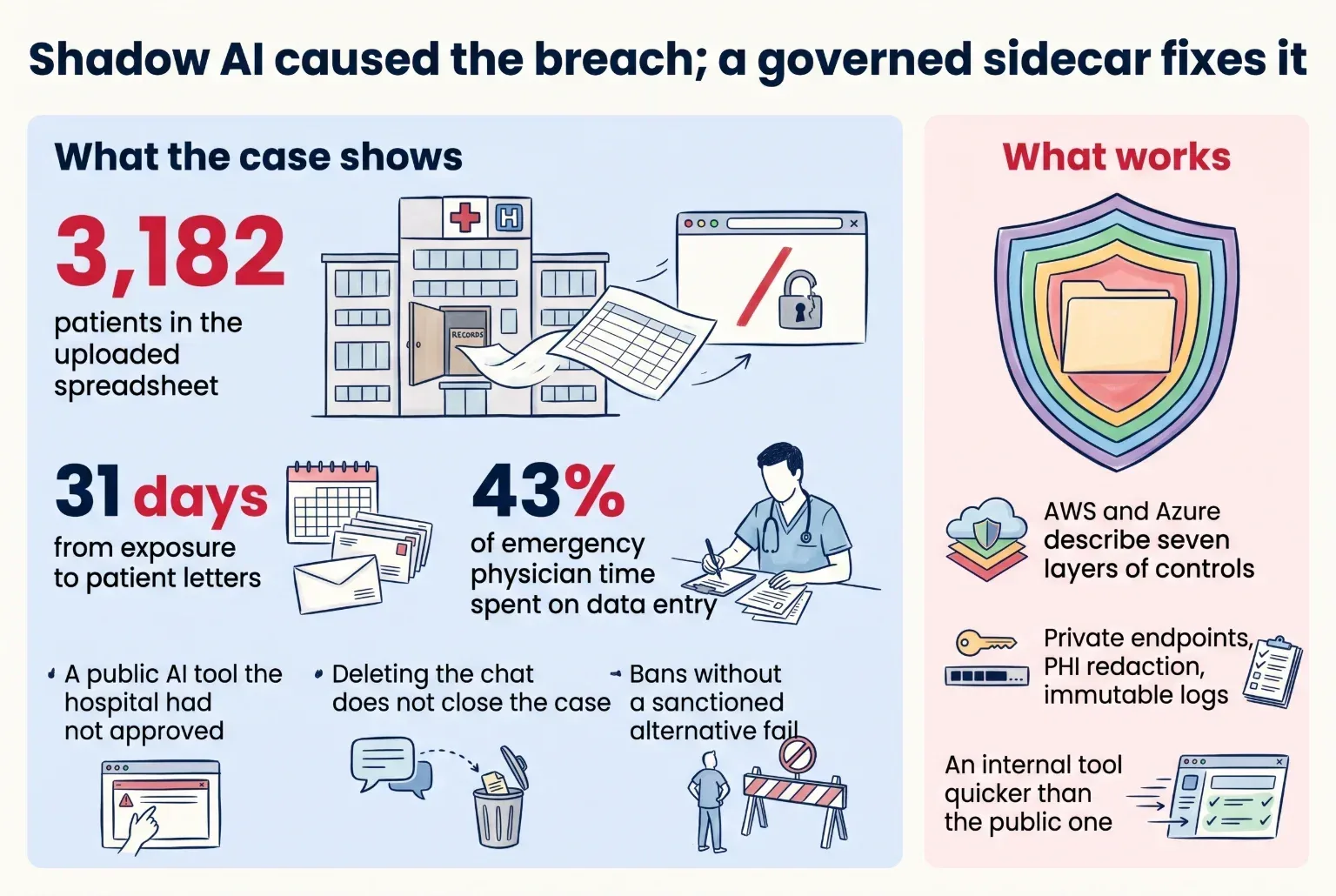
A staff member at Johns Hopkins Bayview Medical Center put a patient tracking spreadsheet into a public AI tool. The hospital spotted it the same day and began telling patients 31 days later.
Nobody hacked anything. One employee put patient data into a public AI tool that was a browser tab away, and that is the part hospital technology leaders should plan around.
What Happened at Johns Hopkins Bayview
The exposure happened on September 21, 2026, during an internal review at the Baltimore teaching hospital, which is part of Johns Hopkins Medicine. A staff member uploaded a patient tracking spreadsheet into a public AI platform the hospital had not approved. Accounts of the incident do not give the employee's role or say why they did it. Hospital administrators and IT security caught it on the day it occurred and started containment.
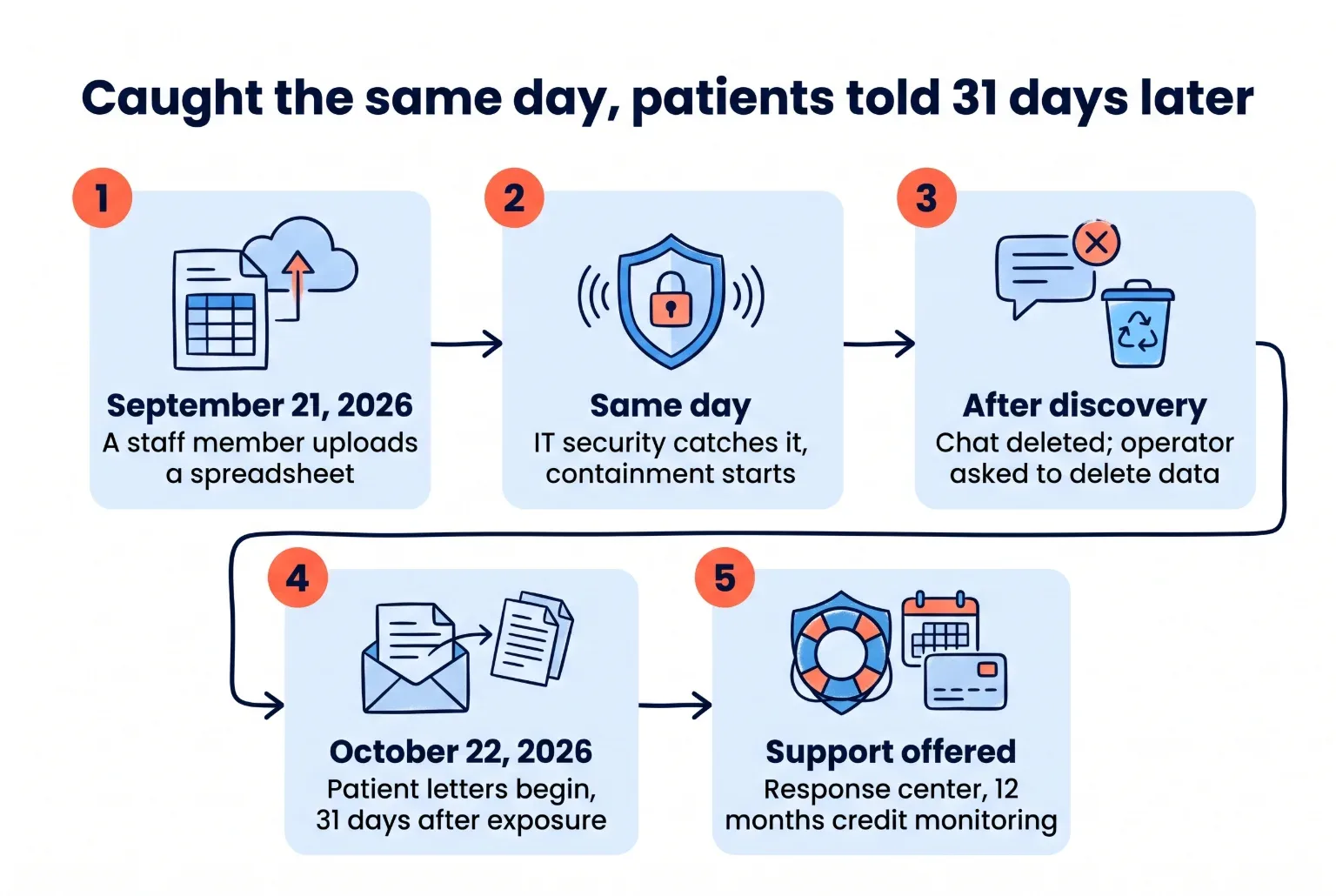
Detection was fast. Letters to affected patients began going out on October 22, 2026, which is 31 days after the exposure. That is inside the federal limit. The HIPAA breach notification rule requires notice without unreasonable delay and no later than 60 days after discovery. The hospital carries the burden of showing its notices met federal requirements, and it has to keep supporting records for six years.
Bayview opened a toll-free response center. It also offered affected people 12 months of credit monitoring and identity recovery through Experian IdentityWorks.
What Was in the Spreadsheet
The file covered 3,182 patients who were admitted and treated at the medical center between May and September 2026. The fields included full names, admission and treatment dates, medical record numbers, internal account numbers, attending departments, provider names, and the medications and treatment courses patients received.
Hospital representatives said Social Security numbers, banking information and credit card details were not in the file. That is good news for identity theft risk. It does not make the data harmless. A medical record number paired with treatment dates and prescribed drugs is sensitive PHI by any measure.
There is a second problem. A public AI operator with no business associate agreement sits outside HIPAA, so once it ingests health records, secondary use of sensitive medical histories becomes possible.
Why Deleting the Chat Does Not Close the Case
After discovery, administrators told the employee to delete the prompt, the follow-up conversation threads and the uploaded document from the AI tool's interface. They also contacted the company that runs the platform and asked it to delete the data permanently.
Deleting a chat on the user's side clears it from the user's view. According to Physicians Practice, it does not guarantee the data is purged from the provider's backend servers or kept out of later model training. As of late October 2026, the hospital had not publicly said whether the unnamed AI operator confirmed the erasure.
That gap is the real lesson for compliance officers. When a patient file goes to a public AI service, you cannot verify that it was destroyed. You can ask, and then you wait.
What a Shadow AI Incident Costs
No penalty against Bayview has been reported. Even so, the baseline costs for incident response, forensics, patient notification and credit monitoring for 3,182 patients are substantial.
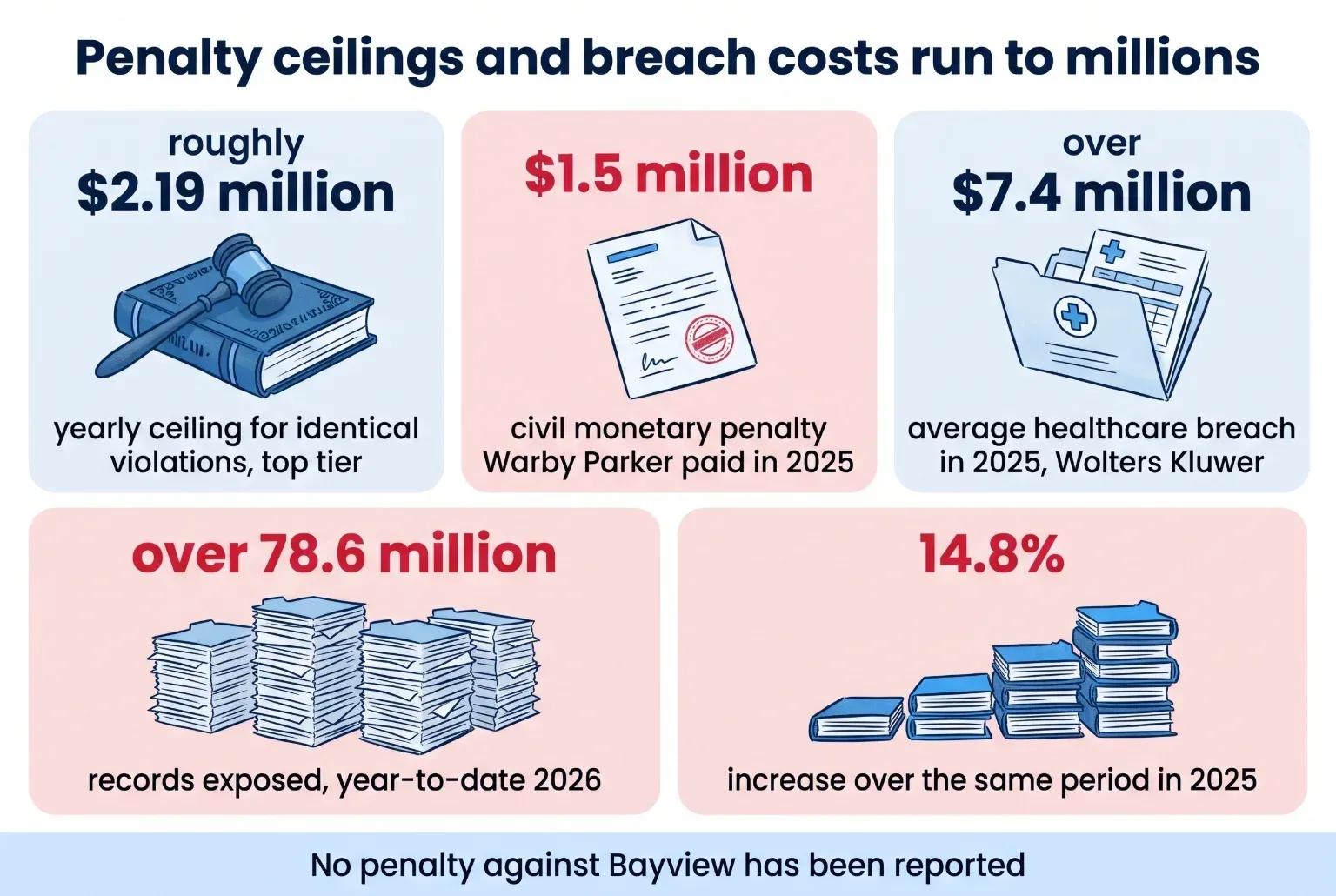
The regulatory ceiling is higher. In 2026, civil monetary penalties for HIPAA violations run up to roughly $2.19 million per year for identical violations at the highest tier of culpability, which turns on what the organization knew and how fast it fixed the problem. For a sense of what OCR does with that authority, Warby Parker paid a $1.5 million civil monetary penalty in 2025 tied to risk analysis and risk management failures.
Wolters Kluwer's shadow AI paper puts the average security breach in healthcare at over $7.4 million in 2025. The wider trend is also moving the wrong way. Year-to-date 2026 data shows healthcare breaches exposing over 78.6 million records, a 14.8% increase over the same period in 2025.
How Common Shadow AI Is in Healthcare
Bayview is a visible case of something that happens daily. Shadow AI means employees using AI tools, models and generative platforms outside the oversight and visibility of corporate IT and security. It differs from ordinary shadow IT, such as an unapproved cloud drive. These systems ingest and process what you give them, and sometimes train on it, so the data becomes ungovernable once it crosses the perimeter.
Wolters Kluwer Health ran a January 2026 survey of more than 500 healthcare professionals. In that survey, 57% of respondents said they had encountered or personally used unauthorized AI tools at work. Physicians Practice reports that 17% of healthcare workers admitted using unauthorized AI tools at work.
Those numbers come from self-reporting, so compliance analysts treat them as trailing indicators. People rarely volunteer policy violations accurately, and actual use is assumed to be higher. Separate global data from Heidi Health suggests 83% of clinicians globally work with AI tools in daily practice on their own, without corporate guidance, formal policies or sanctioned applications.
Why Blocking Public AI Does Not Work
The usual reaction is to block the domains, update the acceptable use policy and threaten discipline. It feels responsible. Industry analysts, legal scholars and clinical leaders broadly say it fails.
Banning public AI without a capable, sanctioned alternative pushes the behavior underground. Risk goes up, and the hospital gives up the productivity gains that governed AI can deliver. Users who find real value in a tool will reach it from a personal smartphone or an off-network device, and the security operations center loses sight of the data flow entirely.
Clinical informatics researchers add a point about diagnosis. Treating shadow AI purely as a discipline problem hides what is happening on the ground. The clinicians doing it are generally not acting maliciously. They are signaling that the sanctioned tools do not fit their daily tasks.
The Workflow Friction Behind Shadow AI
Bayview has not said why its employee used a public tool. Surveys point to friction as the usual reason, so leaders need to look at what the friction is. The numbers are ugly.
Documentation Time and the 4,000-Click Shift
Data entry consumes 43% of an emergency physician's time, compared with 28% spent on direct patient care. Emergency physicians log nearly 4,000 mouse clicks per 10-hour shift just to move through the EHR.
The chart itself is huge. Epic holds an estimated 43.7% of U.S. acute-care hospitals and carries a significant optimization backlog. A University of Wisconsin study of Epic usage found that one in five patient charts exceeds 206,000 words.
Fatigue sets in quickly. A simulation study of physicians using Epic found that 80% showed measurable cognitive fatigue after only 22 minutes of continuous EHR use, which is shorter than many single patient encounters.
The In-Basket Never Empties
Charting is only part of the load. System-generated messages make up nearly half of a physician's weekly inbox, averaging 114 out of 243 messages per week. A 2025 study of more than 15,653 oncology physicians using Epic found that message volume rose 19% between 2019 and 2022, driven by routine alerts, refill requests and lab results.
So a clinician who spends evenings charting at home (the "pajama time" the industry talks about) sees a free summarization tool and uses it. That is a rational choice. According to Physicians Practice, 45% of providers who bypassed IT security said faster workflow was the main reason.
If the hospital's own tools need extra clicks, load slowly or look clunky, the clinician will move to a smooth consumer product whatever the compliance rules say. This is the design requirement for everything that follows. The internal tool has to beat the public one on speed and effort, not only on safety. Our analysis of the internal tool tax shows how bad UX quietly burns salary dollars.
Ambient Scribes Help, With Trade-Offs
Ambient AI scribes listen to patient encounters and draft structured notes, and they are one of the fastest-adopted sanctioned tools. The results are real. Across five academic medical centers, they cut total EHR time by 13.4 minutes and documentation time by 16.0 minutes. Doximity data shows regular physician use of ambient and AI scribe tools rising from 20% in April 2025 to 29% by January 2026.
Accuracy is also uneven. A Mayo Clinic evaluation of five commercial AI scribe platforms averaged 3.0 potentially harmful errors per simulated case, and a 2025 JMIR Human Factors study of six AI scribes in primary care found that none were consistently error-free. A scribe, then, is an assistive tool that needs a human reviewing the output, not a replacement for clinical judgment.
The Rules That Apply in 2026
An internal AI tool lives under several overlapping rules. Two matter most here.
HIPAA Is Already Enough to Enforce
The proposed HIPAA Security Rule overhaul from January 2025, which would address AI and cybersecurity directly, moved to the HHS "Long-Term Actions" agenda with a non-binding target of July 2027. Nothing waits on that rule. HIPAA is technology-neutral, so the existing Privacy and Security Rules already govern any AI tool that touches PHI.
The Security Rule requires confidentiality, integrity and availability of all ePHI. That means risk analyses, system hardening, access management and audit controls.
NIST AI RMF as a Governance Spine
The NIST AI Risk Management Framework gives governance programs a structure. Its 2025-2026 updates added sector-specific profiles, including guidance tailored to healthcare and critical infrastructure. It uses four functions in a continuous lifecycle rather than a static checklist.
- Govern. Set board-level accountability, define risk tolerance and adopt enterprise AI acceptable use policies.
- Map. Build an AI Bill of Materials that lists every sanctioned and unsanctioned tool, its data flows, its dependencies and its intended clinical use.
- Measure. Assess bias, hallucination rates, data poisoning and model robustness in your own patient population.
- Manage. Rank the risks, apply mitigations such as algorithmic deferral and human-in-the-loop overrides, and watch for model drift after launch.
Why a BAA Alone Does Not Make an AI Tool Compliant
Many procurement teams assume that a signed Business Associate Agreement makes an AI application HIPAA-compliant. Major cloud providers (AWS, Microsoft Azure, Google Cloud) and LLM developers (OpenAI, Anthropic) now offer HIPAA-eligible configurations and sign BAAs. The agreement governs disclosure of data and the vendor's own infrastructure. It does not cover misconfigurations made by the hospital's engineers. The outcome depends on how the environment is configured, not on whose logo is on the architecture diagram.
Agentic systems make this worse. A BAA with a model provider covers the inference endpoint. Prodinit notes that it does not cover your prompt logs, your observability tool, your vector store or your fine-tuning jobs unless those are also under a BAA. Check each provider's current terms for web search, tool calling and file handling as well.
If an agent logs its reasoning steps to an observability platform with no BAA, or routes data through an unapproved vector database, the hospital risks a HIPAA violation whatever agreement it holds with the model vendor.
| Component | Typical BAA status | What to do |
|---|---|---|
| LLM inference endpoint | Covered if an enterprise tier is negotiated | Require Zero Data Retention so the vendor safeguards data during processing |
| Third-party observability logs | Usually excluded | Treat as high risk, since trace logs often capture raw PHI in prompts and outputs |
| RAG vector databases | Needs a separate BAA | Enforce encryption at rest and role-based access control |
| Agent web search and external APIs | Often excluded, so check the terms | Treat as high risk, since PHI in public search queries violates transmission security rules |
What an AI Sidecar Is
Many hospitals run legacy EHR environments, such as aging HL7 v2 setups or heavily customized on-premises databases. A full modernization before offering AI is too costly and disruptive. The usual answer is an AI sidecar.
An AI sidecar is an incremental, decoupled microservice that connects to legacy systems through secure API facades, such as SMART on FHIR apps or replicated FHIR repositories. It lets a health system add "chat with data," predictive analytics and ambient documentation without changing the core transactional databases, so the legacy platform is not disrupted.
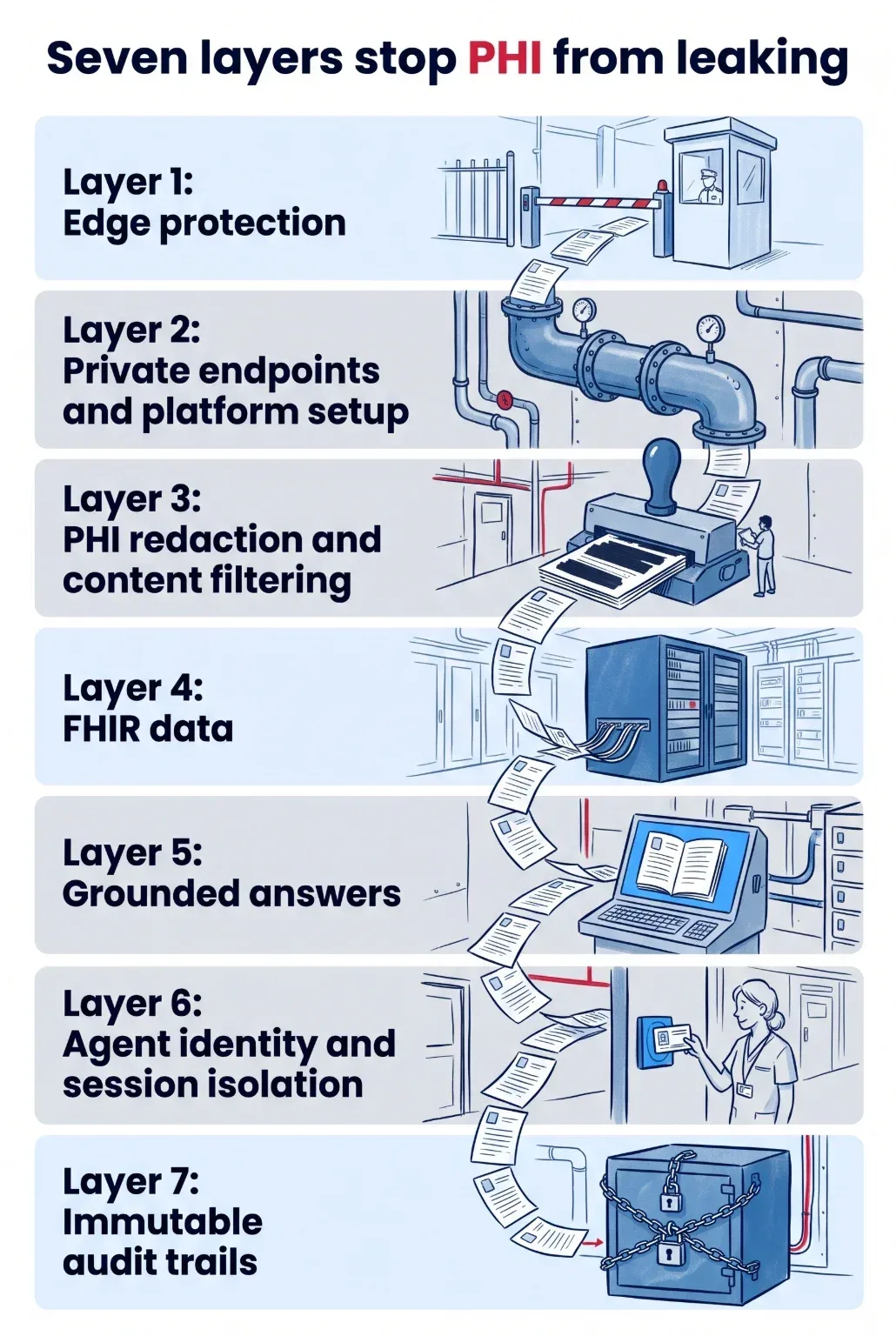
For the clinician, this is the replacement for the public tab. It has to answer questions about charts, draft summaries and sit inside the workflow, and it has to do so under controls that stop PHI from leaking. Reference architectures from AWS and Azure describe seven layers of technical controls, built so that no single point of failure exposes patient data.
Layer 1: Edge Protection
The first layer isolates the environment from the public internet. Amazon CloudFront with AWS Web Application Firewalls, or Azure's equivalent, intercepts traffic before it reaches regional infrastructure. It blocks malicious traffic, DDoS attacks, SQL injection and conversational prompt injection that tries to push the model outside its clinical scope.
Layer 2: Private Endpoints and Platform Setup
Layer 2 sets the compliance and network baseline. It requires a BAA with the cloud provider and configured Virtual Private Clouds. Whether the model runs on AWS Bedrock or Azure AI, the connection to the inference engine should use private endpoints, such as AWS PrivateLink or Azure private links.
With private endpoints, traffic between the hospital application and the model stays on the cloud provider's private backbone, and patient data never crosses the public internet. Data is encrypted at rest and in transit with customer-managed keys, such as AWS KMS or Azure Key Vault, which adds a second authorization gate.
Layer 3: PHI Redaction and Content Filtering
Even inside a secured VPC, the best practice is to scrub raw PHI before the model sees it. That reduces the damage from data retention or log leakage. A layered de-identification pipeline runs in the application layer before the API call. The design uses two engines.
- Clinical entity recognition. A tool such as AWS Comprehend Medical runs first. It identifies, extracts and tokenizes structured clinical entities such as medication names, diagnoses and anatomical references.
- General PII redaction. An open-source engine such as Microsoft Presidio follows. It uses named entity recognition to apply the HIPAA Safe Harbor method, which strips the 18 specific identifiers, including names, dates (excluding years) and geographic subdivisions.
The cleaned prompt then goes to the model. Platforms such as Amazon Bedrock Guardrails also filter inputs and outputs, which blocks hallucinated clinical facts and attempts to override system instructions.
Put the Bayview spreadsheet through this pipeline and the names, dates and account details would be tokenized before the model saw a single row. That is the practical difference between a public chatbot and a sidecar.
Layers 4 and 5: FHIR Data and Grounded Answers
To keep the model from falling back on general, often inaccurate training weights for medical questions, the sidecar grounds answers in the patient's actual records using Retrieval-Augmented Generation (RAG).
Layer 4 normalizes siloed records into standardized FHIR R4 formats, using a service such as AWS HealthLake, and translates varied terminologies such as SNOMED CT and ICD-10 into one language. Layer 5 uses secure vector databases, such as Amazon Bedrock Knowledge Bases, to pull relevant chunks of clinical documents at query time. The model is forced to answer from the retrieved local documents, with a confidence threshold set through APIs like RetrieveAndGenerate, which sharply reduces clinical hallucinations.
Layer 6: Agent Identity and Session Isolation
As AI moves from chatbots to agents that act across systems, Layer 6 adds session isolation and identity controls. The agent acts under the specific context of the authorizing clinician, through SMART on FHIR or per-user OAuth, and not through a shared service account.
That enforces "minimum necessary" access. An agent that schedules appointments is restricted from reading a patient's psychiatric history.
Layer 7: Immutable Audit Trails
The last layer handles auditability, which the HIPAA Security Rule treats as non-negotiable. The log captures the user identity, timestamps, tool calls and the hash of the de-identified prompt. The logs hold metadata only and skip raw prompt payloads, so the logging system does not become a second PHI exposure.
They sit in write-once-read-many storage, such as Amazon S3 with Object Lock in COMPLIANCE mode. That supports HIPAA's six-year retention rule for required documentation and gives compliance teams searchable records for monitoring and threat detection.
Self-Hosted or API: What It Costs
The sidecar can sit on a vendor API or on models the hospital runs itself. Cost and control pull in different directions.
The Pay-Per-Token Route
Vendor APIs charge per token. In late 2026, blended rates for mid-tier commercial models on a standard chatbot input-output mix run from roughly $0.53 per million tokens for OpenAI GPT-5.6 Luna to $1.75 for Google Gemini 3.7 Flash. They climb to $4.67 for Anthropic Claude Sonnet 5 and $5.33 for OpenAI GPT-5.6 Terra. The vendor takes on scaling, reliability and security patching.
The Self-Hosted Route
Self-hosting open-weight models such as Llama 3 or Mistral, in an on-premises data center or an isolated cloud tenant, requires upfront spending on GPUs and steady operating overhead. A 70B-parameter model at 16-bit precision needs roughly 140 GB of VRAM. Based on median 2026 data, running a private LLM at INT8 quantization costs about $637 per month in hardware and power for a 7B-class model and $3,178 per month for a 70B-class model.
On top of that sits an "operations floor," the loaded cost of engineers who keep the system up, patch it and handle incidents. It adds a fixed $1,500 to $2,500 per month.
Navya AI puts the median break-even at 10.5 million tokens per day against GPT-5.6 Terra and 12.4 million against Claude Sonnet 5, rising to 33 million against Gemini 3.7 Flash and 82.2 million against GPT-5.6 Luna. Those figures cover hardware alone, so the operations floor pushes them higher. For a small clinic or a low-traffic tool, such as a triage bot serving five concurrent users, the fixed hardware sits idle and the API wins on price.
When Control Outweighs Unit Cost
For larger health systems, unit cost is often not the deciding factor. In a sovereign setup, the model weights and the data never leave the hospital's physical or isolated cloud perimeter. That removes the BAA subprocessor chain and third-party retention risk. If inference runs entirely inside the clinical network, no disclosure to a business associate takes place, and the audit surface shrinks. Organizations that handle especially sensitive populations or develop proprietary clinical algorithms they want to patent may find that control worth the infrastructure premium.
| Model | Main cost driver | Governance profile | Best fit |
|---|---|---|---|
| SaaS API, such as Azure OpenAI | Per-token pricing, $0.53 to $5.33 per million tokens | Needs a BAA and private links, with subprocessor chain risk | Low-to-medium or variable volume, quick pilots |
| Self-hosted | Hardware ($3,178 per month for 70B) plus a $1,500 to $2,500 operations floor | Full data sovereignty, no external BAA for inference | Steady, high volume well above 10 million tokens per day, or extreme privacy needs |
How Three Health Systems Run Governed AI
Three large U.S. systems show different ways to get there. They share one habit, which is that they put the approved tool where clinicians already work.
Mayo Clinic Builds Its Own Platform
Mayo Clinic runs a proprietary internal platform that processes large volumes of de-identified clinical data to validate and scale tools. It manages over 1.3 million patients, holds more than 50 AI patents and has invested heavily in sovereign AI infrastructure.
Introl, a GPU infrastructure vendor, says Mayo's imaging platform required $45 million in specialized infrastructure, including 500 NVIDIA A100 GPUs, and processes 3.2 million medical images a day. Protections include FIPS 140-2 Level 3 hardware security modules, break-glass emergency access and 2 petabytes of immutable storage for 7-year audit trails. That is the high end of what sovereignty costs.
Cleveland Clinic Fixes the Documentation Pain First
Cleveland Clinic, a 23-hospital academic system, went another way. It put BAA-covered vendor tools directly into Epic to relieve immediate friction. It rolled out ambient AI from Ambience Healthcare to more than 4,000 clinicians. Prosper's hospital roundup says the tool trims 14 minutes of daily EHR note time.
The Clinic also deployed Bayesian Health's predictive sepsis detection across 13 hospitals. It identified 46% more cases with 10 times fewer false alerts than legacy systems, which helps with alert fatigue. A central AI task force approves algorithms before clinical use, so physicians understand each tool's intended use and limits.
Intermountain Watches for Shadow AI Directly
Intermountain Health runs Microsoft Dragon Copilot, an ambient documentation tool built on Azure OpenAI, and reports a 27% cut in note-taking time per appointment among more than 2,500 active clinician users. It treats broad deployment as a risk in itself. It uses AI telemetry across its clinical networks to detect shadow AI and find unapproved tools operating outside governance. It also runs 90-day review cycles to catch model drift and uses automated RiskOps platforms, so human oversight stays in the loop.
A Practical Plan for CTOs and Compliance Officers
The shift is from prohibition to running AI as a product that clinicians want to use, inside boundaries that protect the institution. Here is a sequence that fits the evidence.
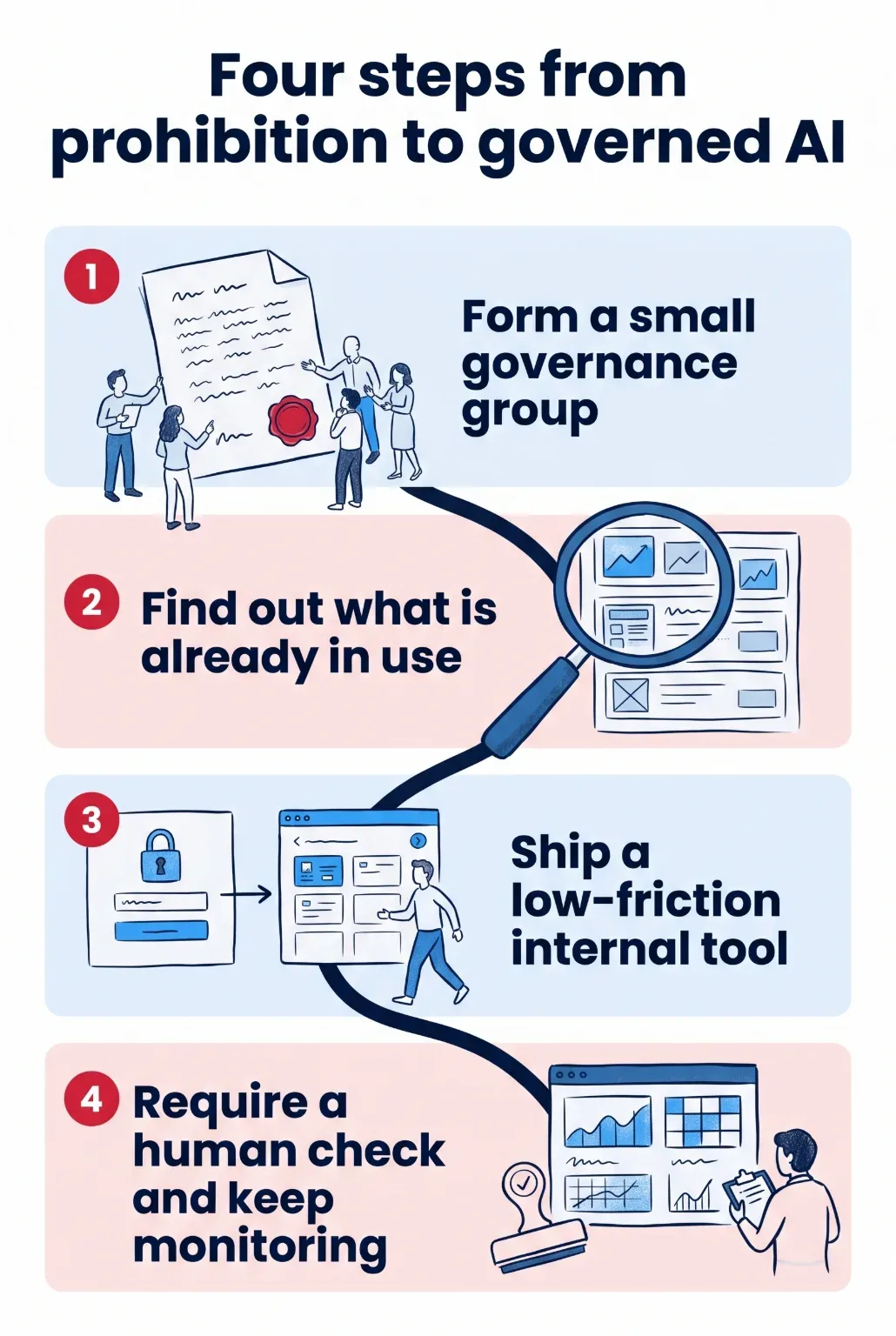
1. Form a Small Governance Group
Put the CTO, the Chief Medical Information Officer, the Chief Compliance Officer and frontline clinicians in one committee. It sets risk appetite and reviews vendor BAAs for hidden exclusions such as web search or file processing. It also writes a clear AI acceptable use policy that names the sanctioned tools and the penalties for unauthorized PHI uploads.
2. Find Out What Is Already in Use
You cannot secure what you cannot see. Use network telemetry and departmental surveys to build an AI Bill of Materials listing every AI tool that touches your data. Note where friction pushes people toward unsanctioned tools, and fix those pain points first. Given the self-reported rate of nearly 17% and the knowledge that actual use runs higher, treat survey answers as a floor.
3. Ship a Low-Friction Internal Tool
Do not stop at blocking consumer AI sites. Deploy a private instance of a generative model, for example an Azure OpenAI private endpoint enclave, that staff reach through single sign-on. A logged lane that scrubs PHI meets the demand for AI productivity while the hospital keeps control of the data flow.
Judge it against the public tools your staff already use. If it takes more steps or more time to get a summary, people will keep their old habit, and the investment in layers 1 through 7 will protect an empty room.
4. Require a Human Check and Keep Monitoring
For any tool in clinical or revenue cycle workflows, design for human-in-the-loop validation. Add "algorithmic deferral," which makes the system ask a human for input when it operates outside validated confidence thresholds. That reduces automation bias. Keep watching deployed models for output drift, hallucination rates and bias, to stay in line with the NIST AI RMF.
Conclusion
We do not know why the Bayview employee used a public AI tool. We do know that clinicians face 4,000-click shifts and overflowing in-baskets, and that a plain block on public AI does nothing about that. The fix that works gives staff an internal tool that is quicker than the public one and wrapped in private endpoints, PHI redaction, grounded retrieval, per-user access and immutable logs.
Start by finding out which tools your staff already use and which workflow steps send them there.
FAQ
Was the Johns Hopkins Bayview breach a cyberattack?
No. A staff member uploaded a patient tracking spreadsheet into a public AI tool the hospital had not approved during an internal review on September 21, 2026. It was an employee using an unapproved tool, not an outside attack.
What patient data was exposed?
The file covered 3,182 patients treated between May and September 2026. It included names, admission and treatment dates, medical record numbers, account numbers, departments, provider names and medications and treatment courses. Hospital representatives said Social Security numbers, banking information and credit card details were not included.
Did the hospital get the data deleted?
The hospital had the employee delete the prompt, the conversation threads and the document, and it asked the AI operator to delete the data permanently. Deleting on the user side does not guarantee the data is purged from backend servers or kept out of training. As of late October 2026, the hospital had not publicly said whether the operator confirmed deletion.
Why do clinicians use unapproved AI?
Many of them want speed. Physicians Practice reports that 45% of providers who bypassed IT security said faster workflow was the main reason. The backdrop is that emergency physicians spend 43% of their time on data entry against 28% on direct patient care.
Is a signed BAA enough to make an AI tool HIPAA-compliant?
No. A BAA covers disclosure of data and the vendor's infrastructure, and it does not protect against configuration mistakes by the hospital. A BAA with a model provider covers the inference endpoint, not your prompt logs, observability tool or vector store unless those are also under a BAA.
How does a sidecar keep PHI from leaking?
It stacks controls so no single failure exposes data. Private endpoints keep traffic off the public internet. A two-engine redaction pipeline, with Comprehend Medical and Presidio, strips identifiers before the model sees a prompt. Per-user access limits what an agent can read. Audit logs hold metadata only, so the logging system does not store raw prompts.
How long should audit logs be kept?
The architecture calls for write-once-read-many storage, such as Amazon S3 with Object Lock in COMPLIANCE mode, and at least six years of retention to match HIPAA's rule for required documentation. Introl says Mayo Clinic's imaging environment keeps 7-year audit trails.
When does self-hosting make sense?
On cost alone, only at high, steady volume. Navya AI's hardware-only break-even runs from about 10.5 million tokens per day against the priciest mid-tier API to 82.2 million against the cheapest, and operations cost pushes both higher. Smaller or low-concurrency deployments are cheaper on a vendor API. Self-hosting can still make sense below that volume if you want to remove BAA subprocessor chains, handle especially sensitive populations or protect proprietary clinical algorithms.
Do AI scribes solve the friction problem?
They help. They cut total EHR time by 13.4 minutes and documentation time by 16.0 minutes across five academic medical centers. They also make mistakes. None of the six scribes tested in a JMIR Human Factors study were consistently error-free. Keep a human reviewing the output.
Supporting Links
- HHS on the HIPAA breach notification rule
- CBS News Baltimore on the Bayview patient data breach
- Captain Compliance on the Johns Hopkins AI data exposure
- ComplexDiscovery on Bayview's deletion request to the AI operator
- Wolters Kluwer Health report on shadow AI in healthcare
- Edvak on which EHR reduces documentation time most
- Prodinit guide to HIPAA-compliant LLM deployment
- AWS guide to a HIPAA-ready generative AI architecture for healthcare
- Navya AI guide to self-hosting an LLM versus using an API
About Baytech
At Baytech Consulting, we specialize in guiding businesses through this process, helping you build scalable, efficient, and high-performing software that evolves with your needs. Our MVP first approach helps our clients minimize upfront costs and maximize ROI. Ready to take the next step in your software development journey? Contact us today to learn how we can help you achieve your goals with a phased development approach.
About the Author

Bryan Reynolds is an accomplished technology executive with more than 25 years of experience leading innovation in the software industry. As the CEO and founder of Baytech Consulting, he has built a reputation for delivering custom software solutions that help businesses streamline operations, enhance customer experiences, and drive growth.
Bryan’s expertise spans custom software development, cloud infrastructure, artificial intelligence, and strategic business consulting, making him a trusted advisor and thought leader across a wide range of industries.