In this article
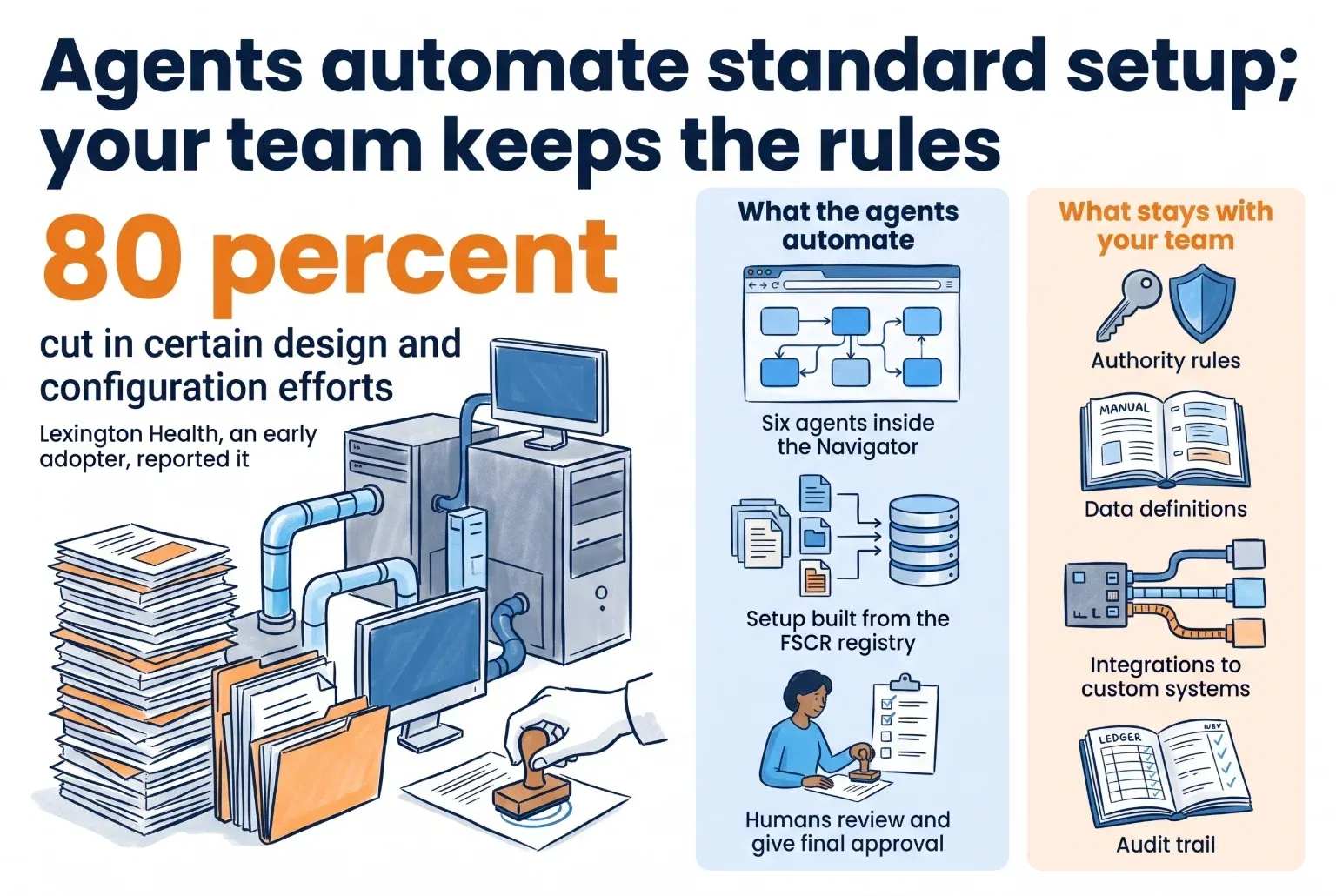
Oracle now has AI agents that build a Fusion Cloud setup from its own documentation. They do not decide who is allowed to approve a purchase order.
What Oracle Announced and When
At its AI World conference in Las Vegas on October 26, 2026, Oracle announced an agentic AI platform for business processes in finance, supply chain, HR and customer experience. For anyone planning a migration, the more interesting part is that Oracle also pointed agents at the implementation itself.
That second piece is the Oracle AI Success Navigator. It uses specialized agents for discovery, design, configuration, testing and integration on a Fusion Cloud Applications rollout.
The operational side runs on a runtime called Oracle Fusion Claw. Oracle made 25 Claw-powered agentic applications available across ERP, HCM, supply chain and customer experience. Those run your business after go-live. The Navigator is the part that helps you get there.
How the Setup Automation Works
Oracle's new Fusion Setup and Configuration Registry (FSCR) does the heavy lifting. It is a continuously maintained, public Git repository that turns Oracle's product documentation, setting dependencies, best practices and sequencing rules into machine-readable, executable AI skills.
Before, consultants rebuilt that knowledge from PDF guides. Now AI coding agents, including frontier models from OpenAI, read the registry and turn a customer's requirements into implementation runbooks. The agents make the changes directly in the live Fusion environment and test their own results. Human experts then review the finished setup, ask for changes and give final approval.
Oracle describes six agents inside the Navigator.
| Agent | What it automates |
|---|---|
| Discovery | Analyzes the customer's current technology environment to find process gaps, risks and modernization options. |
| Design | Turns the discovered business processes into proposed Fusion application designs for human review and approval. |
| Configuration | Uses the FSCR to build prototypes and run configurations from the approved designs and Oracle's best practices. |
| Testing | Generates customer use cases and works out the steps to line up testing with the automated configuration. |
| Integration | Defines the scope for connecting Fusion to existing legacy systems and generates the foundational code for those connections. |
| Innovation | Watches post-go-live operations and ranks further AI features to adopt by potential ROI. |
Systems integrators can extend the registry too. Accenture, Deloitte and PwC can add their own methods, industry accelerators and implementation resources. So the consulting firm you hire may bring its own skills into the same tool.
What Changes for Time-to-Value and Errors
The pitch is simple. Configuration built from a versioned, machine-readable source should be faster and less prone to typos and missed dependencies than configuration rebuilt by hand from manuals. Oracle says the agents cut manual errors by relying on that source.
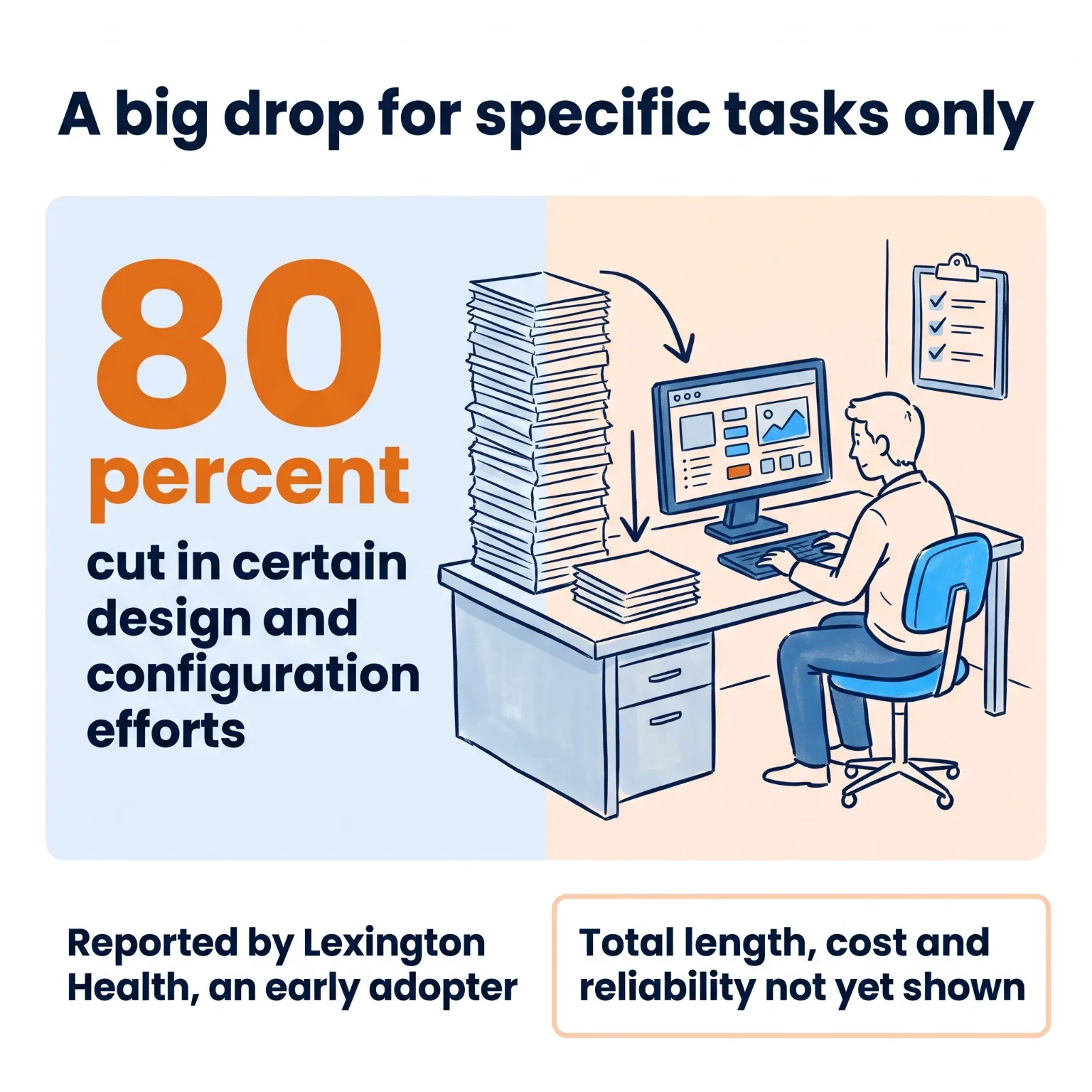
The one customer number comes from Oracle's own materials. Lexington Health, an early adopter, said the agentic approach cut certain design and configuration efforts by 80 percent. That is a big drop for specific tasks. Journalists covering the launch note that the effect on total project length, total cost and long-term reliability has yet to be shown across a wider range of complex environments.
Before you plan around that number, ask for the baseline behind it and which tasks it covered.
The role of your team changes either way. People review and approve instead of building from scratch. That moves effort toward governance, data preparation, testing upkeep and operational finance, the areas where practitioners say the work now lands.
It also helps to know the market context. Analyst Brian Sommer of TechVentive notes that SAP, NetSuite, Infor and Oracle have all followed the same playbook this year. It includes an AI user experience layer, a secure runtime, agent teams and the promise of AI-automated implementation. He calls it "sameness as a service" and says the differences will show up in integration reliability, compliance and financial results.
The Integration Layer Gets More Important
Few enterprises run on one ERP alone. They run on Fusion plus custom apps, third-party software and legacy databases. An agent can't make a sound decision if the context it needs sits in disconnected apps, spreadsheets or delayed transfers. A 2026 Connectivity Benchmark Report found that 86% of IT leaders believe AI agents can create more complexity than value when proper integration is missing.
Oracle's answer uses Oracle AI Agent Studio and Oracle Integration Cloud (OIC). Agent Studio is built into Fusion and lets no-code, low-code and pro-code builders create agents. Pro-code teams can use Git-based workflows and tools such as Claude Code.
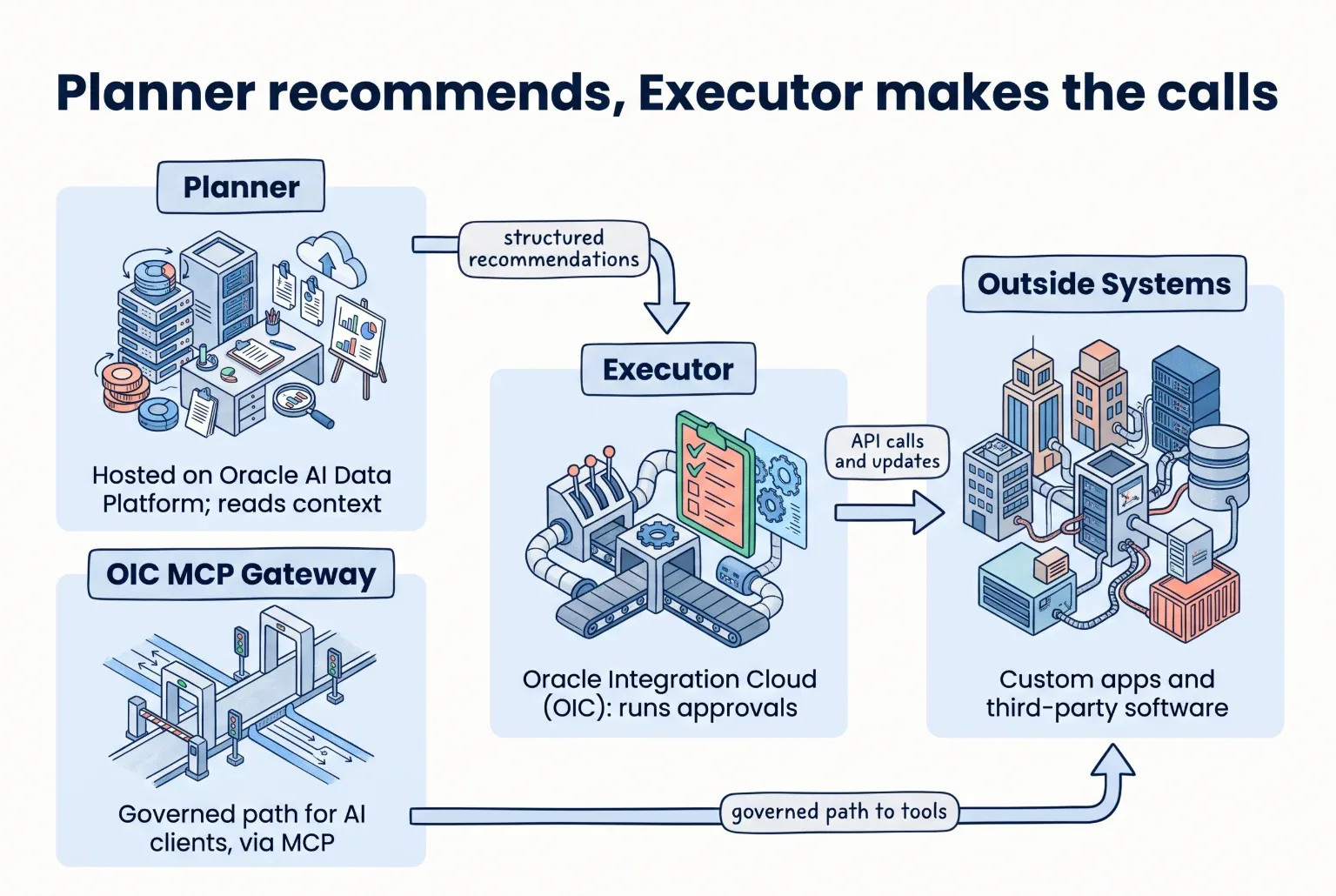
The recommended design splits the work in two. The Oracle AI Data Platform hosts the agent as the "Planner." It reads the business context and produces structured recommendations. OIC is the "Executor." It makes the API calls, runs approvals and sends asynchronous updates to outside systems, with reliability and an audit trail.
Oracle builds this from small, reusable integrations that show up to the AI as individual tools. The assistant decides which system to call, in what order and when a person must approve.
In September 2026, Oracle released the OIC MCP Gateway. It gives AI clients a governed path to outside tools and data through the Model Context Protocol, with central identity management, policy enforcement and observability. Any outside agent framework that supports MCP can then find and use your custom integrations.
Third-party platforms are doing the same thing. Workato, Boomi and Lyzr Studio let companies turn existing integration recipes into governed skills for agents. A January 2026 Workato release let prebuilt agents act as MCP clients with single sign-on and role-based access. The example was a procure-to-pay flow across an Oracle ERP, a Salesforce CRM and a custom warehouse system.
Note that the Navigator's Integration Agent defines scope and generates foundational code. Your custom workflows, with their own rules and exceptions, still need an owner and an architecture.
The Manual Gaps That Remain
Oracle's tools take over standard setup. They don't take over the decisions that depend on your company.
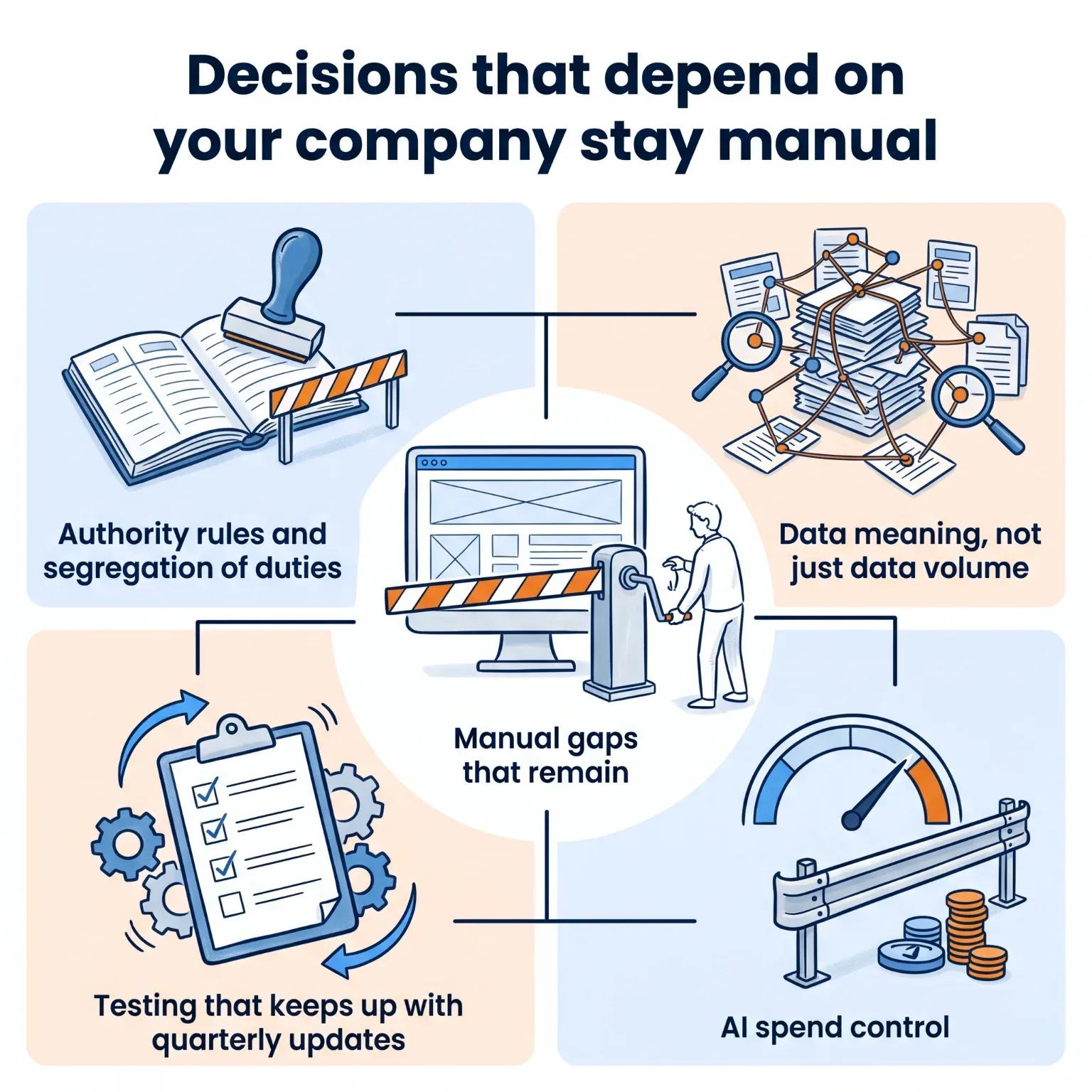
Authority Rules and Segregation of Duties
This is the biggest gap. Velocity Software Solutions, an integration consultancy, says vendor-native agents from Oracle, SAP and NetSuite often ship assuming a flat, vendor-controlled layer that rarely survives a real authority matrix. It cites a Forbes April 2026 AI Compliance Survey. In that survey, 62% of enterprises piloting agentic AI in finance and operations reported a material control deficiency within nine months of go-live. Velocity says the cause was architecture, not wrong answers from the model.
The rules are strict. An agent can't be allowed to both create and approve the same purchase order, even if the model could do it. Every autonomous action also needs a tamper-proof record that satisfies external auditors for up to seven years.
Agent Studio provides approval gates, so an agent can pause until a person authorizes a sensitive write action. Deciding which actions need approval and who may grant it is a manual job for IT and compliance. So are role-scoped authority and idempotency keys that stop duplicate transactions when a system retries.
Data Meaning, Not Just Data Volume
If history is inconsistently labeled or scattered across silos, agents act with confidence on bad context. IDC predicts that by 2027, companies that don't prioritize high-quality, AI-ready data will struggle to scale GenAI and agentic solutions, resulting in a 15% productivity loss. Gartner projects that by 2027, organizations that prioritize semantics in AI-ready data could raise agentic AI accuracy by up to 80% and cut costs by up to 60%. Similar data quality issues in customer systems are why teams often need to fix the CRM before trusting AI.
Data engineers have to define the business ontologies, meaning the relationships and rules between terms and concepts, before an agent can reason over the data well.
Testing That Keeps Up With Quarterly Updates
Each mandatory Oracle quarterly update can break test scripts through small interface changes, relabeled fields or reordered approval steps. Testing agents now detect that drift and adapt test logic on their own. Datavail used the Opkey agentic platform on high-risk Oracle processes for a client and saw regression testing fall from about three weeks to about three days.
Even so, QA still has to set the initial scope, pick the riskiest integrations and check the agent's self-healed logic.
AI Spend Control
Agents burn tokens through an unpredictable chain of planning, retrieval, tool calls, retries and replanning. An agent stuck in a loop can use tokens without moving the task forward, which is both a cost problem and a failure. Oracle's own guidance calls for runtime budget guardrails, tuned thresholds and metrics like "cost per successful task". Someone on your side has to set those numbers.
Pricing and Regulatory Questions to Settle Early
Pricing is still open. Futurum Group points out that Oracle calls its agents "outcome-driven" but hasn't announced how it will price outcomes. Futurum's 2H 2026 Enterprise Applications Decision Maker Survey found that 24.1% of enterprise buyers see pricing as the top hurdle to buying. Ask for pricing in writing before the contract, not after the pilot.
The EU AI Act's enforcement phase began in August 2026. Velocity says most reasonable legal readings put autonomous agents in corporate finance and operations in the "high-risk" class. It warns that teams deploying vendor-native agents without their own compliance architecture, including an "audit-witness" pattern that logs and explains each decision, face six-to-nine-month remediation projects and possible fines. That is one consultancy's view, but the audit requirements above apply whatever the legal reading.
What to Do Now
- Map your authority matrix before anyone configures an agent. Finance and compliance leads should define role-scoped authority, materiality rules and idempotency keys. Velocity recommends a policy-enforcing layer between the agent and the ledger so segregation of duties is enforced before execution.
- Start data modeling now. The ontology work takes human time and the agents depend on it.
- Assign an owner for each custom workflow. The Integration Agent produces starting code. Your connections to custom systems need a design, an MCP or OIC pattern and someone accountable.
- Run agents in shadow mode first. Velocity advises against rushing a 30-day pilot into production, which it names as the main cause of audit failures.
- Put budget guardrails in the execution path. Track token use, tool failures and latency, and stop runaway loops automatically.
Velocity's staged rollout looks like this.
| Days | What happens |
|---|---|
| 1 to 30 | The agent runs in shadow mode on real transactions. It interprets and decides but can't commit changes to the database. |
| 31 to 60 | Each shadow decision is logged and compared with what human staff did. The comparison becomes evidence for compliance officers and auditors. |
| 61 to 90 | The agent goes into a two-lane production setup, limited to 30% of transaction volume. The share rises to 70% only if control violations stay at zero for a full 30-day cycle. |
Measure results at the business level. Oracle's guidance says success should be judged on outcomes, not individual agent metrics like token counts, and its example dashboards pair technical indicators with business KPIs.
Conclusion
Oracle's registry and six agents take over a large share of standard Fusion setup, and early evidence suggests real savings on specific tasks. The harder parts of a migration still belong to your team. Those are the authority rules, the data definitions, the integrations to custom systems and the audit trail.
The practical next step is to start those workstreams before the agents start building.
FAQ
Which implementation steps do Oracle's agents automate?
Oracle describes agents for discovery, design, configuration, testing, integration scoping and post-go-live adoption planning. The configuration agent builds prototypes and runs setup using the FSCR and Oracle's best practices.
Do humans still approve the setup?
Yes. The agents test their own results and present the finished setup to human experts, who can request changes and give final deployment approval.
How reliable is the 80 percent savings figure?
It comes from Lexington Health, an early adopter featured in Oracle's materials, and covers certain design and configuration efforts. Independent coverage says the effect on total project duration, cost and reliability is not yet shown.
Do the agents handle integration with custom systems?
The Integration Agent defines scope for connecting Fusion to existing systems and generates foundational code. Running those connections in production uses tools like Oracle Integration Cloud and the MCP Gateway, with a Planner and Executor split.
Has Oracle announced pricing for the agentic applications?
Futurum Group says Oracle has not announced how it will price outcomes.
Supporting Links
- Oracle announcement of the agentic AI platform for Fusion implementation
- Oracle announcement of the Fusion setup and configuration registry
- DQ India coverage of the platform and faster Fusion rollouts
- Agentic enterprise ERP overview citing the 2026 Connectivity Benchmark Report
- Oracle Integration release notes for September 2026
- Velocity Software Solutions on agentic AI ERP production patterns
- Datavail on fixing Oracle Cloud testing with agentic AI
About Baytech
At Baytech Consulting, we specialize in guiding businesses through this process, helping you build scalable, efficient, and high-performing software that evolves with your needs. Our MVP first approach helps our clients minimize upfront costs and maximize ROI. Ready to take the next step in your software development journey? Contact us today to learn how we can help you achieve your goals with a phased development approach.
About the Author

Bryan Reynolds is an accomplished technology executive with more than 25 years of experience leading innovation in the software industry. As the CEO and founder of Baytech Consulting, he has built a reputation for delivering custom software solutions that help businesses streamline operations, enhance customer experiences, and drive growth.
Bryan’s expertise spans custom software development, cloud infrastructure, artificial intelligence, and strategic business consulting, making him a trusted advisor and thought leader across a wide range of industries.