In this article
- What the DLA Awarded and What It Covers
- Why a Rewrite Without the Rules Fails
- How AI-Assisted Discovery Works
- What Vendors Report, and How to Read the Numbers
- Where People Still Do the Work
- What It Costs and Where the Compute Goes
- Rules for Using AI on Sensitive Code
- Turning Extracted Rules Into a Platform That Lasts
- Steps to Take First
- Conclusion
- FAQ
- Supporting Links
- About Baytech
- About the Author
Most failed rewrites fail on logic nobody knew was there. The code that gets copied is the easy part.
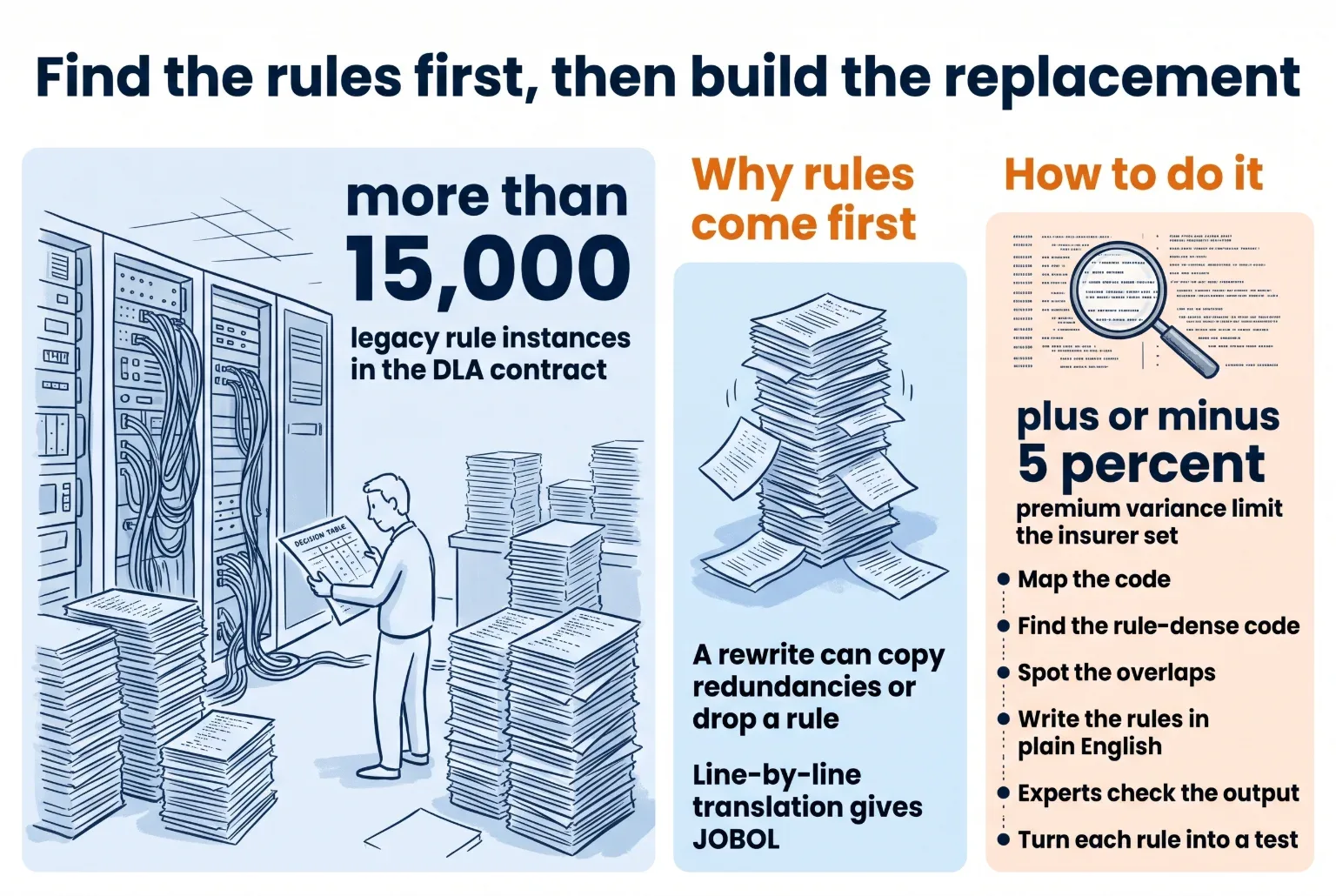
The Defense Logistics Agency now has a contract built around that idea. It pays a vendor to find, document and consolidate more than 15,000 business rules in a 30-year-old system before anyone builds the replacement.
What the DLA Awarded and What It Covers
In October 2026, the Defense Logistics Agency (DLA) awarded Credence Management Solutions a contract to modernize the business rules engine of the Defense Automatic Addressing System (DAAS) and rationalize more than 15,000 legacy rule instances. Those rules sit inside application code, not in a document anyone can open. The award builds on the ongoing DAAS Digital Business Transformation (DBX) effort.
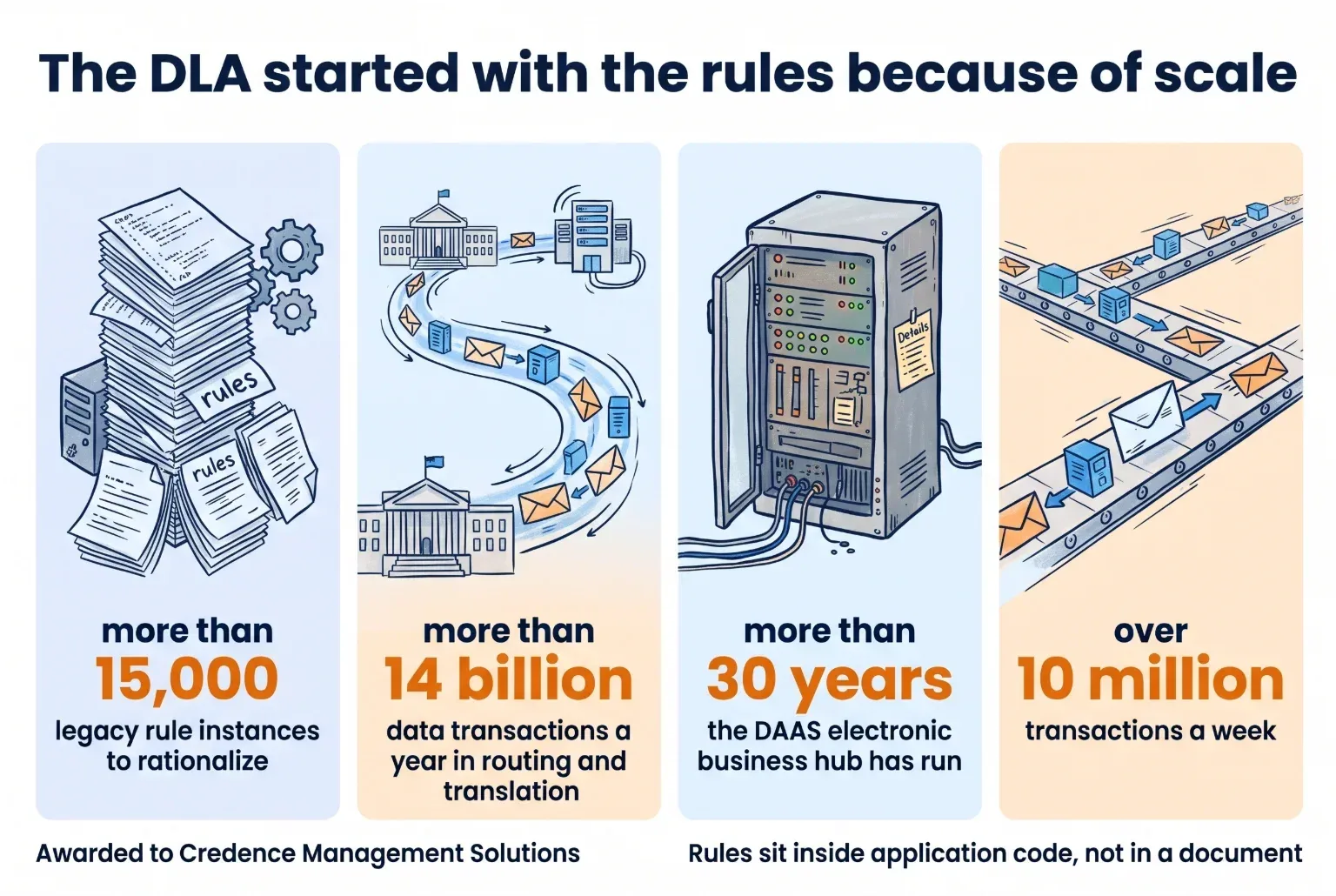
The scale explains why the agency started with the rules. DAAS receives, edits, validates, routes and delivers transactions across participating federal and military agencies. Its routing and translation component alone handles more than 14 billion data transactions a year.
The DAAS electronic business hub has run for more than 30 years on software such as Global Exchange (GEX) and the Mercator translator, and it handles over 10 million transactions a week. A system that old has collected rules from every policy change, workaround and special case in three decades.
The Stated Goals
The contract has four goals as the coverage describes them:
- Separate the business logic from the legacy systems.
- Document and rationalize that logic.
- Consolidate overlapping rules.
- Implement the result in a modern business rules platform that uses open standards.
The project also deploys artificial intelligence and machine learning to speed delivery. It adds a web interface that gives DAAS personnel one place to read the rule documentation. The coverage we reviewed does not name the AI tools or methods Credence will use. So the rest of this post describes how this kind of discovery works in general, using published vendor material and research.
The order of work matters most. The agency pays to understand the rules first and to build the new platform second. Most organizations do it the other way around.
Why a Rewrite Without the Rules Fails
Our position is simple. If you rewrite a system before you know what its logic does, you will fail, and you will find out late. The new code will either copy every redundancy of the old code or drop a rule that mattered.
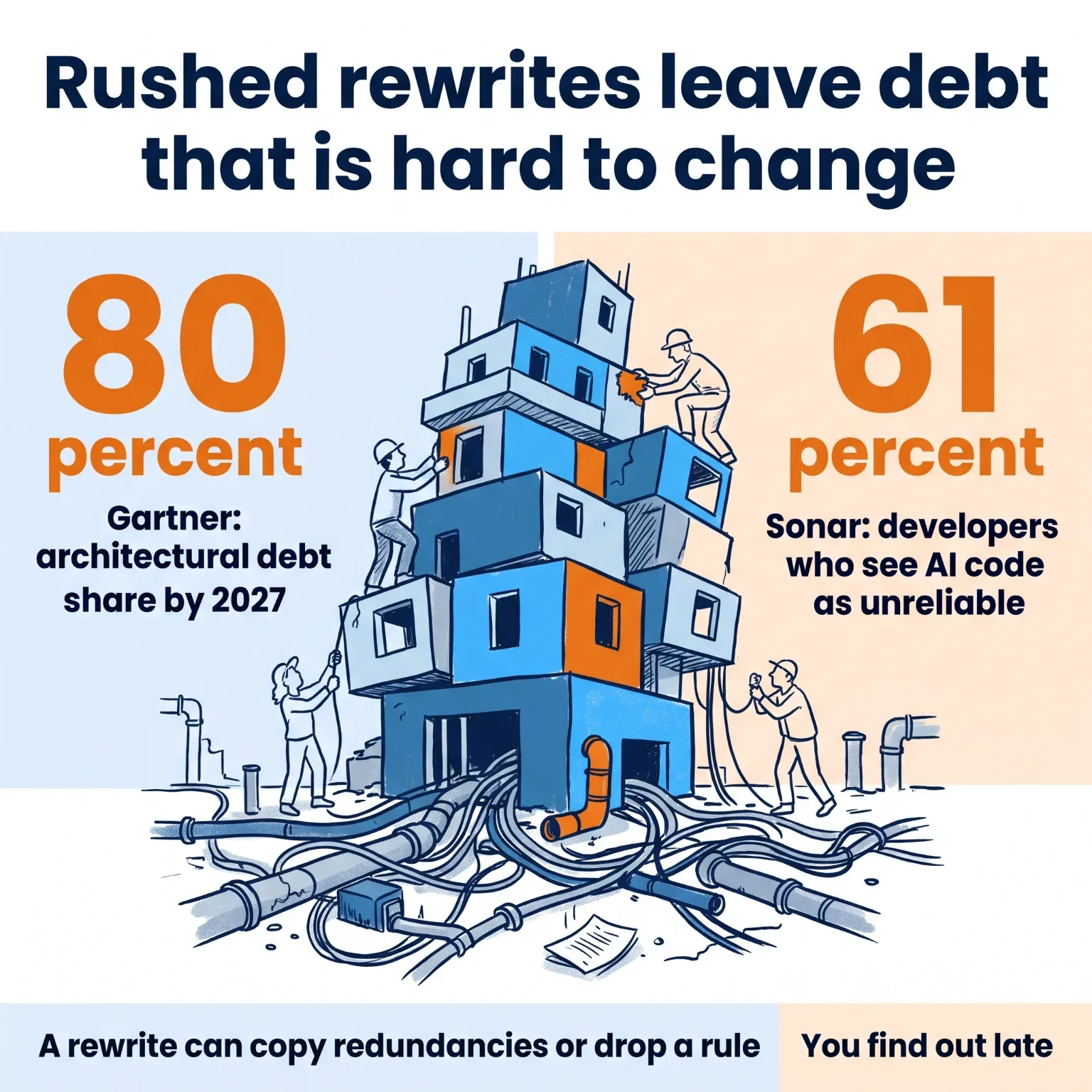
The evidence points in the same direction. A Gartner Market Guide for Technical Debt Management Tools, dated April 13, 2026, forecasts that by 2028 AI will create more architecture-level technical debt than it solves. Gartner expects architectural debt, the kind that cuts across several systems, to make up 80 percent of all technical debt by 2027.
Sonar's 2026 report adds a developer view. It found that 61 percent of developers believe AI often produces code that looks correct but is unreliable. It also found that 90 percent of the issues tied to AI-generated code are code smells or maintainability problems. Code that runs but is hard to change is exactly what a rushed migration leaves behind.
What Line-by-Line Translation Produces
IBM's ICSE 2026 research on enterprise-scale COBOL-to-Java translation gives the problem a name. "JOBOL" is Java that mirrors the procedural logic of the COBOL it came from, produced when AI translates syntax line by line. The Java compiles. Nobody wants to maintain it.
IBM's answer was not to hand whole programs to one large language model. Its work points to a pipeline driven by meaning, built on static program analysis such as backward and forward slicing and dependency mapping. In plain terms, the tools first work out what each piece of code depends on and what depends on it. The model reads smaller, well-defined slices after that.
The Old Way Costs Too Much
Skipping discovery is tempting because the traditional version is slow and expensive. CodeDistrict, a development firm, writes that traditional IT vendors typically quote discovery phases of 18 to 24 months, with costs frequently above $5 million. A COO who hears that quote may well decide to skip it.
That is the trap. Manual discovery is too slow to be practical, and blind rewriting is too risky. AI-assisted extraction is attractive because it attacks the first problem without accepting the second.
How AI-Assisted Discovery Works
Business rule extraction is the process of finding and documenting the policies, calculations and conditions buried in legacy software. AI changes how fast it goes, and it changes who can read the result. It does not change the goal, which is turning trapped logic into something a business person can read, check and reuse.
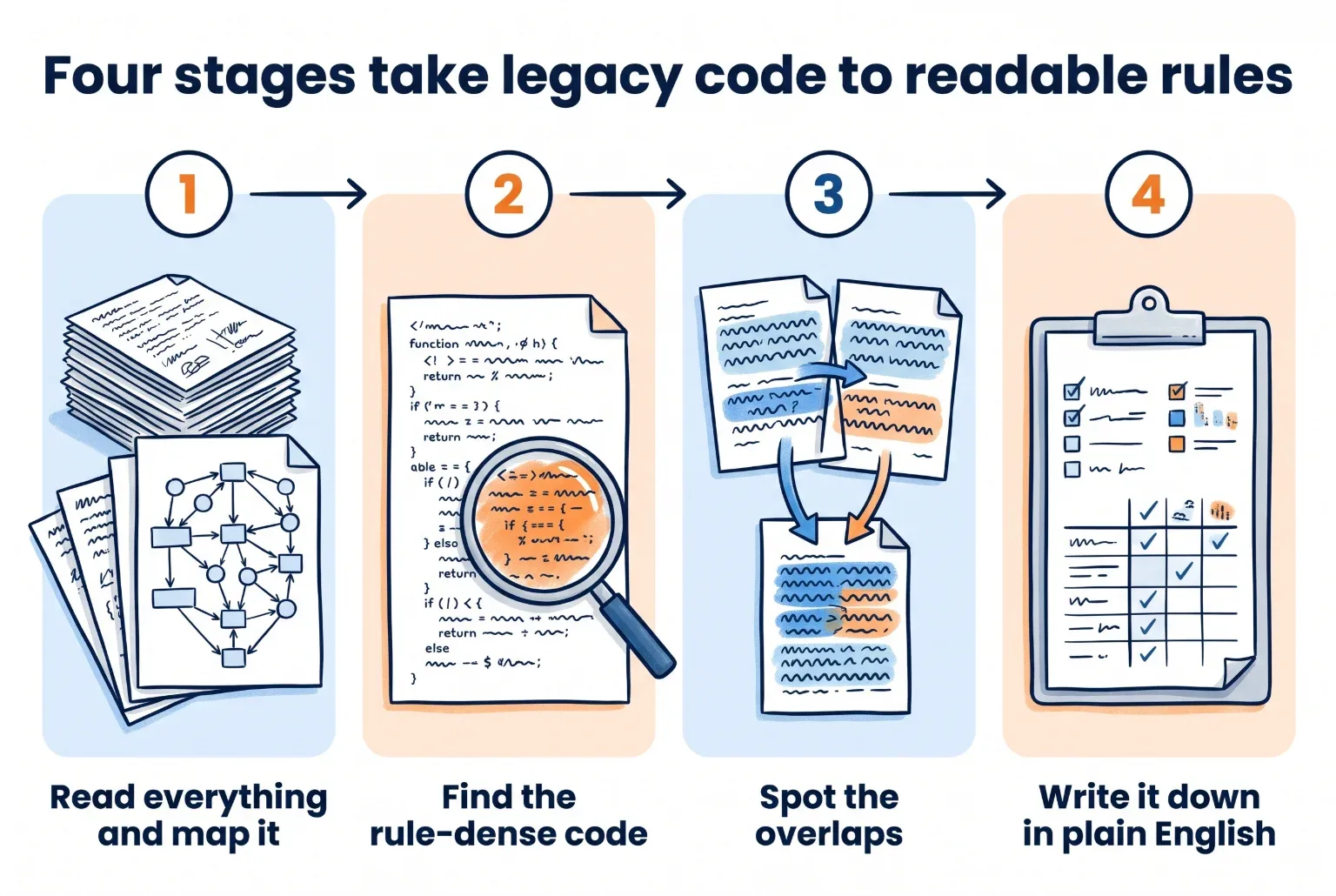
The process runs in four stages. They overlap in practice, but the order is worth keeping.
Stage One: Read Everything and Map It
Discovery starts by ingesting the codebase. That can include COBOL programs, PL/I routines, JCL steps, Assembler snippets and embedded database calls. Some platforms turn code fragments into high-dimensional semantic vectors, which later let them compare pieces of code by meaning.
The same tools build Abstract Syntax Trees and dependency graphs. These show how programs call each other and which data they touch. IBM's watsonx Code Assistant for Z pairs with IBM Application Discovery and Delivery Intelligence (ADDI) to map call hierarchies, DB2 schemas and VSAM file dependencies before any generative AI runs.
This step is not glamorous, and it should not be skipped. In large estates, database access, orchestration and domain rules have become tightly tangled over decades. You cannot pull one layer out without knowing what holds it in place.
Stage Two: Find the Rule-Dense Code
With the structure mapped, AI models look for the places where rules live. They flag control flows, data checks and calculations. Most of a legacy program is plumbing, such as file handling, loops and formatting. The rules are in a small share of it.
One published example shows the output. A junior developer points the tool at a complex COBOL PERFORM loop that governs an insurance premium. The model writes a natural-language explanation of the tiered rates, tenure adjustments and leap-year conditions the code calculates. The business rule comes out separate from the procedural steps that run it.
That separation is the same one the DLA contract names as its first goal. A rule you can state in a sentence can move to a new platform. A rule that exists only as a tangle of paragraphs and GO TO statements cannot.
Stage Three: Spot the Overlaps
Overlap is where the DLA contract gets specific. It calls for consolidating overlapping rules. In old systems, bloat comes in two common forms. Obsolete rules are logic the business no longer uses but the code still carries, and duplicate rules are the same policy enforced in several ways across modules.
AI tools find these by comparing the meaning of code, not its text. One technique measures vector similarity, such as cosine similarity, across the whole codebase. Through a process known as semantic fusion, the tool can match different functions built for the same goal and merge them into one conceptual model.
The payoff is that the organization can cut its logic down to what it needs today and surface environment-specific code blocks that no longer apply. For DAAS, working through 15,000 embedded rule instances gives the agency a baseline for removing redundancy before it pays to build the target system. Every duplicate removed before the rewrite is a duplicate nobody has to rebuild, test or maintain.
Stage Four: Write It Down in Plain English
The output of good discovery is requirements a person can read, not new Java or C#. ArgonDigital, a requirements firm, uses a framework called the Requirements Modeling Language (RML). It turns extracted control flows into statements of business intent: plain-English requirements, structured feature lists and decision tables.
State models matter most here, because they catch rules that live in transitions. Legacy systems often encode status fields and conditions in code with no formal documentation. What happens when a logistics requisition moves from "Pending" to "Rejected," or when a loan application goes back for more documents, exists only in those transitions. Extraction tools pull this logic out and tie each requirement back to the source code that produced it.
That traceability gives your business analysts something to check. In our view, this is where a modernization project stops being an IT problem. When the rules are in decision tables, the people who understand the business can say "yes, that is right" or "no, we also do this other thing." That conversation is cheaper before the new code exists.
What Vendors Report, and How to Read the Numbers
Every modernization vendor has a case study, and the percentages are large. Most are the vendor's own claims, measured against the vendor's own manual estimates. We read them as evidence that extraction can go much faster than manual work, not as a forecast for your system.
| Vendor | What it did | Reported result | Baseline |
|---|---|---|---|
| Persistent Systems (SASVA) | 112,588 lines of COBOL at a US property and casualty insurer | 12 validated rules in two days | Six to nine months, manual estimate |
| Hexaware (RapidX) | Natural ADABAS applications at a US airline | Up to 40% less reverse engineering effort and cost | 14 to 18 months, manual estimate |
| IBM (watsonx Code Assistant for Z) | COBOL code understanding | 60 to 70% less time in the code-understanding (archaeology) phase, per Mobisoft Infotech's own assessment | About three weeks for a senior engineer, cut to three to five days |
| EvolveWare (Intellisys) | Rule extraction across more than 20 legacy and modern languages | At least 60% less extraction time, per EvolveWare's marketing | Manual processes |
The Persistent Case
Persistent Systems describes the most concrete example. Its client's policy administration system sat at the center of underwriting, rating and servicing. The insurer had tried a traditional manual approach first, and it failed because manual discovery and rule extraction could not move fast enough.
Persistent then used SASVA, its generative AI engineering platform. It distilled the 112,588 lines into 12 validated business rules in two days. The insurer's test was strict. The logic had to move to the target platform with premium variance held to plus or minus 5 percent.
Persistent reports 100 percent premium parity, with 84 percent automation for COBOL rules and 66 percent for data migration. The detail to notice is the yardstick. The insurer defined success as a number it could check, and that is what made the result believable.
The Hexaware Case
Hexaware's airline project shows the human side. The airline's modernization was blocked by missing documentation, a codebase spanning decades and too few subject matter experts (SMEs). Manual extraction was estimated at 14 to 18 months.
Hexaware says its RapidX platform cut reverse engineering effort and cost by up to 40 percent, and overall manual effort by up to 60 percent in certain workstreams. It also says human experts stayed in the loop. SMEs supplied the airline's operating context, validated the AI output and refined it in phases to reduce the risk of misreading and bias.
The Warning in the Data
Not every number is as cheerful. IBM claims 80 percent code accuracy for its automated COBOL-to-Java conversion. Against that, 2026 data from IEEE Software says automated COBOL conversion tools across the market still need 40 to 60 percent manual remediation before they are ready for production.
The two figures measure different things and come from different parties, so do not set them against each other as if one cancels the other. Together they say the same thing. Whatever a tool produces, plan for people to check and fix it.
Where People Still Do the Work
AI models do not know your business. An algorithm that calculates logistics routing for a defense agency, or interest for a bank, may contain contractual overrides or compliance workarounds. A model can read them as dead or anomalous code. If the tool flags such a rule as unused and nobody checks, the new system quietly drops it.
For that reason, we would never accept an extraction output that skips expert review. Hexaware's case study says the same about its own tool, with SMEs grounding, validating and correcting the AI's output. The people who know why a strange rule exists are often close to retirement, and their time is the scarce input. Use it on review, not on reading raw code.
Context Limits Shape the Method
There is a technical reason too. Even the largest context windows hold only part of a mainframe estate, which runs to millions of lines of code, JCL batch jobs and database calls. Pushing unstructured whole-program code into a model leads to reasoning failures, hallucinations and large token bills.
The fix is the stage-one work above. Deterministic static analysis maps the call hierarchies first and breaks the code into bounded modules. The model then extracts rules from each module. This also gives reviewers a manageable unit. An SME can check the rules from one module in an afternoon. Nobody can check the rules from a whole portfolio at once.
What It Costs and Where the Compute Goes
Semantic analysis across millions of lines of code uses real computing resources, and the way you buy it affects the bill. Output tokens cost more than input tokens in the large language model market, so verbose generation and hidden reasoning tokens carry the most cost risk.
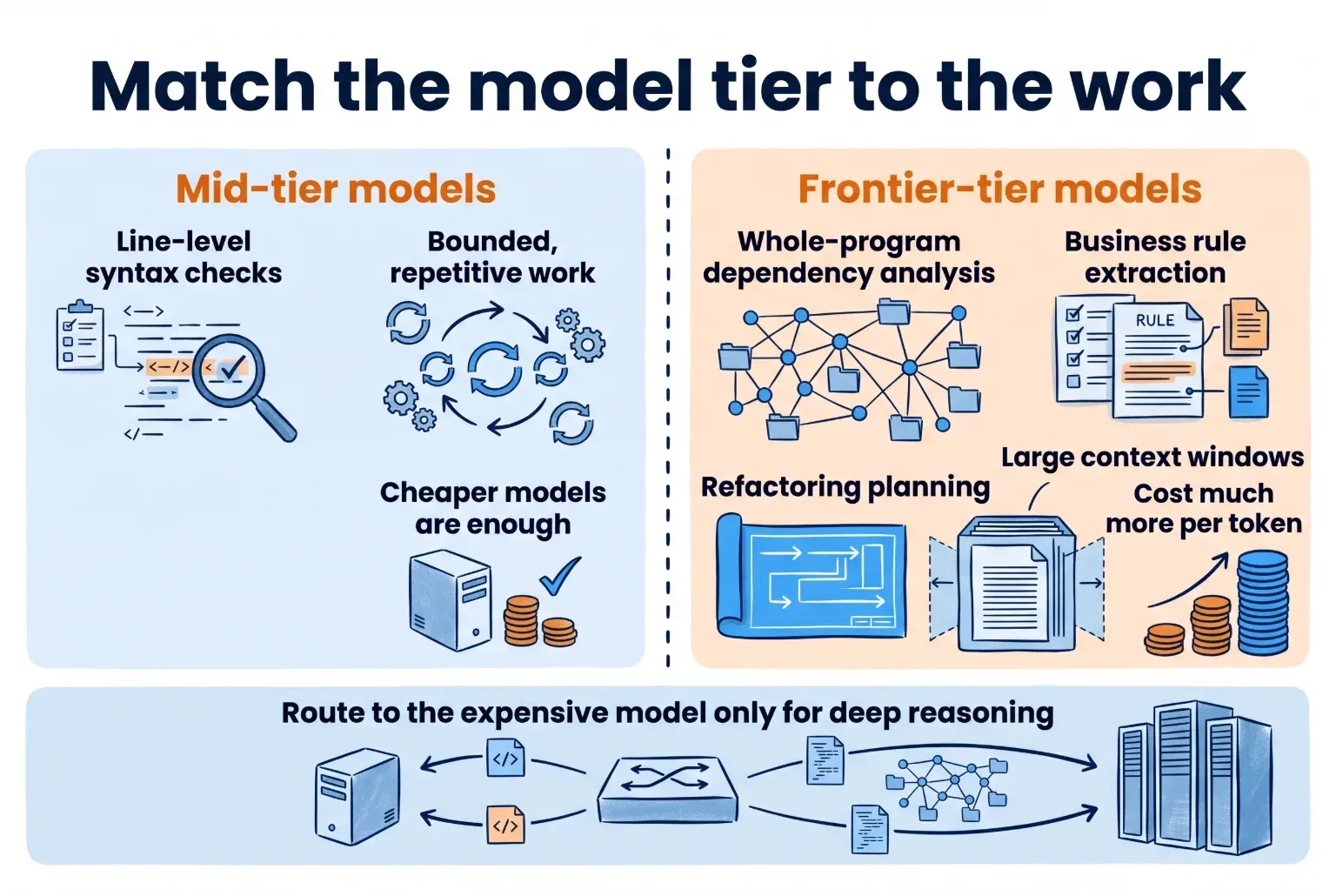
The practical response is tiering. For bounded, repetitive work, such as line-level syntax checks, cheaper mid-tier models are enough. Whole-program dependency analysis, business rule extraction and refactoring planning call for frontier-tier models with large context windows, and those cost much more per token. A routing setup makes sure the expensive model runs only when deep reasoning is needed.
Our view is that the money in a project like this should go mostly to people and testing, not to model calls. A tiered, bounded approach keeps token spend predictable. A project that sends everything to the biggest model will find its first invoice more educational than its first result.
Compare that to the manual baseline. CodeDistrict's 18 to 24 months and $5 million-plus quote for discovery sets the yardstick. An AI-assisted pass that costs a fraction of that, but still needs expert review time, can come out well ahead. Ask any vendor for a cost range that includes review hours, and treat a quote with no review line as incomplete.
Rules for Using AI on Sensitive Code
If you work with the Department of War (DoW) or sell to it, there is a binding instruction to know. DoW Chief Information Officer Kirsten A. Davies approved DoW Instruction 8430.01, "Accelerated Mission Software," on August 31, 2026. It took final effect on September 8, 2026 and applies across the software lifecycle for acquisition and non-acquisition programs, whatever the dollar value.
Paragraph 3.5.a makes machine-readable evidence a condition for operation. Software cannot be authorized to run on DoW networks without standardized evidence of its components, build integrity and application security. The instruction calls for a software bill of materials covering both custom and commercial off-the-shelf software, including transitive dependencies.
What It Says About AI Output
The instruction welcomes AI-assisted development but sets accountability rules. All AI-generated code counts as "unverified input". Developers and cybersecurity teams stay accountable for what an AI agent produces.
Code, scripts and tests written with AI help need the same security reviews, dynamic testing and IP and license checks as human-written work. AI-made changes to security- or safety-critical functionality need documented human review and approval. The instruction also calls for an "AI SBOM," a record of the models, versions, approved environments and datasets used to generate or change code.
One rule bears directly on extraction. Paragraph 3.6.b.(1) bars processing non-public DoW information, including code, schematics, configuration scripts and documentation, through any generative AI service that does not run on approved DoW information systems. That means the model reading the legacy code has to live inside the accredited boundary.
What Non-Defense Teams Can Take From It
The instruction covers code and software evidence, and it does not set rules for rule documents as such. Still, the way it treats AI output is a sensible template for any regulated company. Our own view, not the instruction's text, is that extracted rules deserve the same treatment as "unverified input." A named human checks each one before it goes into a platform. You also log which model, which version and which environment produced it.
The same logic applies to your source code. Before you point any outside AI service at a legacy codebase, find out where the code goes, who can see it and how long it is kept. That is a procurement question to settle first.
Turning Extracted Rules Into a Platform That Lasts
Extraction produces a catalog of rules. A catalog does not run payroll or route requisitions. This is where a custom software partner earns its fee: it turns the validated rules into a platform people can change safely.
Keep the Rules Separate From the Plumbing
The DLA contract's first goal, separating business logic from the legacy systems, carries into the new design. Put rules in a business rules platform or in cleanly bounded services, not scattered through orchestration code. Then a policy change means editing a rule, not hunting through programs.
The DAAS contract also calls for open standards, to simplify governance, increase transparency and allow faster adaptation. We would ask every vendor one question: what format does your tool hand back? Proprietary intermediate formats can lock you into one vendor's ecosystem. Standard, interoperable outputs such as JSON and plain-language decision tables leave you free to change tools later. That last point is our view, not a finding from the contract.
Make Each Rule a Test
Each validated rule should become at least one automated test, written before the new code is. The decision tables from stage four are close to test cases already, since each row is an input and an expected result. When the new platform is built, those tests tell you whether it behaves like the old one.
The Persistent case shows the principle. The insurer set a premium variance limit of plus or minus 5 percent before the migration, then measured against it. Pick your own measure the same way. For a payroll system it might be net pay per employee. For DAAS-style routing it might be the destination and status of each transaction.
Cut Over a Slice at a Time
Avoid a single big-bang switch. CodeDistrict recommends the strangler fig pattern, which isolates, tests and replaces one module at a time. Run the new rules engine in parallel with the legacy system and confirm the results match before you retire the old one.
A partner who is good at this will keep the old system running as the reference the whole way. It is slower to start. It is much cheaper than finding a missing rule in production.
Steps to Take First
If we were sitting with a COO today, this is the order we would follow. The same order works when you bring in a project rescue partner to stabilize a stalled modernization effort.
- Map before you read. Run static analysis across the application and its neighbors. Trace dependencies through programs, VSAM files, DB2 databases and job schedulers. Do not rely on old documentation or on what people remember.
- Pick one bounded slice. Choose a module with a clear edge and a known owner. A first pass on something small gives you real numbers on speed, accuracy and review time before you commit to the whole estate.
- Extract, then ask for plain language. Have the AI output rules as business intent, in decision tables and state models, not as procedural descriptions. Flag obsolete and duplicate rules for a decision instead of deleting them.
- Put experts in front of the output. Make business owners, compliance staff and domain SMEs sign off on the rules in plain language. Treat sign-off as a gate. Platform engineering waits until the logic is certified.
- Turn the rules into tests and set the yardstick. Write the pass mark before the build, as the Persistent insurer did with its plus or minus 5 percent.
- Build in slices and run in parallel. Replace one module at a time and compare outputs against the legacy system until they match.
What We Would Not Bother With
We would not start with a line-by-line language conversion. IBM's JOBOL finding shows what it produces. We would not trust a vendor's percentage claim without a baseline and a stated method, since most are the vendor's own figures. And we would not try to extract the whole portfolio in one pass. Context limits and review capacity both argue against it.
We would also not treat "unused" as "safe to delete" without an expert's say-so. The one rule that looks dead may be the contractual override that matters every March.
Conclusion
The DLA gave its vendor the rules first and the build second, and put a documentation portal at the end of the discovery work. Any organization with an aging system can copy that order, at any scale. Map the system, extract the rules, have people check them, turn them into tests and then build.
If your team is stuck with software nobody fully understands, a short, bounded discovery pass is the cheapest first move. Baytech Consulting can talk through where yours would start.
FAQ
What exactly did the DLA award, and when?
In October 2026, the Defense Logistics Agency awarded Credence Management Solutions a contract to modernize the DAAS Business Rules Engine. The work covers analyzing and rationalizing more than 15,000 legacy rule instances in application code. It also calls for consolidating overlapping rules into a modern platform built on open standards.
Why not just rewrite the system and fix problems as they come up?
Because a rewrite that does not capture the logic copies its flaws or loses rules nobody wrote down. Gartner forecasts that by 2028 AI will create more architecture-level technical debt than it solves. IBM's ICSE 2026 research describes "JOBOL," unmaintainable Java that mirrors the COBOL it replaced.
How fast can AI-assisted extraction really be?
Vendor case studies report large gains against their own manual estimates. Persistent Systems reports 12 validated rules from 112,588 lines of COBOL in two days, against a manual estimate of six to nine months. Hexaware reports up to 40 percent less reverse engineering effort and cost against a 14 to 18 month manual estimate. These are vendor figures, and your results will depend on your code and your review capacity.
Can the AI do this without our experts?
No. A model can treat an unusual contractual override as dead or anomalous code. In Hexaware's airline case, SMEs supplied operating context, validated the AI output and refined it in phases. Across the market, IEEE Software data from 2026 says automated COBOL conversion tools still need 40 to 60 percent manual remediation before production readiness.
How does the AI find overlapping rules?
Some platforms turn code into semantic vectors and compare them with measures such as cosine similarity. A process called semantic fusion can match functions built for the same purpose and merge them into one conceptual model. The goal is to surface obsolete rules and duplicate rules, which are the same policy enforced in several places.
Does DoWI 8430.01 affect us if we are not a defense contractor?
The instruction binds the Department of War, approved August 31, 2026 and in final effect September 8, 2026. Software that runs on DoW networks needs machine-readable evidence, and AI-generated code counts as unverified input. If you work with DoW code, paragraph 3.6.b.(1) bars sending non-public DoW code or documentation to a generative AI service outside approved DoW systems. Outside defense it is not binding, though its treatment of AI output is a reasonable model to borrow.
What should we ask a vendor before we hire them?
Ask where the model runs and who can see your code. Ask what format the extracted rules come back in, because open formats leave room to change tools. Ask how many SME review hours the estimate includes, and how they will test the new system against the old one. If the vendor cannot name a measurable pass mark like the insurer's plus or minus 5 percent premium variance, keep asking.
Supporting Links
- Credence wins DLA contract to untangle 15,000 legacy rules in DAAS
- DLA page on the Defense Automatic Addressing System
- Why successful AI adoption requires technical debt management tools
- A guide to LLM routing and workload-to-model matching
- Claude Code vs traditional COBOL modernization in 2026
- Turning legacy policy logic into migration readiness
- Hexaware annual report 2025
- Legacy modernization at AI speed and the 6R framework
- DoW Instruction 8430.01 makes software evidence a condition to operate
About Baytech
At Baytech Consulting, we specialize in guiding businesses through this process, helping you build scalable, efficient, and high-performing software that evolves with your needs. Our MVP first approach helps our clients minimize upfront costs and maximize ROI. Ready to take the next step in your software development journey? Contact us today to learn how we can help you achieve your goals with a phased development approach.
About the Author

Bryan Reynolds is an accomplished technology executive with more than 25 years of experience leading innovation in the software industry. As the CEO and founder of Baytech Consulting, he has built a reputation for delivering custom software solutions that help businesses streamline operations, enhance customer experiences, and drive growth.
Bryan’s expertise spans custom software development, cloud infrastructure, artificial intelligence, and strategic business consulting, making him a trusted advisor and thought leader across a wide range of industries.