In this article
- What the FDA Released on October 20, 2026
- What Counts as Prescription Drug Use-Related Software
- Device-Connected Versus Standalone Functions
- Two Kinds of Labeling, Two Paths to the FDA
- What It Takes to Get a Standalone App Into the Label
- PDURS Sits on Top of Device Rules
- Splitting Regulated Modules From Engagement Tools
- Risks Worth Taking Seriously
- How the Industry Is Reading It
- What We Would Do First, and What We Would Skip
- Conclusion
- FAQ
- Supporting Links
- About Baytech
- About the Author
If a drug company puts an app in front of patients, whatever that app shows about the company's drug is now treated as drug labeling. The FDA's final PDURS guidance spells out what follows from that.
What the FDA Released on October 20, 2026
On October 20, 2026, the FDA released a final guidance that sets out how drug companies can develop, distribute and label applications used alongside their prescription medicines. Its title is "Regulatory Considerations for Prescription Drug Use-Related Software." It explains how the agency intends to apply its drug labeling authorities to certain software outputs used with prescription drug products and drug-device combination products.
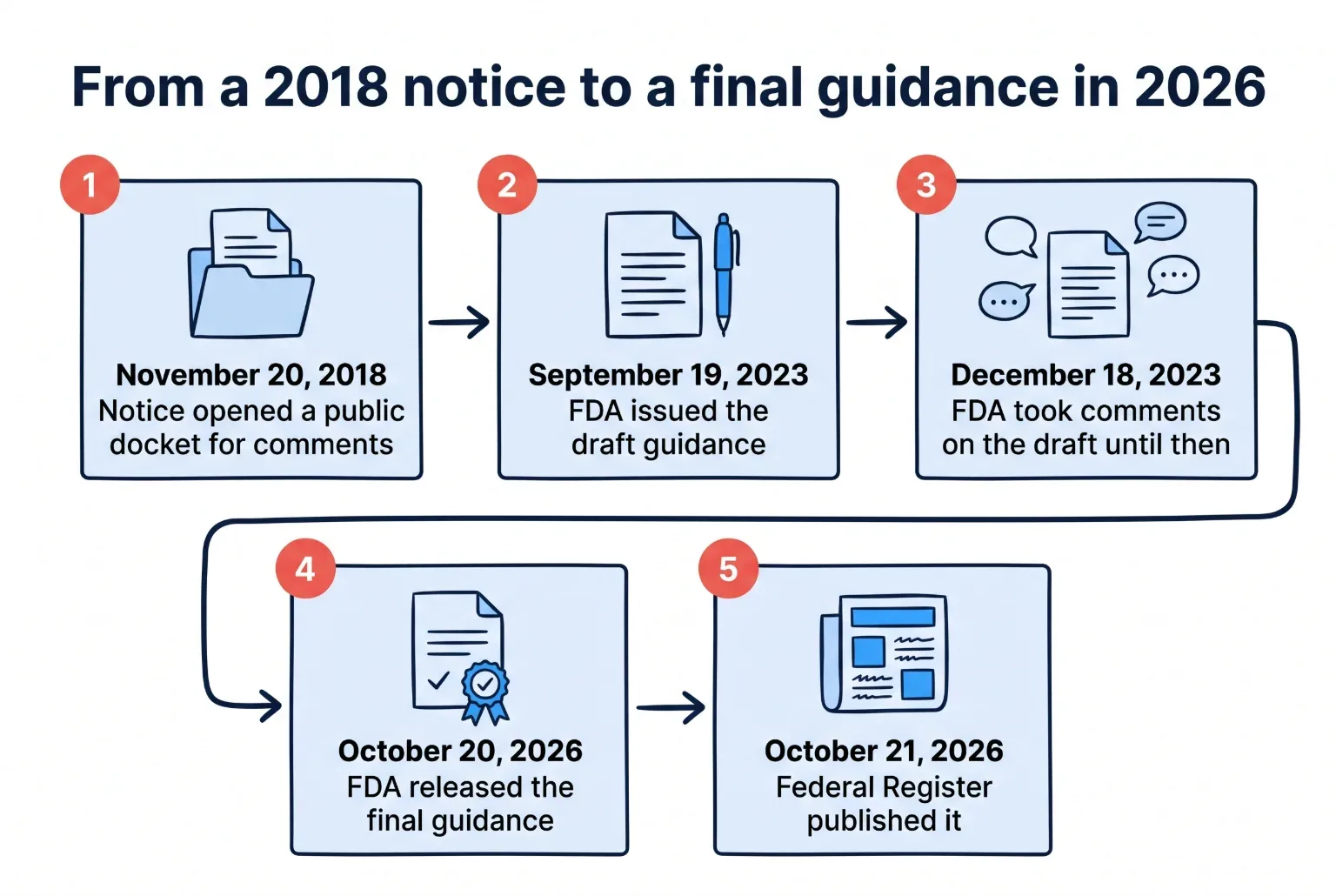
The Federal Register published it on October 21, 2026, as document 2026-21516, under docket number FDA-2023-D-2482. It finalizes a draft with the same title that the FDA issued on September 19, 2023. That draft grew out of a November 20, 2018 Federal Register notice (83 FR 58574) that opened a public docket and asked for comments on prescription drug use-related software. The FDA took comments on the draft until December 18, 2023.
The wait was long. The industry publication HLTH reported that as of March 2026 the guidance was still a draft, with no finalized policy and no definitive timeline. Teams that held off on design decisions now have a final document to work from.
One caveat applies to every FDA guidance. These documents do not create legally enforceable responsibilities and do not bind the FDA or the public. The word "should" in a guidance means a suggestion or recommendation, not a requirement. In practice, sponsors that depart from a guidance need a good reason and a plan to defend it, so we treat it as the working rulebook.
What Counts as Prescription Drug Use-Related Software
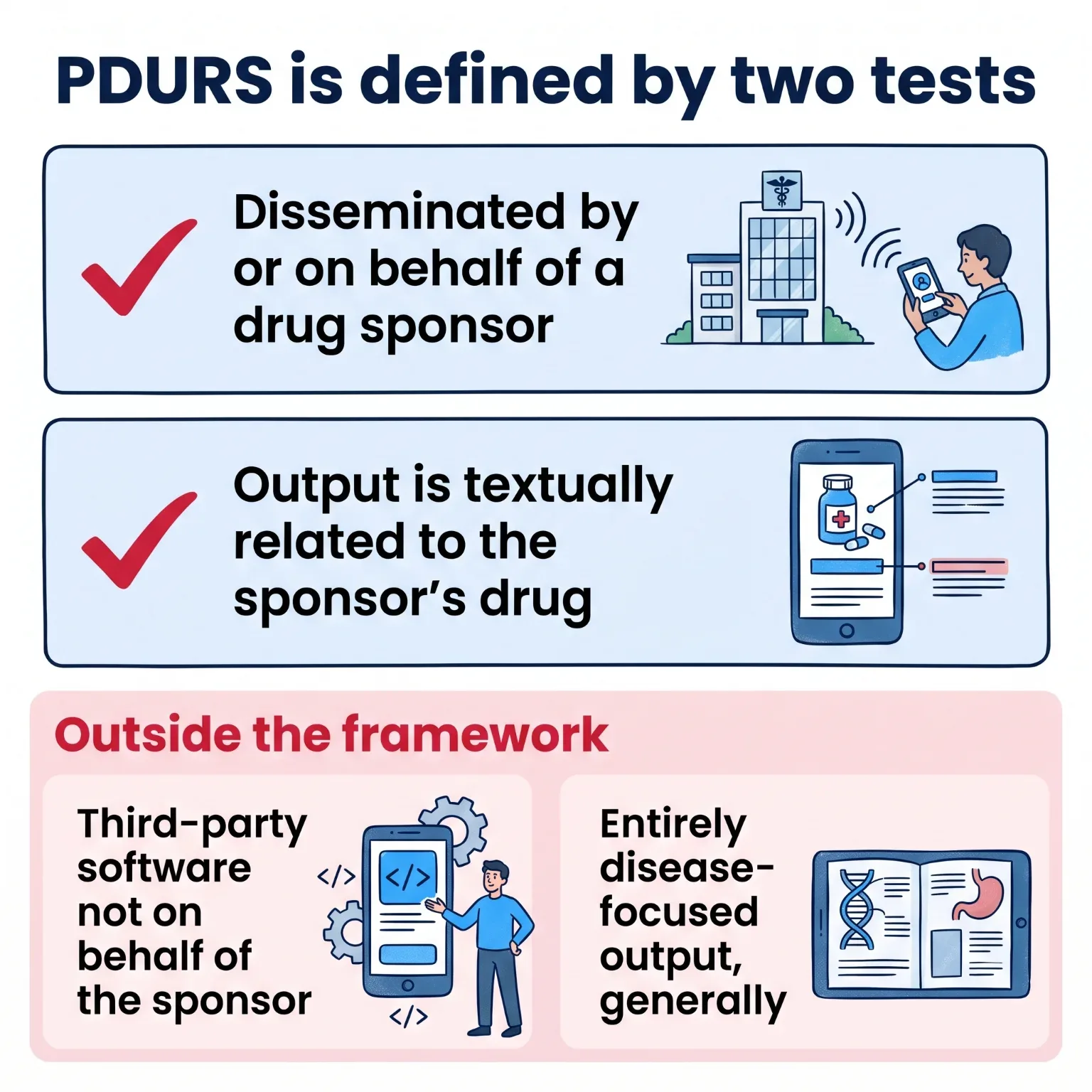
The guidance defines Prescription Drug Use-Related Software (PDURS) with two tests. The software is disseminated by or on behalf of a drug sponsor. And it produces an end-user output that supplements, explains, or is otherwise textually related to one or more of that sponsor's drug products. Whether the software is regulated as a device does not matter for this definition.
Each part of that definition has consequences for how you build and contract.
"By or on Behalf of" a Sponsor
Dissemination on behalf of a sponsor can include a third-party software developer working under an agreement with the company that distributes the software or points users to it. If you are a vendor building an app for a pharma client, the app is likely inside the framework through that agreement. Third-party software that is not disseminated on behalf of the drug manufacturer sits outside it, even if people use it with specific prescription drugs.
"Textually Related" to the Sponsor's Drug
Output that is not specific to the sponsor's prescription drug products generally falls outside the framework. The guidance gives entirely disease-focused output as the example. So a general education module about a condition is treated differently from a screen that explains how to use the sponsor's drug.
The examples of PDURS listed in an IQVIA analysis range from companion apps and branded web tools for treatment and dose selection to safety software and Risk Evaluation and Mitigation Strategies (REMS) software.
"End-User Output"
The FDA defines end-user output broadly. It is any material or content the software presents to the end user, who may be a patient, a caregiver or a health care practitioner. The guidance's central premise is that this output is a type of prescription drug labeling.
The FDA's attention lands on the output, not the code. A framework summary from EVERSANA and a peer-reviewed analysis in PubMed Central both describe the focus as how the output is categorized and regulated as required or promotional labeling. The guidance applies to outputs that drug sponsors disseminate for use with prescription drugs or with combination products led by the Center for Drug Evaluation and Research (CDER) or the Center for Biologics Evaluation and Research (CBER).
For a software leader, this changes the unit of analysis. You stop asking "is this app regulated?" and start asking "what does each screen, message and notification say, and who is it from?"
Device-Connected Versus Standalone Functions
The final guidance sorts software functions into two groups, device-connected and standalone. The sort drives most of what happens next, so it is worth getting precise.
| Feature | Device-connected | Standalone |
|---|---|---|
| Definition | Relies on data transferred directly from the device constituent part of the sponsor's combination product | Any function that is not device-connected, such as one that relies on data the user enters |
| Examples | An app paired with an asthma inhaler | Symptom trackers, dose reminders, health coaching tools |
| Prescribing information | Generally described in the drug's label | Generally not described, unless an additional factor warrants it |
The term "device-connected" describes the data source or the connectivity. It does not say whether the FDA regulates the function as a device. A function can be device-connected and still not be a regulated medical device, and the reverse can also happen. Teams that merge the two ideas end up with the wrong compliance plan.
The final guidance also adds Appendix A, a four-question decision tree. It walks sponsors through a step-by-step determination of how and whether their software should be described in the prescribing information.
What the Split Means in Plain Terms
Picture a connected inhaler with a companion app. The app reads dose events straight from the inhaler. That function is device-connected, and the label will probably say so. Now picture a separate screen in the same app where the patient types in how they feel today. That function is standalone, because it depends on data the user enters. Same app, two categories.
That example is ours, built from the guidance's definitions. The point is that the category belongs to the function, not to the app as a whole. A single app can hold both kinds, which is why architecture matters later in this post.
Two Kinds of Labeling, Two Paths to the FDA
The FDA recognizes two broad categories of prescription drug labeling, FDA-required labeling and promotional labeling. Which one the software output falls into determines how the agency reviews it and what the sponsor must submit. The guidance answers three questions for industry. When is app content required labeling and when is it promotional? When should an app be mentioned in a drug's prescribing information? And what must a company submit when it distributes app content to users?
Promotional Labeling: The Default for Most App Content
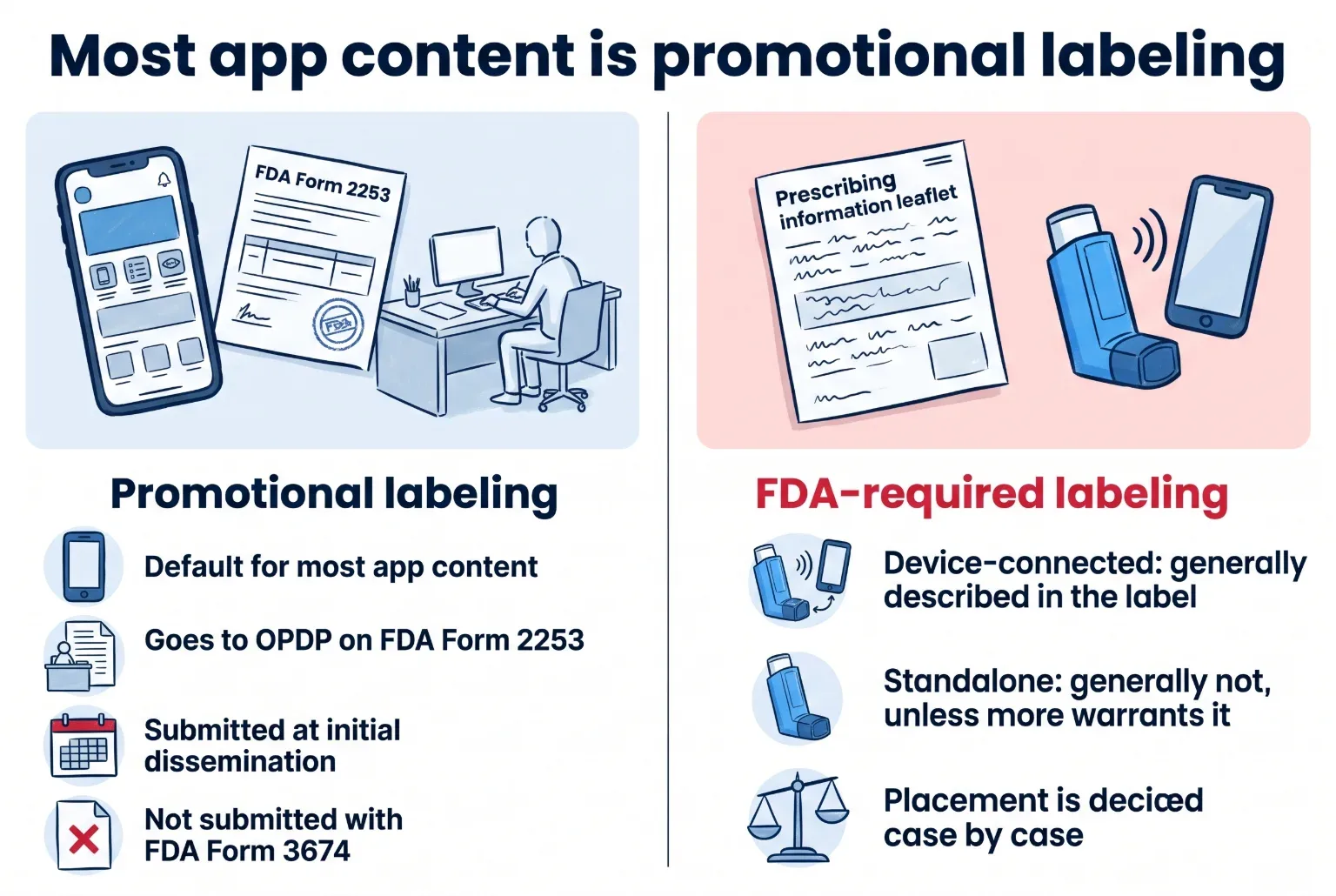
In most cases, what a companion app shows users is treated as promotional material, in line with how the FDA handles other drug advertising. Promotional end-user output must go to the FDA's Office of Prescription Drug Promotion (OPDP) on FDA Form 2253 at the time of initial dissemination. Promotional materials do not need to be submitted with FDA Form 3674.
There is a useful carve-out. Software updates that do not change the user-facing content, such as security patches, do not need a Form 2253 submission. That line gives engineers something to design against. A change to the words, images or messages a user sees can trigger a submission. A change that only touches how the software runs, and leaves the output alone, does not.
FDA-Required Labeling: The Prescribing Information
Whether software shows up in the Prescribing Information (PI), also called the USPI, depends on the category.
For device-connected software, the functions are generally described in the drug's official label, given how central the software is to using the medicine. Software that relies on data transferred from a device constituent part typically appears in the HOW SUPPLIED and STORAGE and HANDLING sections of the USPI.
For standalone functions, the default runs the other way. They generally should not be described in the PI unless something more warrants it. A standalone app belongs on the label only if the company can show it is essential for safe and effective use, or if the FDA finds a meaningful improvement in a clinical outcome from using it.
The guidance also gives illustrative PI language for both device-connected and standalone software. Placement is decided case by case. Where software is necessary for safe and effective use, where and how the PI addresses it gets worked out during the FDA's review.
One more recommendation deserves attention. When software is not considered necessary for safe and effective use, the guidance recommends that the sponsor say so in the PI where the software function and device constituent part are described. This holds whether or not the sponsor submitted evidence of a meaningful improvement in a clinical outcome.
What It Takes to Get a Standalone App Into the Label
Many product teams want label placement, because it signals that the app does something clinically. The evidence bar is real, though.
The Dedham Group, a consultancy, says manufacturers need at least one adequate and well-controlled clinical study to show their software's clinical benefit. The FDA says such studies may use real-world data, where appropriate, to generate real-world evidence. For required labeling, a PDURS with a meaningful clinical benefit would be added to the CLINICAL STUDIES section of the drug label. Dedham reads the guidance as allowing a supplemental NDA (sNDA) to change the label of an existing drug to include software-related benefits. Note the hedge in that reading. Dedham says the guidance "appears to allow" it, so confirm the route with regulatory counsel before you plan around it.
The final guidance includes a worked example. It describes a mobile app with dose reminders, health tracking and behavioral coaching that demonstrated improved HbA1c levels when paired with a drug. ATA Action, an advocacy group affiliated with the American Telemedicine Association, welcomed the final guidance and said this was the kind of example it had repeatedly asked the FDA to provide. Teams working on regulated AI features can also look at the FDA's broader device roadmap in guidance planning for AI devices.
The shape of that example tells you what to plan for. The app bundles several features, and the study compares outcomes with the drug paired with the app. A reminder feature on its own, with no outcome data behind it, is not the example.
Generic and biosimilar products that contain PDURS keep being evaluated under their established statutory frameworks. The guidance does not create a separate track for them.
The Case Click Therapeutics Brings to Mind
IQVIA points to the FDA's De Novo review of Click Therapeutics' digital therapeutic CT 132 for migraine as a concrete case. The FDA evaluated data showing better outcomes when a digital intervention was added to standard pharmacologic care. IQVIA describes that as the same evidentiary bar the PDURS framework is built to meet. IQVIA does not say that review was a PDURS review, so read it as a benchmark for the kind of evidence involved.
PDURS Sits on Top of Device Rules
The framework adds to existing medical device oversight led by the FDA's Center for Devices and Radiological Health (CDRH). It does not replace it. Whether software is PDURS is a separate question from whether it is regulated as a medical device, and the FDA will look at the output of both device and non-device software as PDURS. Device-connected functions could meet the definition of a "medical device" under the Federal Food, Drug, and Cosmetic Act and fall under CDRH regulation.
So a device-connected module can face two reviews at once. One looks at the output as labeling. The other asks whether the function is a device.
The Device Side in Brief
The FDA calls software functions that are device functions "device software functions." These may include Software as a Medical Device (SaMD) and Software in a Medical Device (SiMD). A device software function on a mobile platform may be called a "mobile medical app". The FDA looks at functionality rather than platform. It intends to apply oversight only to software functions that are medical devices and whose functionality could pose a risk to patient safety if the device did not work as intended.
Premarket routes for device software include 510(k) submissions, De Novo requests, Premarket Approval applications, Investigational Device Exemptions and Humanitarian Device Exemptions.
Why Modifications Matter for Architecture
Change control is where the device side touches your design. A new 510(k) is required when a legally marketed device subject to 510(k) requirements is significantly changed or modified in design, components, method of manufacture or intended use. Significant changes are those that could significantly affect safety or effectiveness, or major changes in intended use (21 CFR 807.81(a)(3)). The FDA charges a fee for reviewing 510(k)s.
Some rules in the FDA's page on when a new 510(k) is required shape how you plan releases:
- Software modifications count as design changes under the Quality System regulation (21 CFR Part 820), however the manufacturer classifies them.
- The FDA recommends a risk-based assessment, such as ISO 14971, to judge whether a change likely needs a new 510(k).
- There is no amendment or supplement to an existing 510(k). If a modification is not covered, a new 510(k) is needed.
- A Special 510(k) may fit when the change does not affect intended use or alter the fundamental scientific technology of the device.
Two things follow for a team that ships often. Every release that touches a device function needs a documented change assessment. And the more of your code lives inside the device function's boundary, the more releases pass through that assessment.
Other Wrinkles
HLTH reports that in 2026 the FDA withdrew its SaMD Clinical Evaluation guidance, which had been an internationally aligned reference point. HLTH reads that as a sign software oversight is being re-examined. The Office of Combination Products continues to develop cross-cutting guidance on classification, jurisdiction and combination products. The FDA also offers a Medical Device Software Guidance Navigator to help find relevant guidance, though its listings are not comprehensive.
Rules also change at the border. Health Canada often regulates companion software as a medical device under its Medical Devices Regulations, so a U.S. labeling analysis does not carry over one to one. If you sell in both markets, run two analyses.
Splitting Regulated Modules From Engagement Tools
The rest of this section is our own view, built from the rules above. The FDA guidance does not tell anyone how to structure code. It tells you how output and functions are classified. Architecture is how you keep that classification from spreading across your whole product.
Here is the logic. Three rules from the guidance drive cost. Device-connected functions are described in the label and may be devices. Promotional output needs a Form 2253 when it is first disseminated. And device software modifications go through change assessment. If all three attach to the whole app, every release pays for all of them. If they attach to small, well-marked parts, most releases pay for none.
Three Zones, Drawn Along the FDA's Own Lines
We would split a companion product into three zones, using the categories the FDA already uses.
Zone 1, the device-connected module. This holds everything that reads or depends on data transferred directly from the device constituent part. Keep it small. It handles the connection, validates and stores the device data, and exposes a narrow interface to the rest of the product. Because this is where device-function questions, label placement and 510(k)-style change assessment concentrate, you want few lines of code and few reasons to change it.
Zone 2, the drug-specific content layer. This is where promotional output lives: the words, images and messages about the sponsor's drug. Treat content as data, not code. Store it in a versioned content service with an approval record for each item. The guidance ties Form 2253 to the first dissemination of promotional output. We read new or changed content as what needs a look, so a content service that logs every change gives you a clean list to review with your regulatory team. Code releases that leave content alone do not touch this list. The FDA says security patches that do not alter user-facing content need no Form 2253.
Zone 3, the general engagement layer. This holds standalone functions that depend on user-entered data, such as symptom logs, reminders and coaching flows. It also holds general condition education that is not specific to the sponsor's drug, which generally falls outside PDURS. This zone changes most often. Most experiments happen here.
Rules for the Seams
The zones only help if the seams hold. We would enforce a few rules.
- One-way dependencies. The engagement layer can ask the device module for data through a defined interface. The device module should never depend on engagement code. That keeps engagement releases outside the device module's change assessment.
- No drug-specific text in the engagement layer's code. If a reminder says something about the sponsor's drug, that string belongs in Zone 2 with its approval trail. Hard-coded text scattered through screens is hard to find and harder to submit.
- Tag every output. Give each piece of end-user output a record that says which zone produced it, whether it is drug-specific, and which labeling category you assigned. The guidance is built around output, so your inventory should be too.
- Separate release pipelines. Zone 1 gets a slower pipeline with a documented risk assessment, modeled on the risk-based approach the FDA recommends. Zone 3 gets a fast one. Zone 2 releases carry a content-change check that asks whether a Form 2253 is due.
What Decoupling Cannot Do
Be honest about its limits. Splitting the code does not change how the FDA classifies the output. If a Zone 3 screen explains, supplements or is textually related to the sponsor's drug and the sponsor disseminates it, it is PDURS. Architecture reduces how much code and how many releases the rules touch. It does not take drug-specific content out of the framework.
A second limit is that standalone does not mean unregulated. Standalone output that belongs to a sponsor's drug is still labeling, and most of it is promotional labeling. A standalone function simply tends to stay out of the PI unless there is essential-use or clinical-benefit evidence.
A third is the blurry middle. If one screen mixes disease-focused education with drug-specific instructions, you cannot cleanly say which rules apply. Keep those in separate components with separate approvals so you can show where the line is.
Trade-Offs to Weigh
Decoupling costs something. You add interfaces, a content service and more than one pipeline. Small teams with one feature may find that heavy. The split pays off when you expect many releases and a device-connected core that stays stable. It pays off less for a single-feature reminder app with no device link.
Off-the-shelf software adds another consideration for Zone 1. The FDA defines off-the-shelf (OTS) software as a generally available component used by a device manufacturer that cannot claim full life-cycle control over it, such as an operating system or a display library. The FDA has guidance on documentation for premarket submissions that use OTS software. The fewer third-party components inside the device module, the shorter that documentation. Put general-purpose libraries in the engagement layer where you can.
Risks Worth Taking Seriously
Advertising Penalties
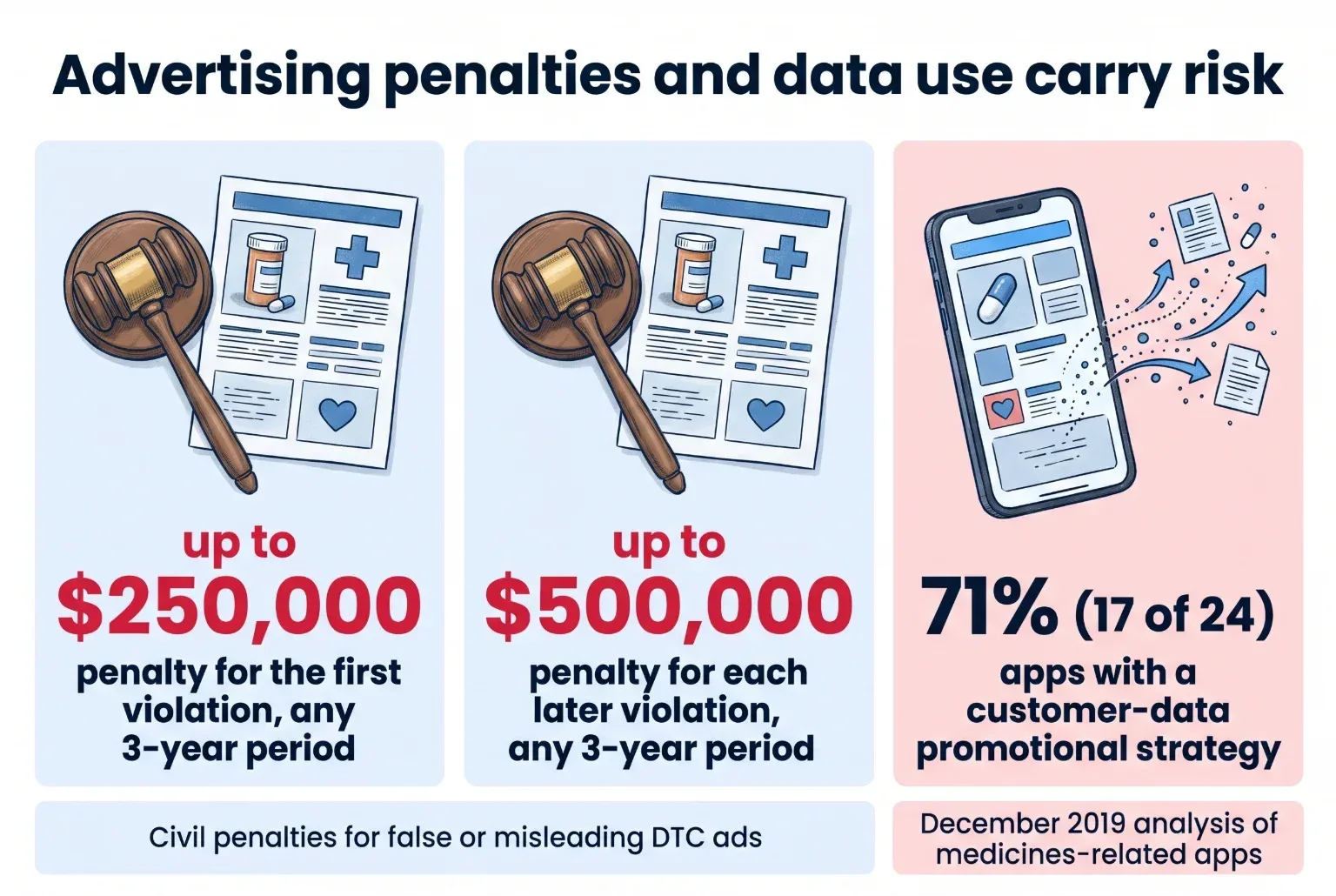
Because most app content is treated like other drug advertising, the FDA's advertising rules are worth knowing. Section 901 of the FDA Amendments Act added civil penalties for false or misleading direct-to-consumer (DTC) advertisements. A holder of an approved application who disseminates, or causes another party to disseminate, such an advertisement is liable for a civil penalty of up to $250,000 for the first violation in any 3-year period and up to $500,000 for each later violation in any 3-year period. The FDA's Q&A states this in the context of DTC ads. The summaries we reviewed do not tell us how those penalties would apply to a given app screen, so take that question to counsel. The practical point is that content review before release is cheap next to those amounts.
Data Use and Commercialization
Design choices about user data carry reputational risk. A December 2019 content analysis of 24 medicines-related apps found that 71% (17 of 24) outlined at least one promotional strategy that used customer data for commercial purposes. Ten of the 24 mainly offered medication adherence services and 14 mainly offered medicines information. The strategies included personalized marketing of the developer's related products, highly tailored advertising, third-party sponsorship of targeted content, and selling aggregated customer insights. In 2011, a New York Times investigation found that Epocrates, a free app clinicians used to look up drug dosing, interactions and coverage, showed users targeted advertisements from pharmaceutical companies.
That analysis predates PDURS and looked at apps generally, so it is a pattern, not a finding about any sponsor's companion app. Still, if your engagement layer and your promotional content layer share a data store, you make it easy for marketing use to creep in. Keeping those separate is also a good design reason for the zones above.
How the Industry Is Reading It
ATA Action had submitted comments supporting the draft guidance. After the October 2026 release it welcomed the final guidance, pointing to the HbA1c example.
On the company side, HLTH reports that Pfizer has set up a PDURS Centre of Excellence and named Marty Culjat as Digital Medicine & PDURS Strategy Lead. The role is meant to drive drug-digital integration across the portfolio by aligning regulatory, clinical, commercial and policy views. HLTH reads this as Pfizer treating PDURS as an enterprise-wide capability with relevance across therapeutic areas. Pfizer has named oncology and cardiometabolic conditions as priority domains for digital medicine, where behavior heavily shapes outcomes and software for adherence, monitoring and engagement could lead to clinical gains.
We would not read too much into one company's org chart. It does show that at least one large sponsor is organizing regulatory, clinical and commercial staff around the topic, which hints at who your product team will be talking to.
What We Would Do First, and What We Would Skip
Our order of work is below, starting with the cheapest step.
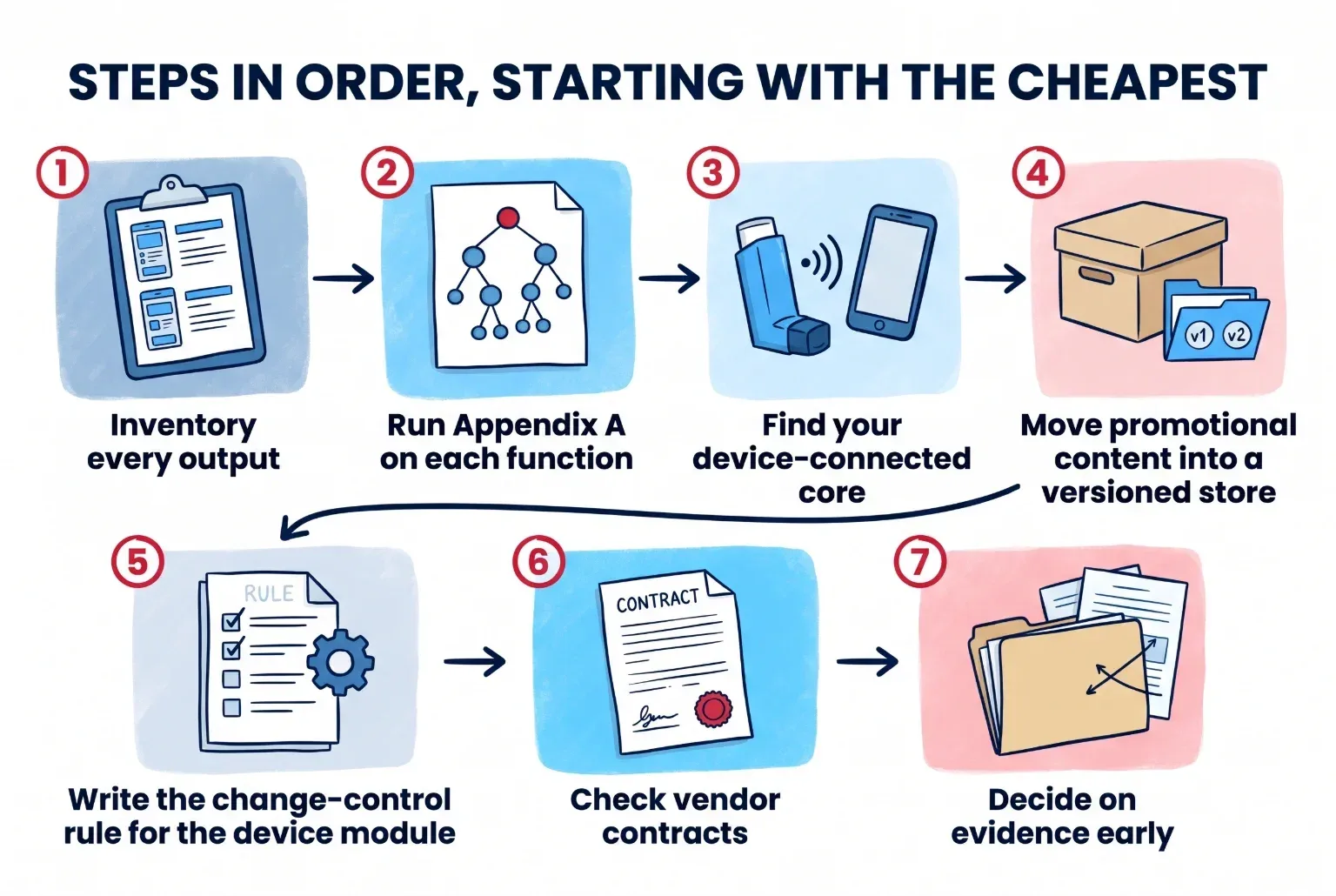
- Inventory every output. List each screen, message, notification and email your product shows to patients, caregivers or clinicians. For each, record whether it is drug-specific, who disseminates it, and whether it depends on device data. This is the cheapest step and it shapes everything else.
- Run Appendix A on each function. The four-question decision tree is the FDA's own path to deciding how and whether software is described in the PI. Keep the answers on file.
- Find your device-connected core. Mark every function that relies on data sent directly from the device constituent part. Ask whether any of it meets the device definition. That is a separate question.
- Move promotional content into a versioned store. Add approvals and a change log. Define what counts as a user-facing content change, and keep security and infrastructure patches outside it.
- Write the change-control rule for the device module. Use a risk-based assessment, such as ISO 14971, to judge whether a change may need a new 510(k). Decide in advance who signs off.
- Check vendor contracts. If a third party builds or runs the app under an agreement with the sponsor, it is likely within "by or on behalf of". Write down who owns submissions and approvals.
- Decide on evidence early. If you want a standalone function in the label, plan an adequate and well-controlled study before you build, not after. If you do not plan to run one, plan for the PI statement that the software is not necessary for safe and effective use.
What would we skip? We would not spend time trying to rebrand drug-specific content as disease education to stay outside the framework. The test looks at what the output says and who sends it. We would also not rewrite a working app into three services before step one is done. And we would not chase PI placement for a reminder tool without outcome data behind it, since the guidance reserves that for essential-use or clinical-benefit cases.
Conclusion
The final guidance gives sponsors and their software vendors a clear rule. Output about a sponsor's drug is labeling, and most of it is promotional, so it goes to OPDP on Form 2253 when first disseminated. Updates that leave user-facing content unchanged need no new form. Device-connected functions usually appear in the prescribing information. Standalone functions usually do not, unless there is evidence of essential use or a meaningful clinical benefit.
The next step is an output inventory, then a split of the product along the same lines the FDA uses. A small, tightly controlled device module, a versioned content layer, and a fast engagement layer keep each rule attached to as little of the product as possible. The guidance is non-binding, but it is the clearest map you have.
If you want a second set of eyes on your companion app's structure, Baytech Consulting is glad to talk it through with your team.
FAQ
Is the PDURS guidance legally binding?
No. FDA guidance documents, including this one, do not create legally enforceable responsibilities and do not bind the FDA or the public. "Should" in a guidance means a recommendation, not a requirement. If you take a different approach, you need a reason you can defend to the agency.
When was the final guidance issued, and what did it replace?
The FDA released it on October 20, 2026, and the Federal Register published it on October 21, 2026, as document 2026-21516 under docket FDA-2023-D-2482. It finalizes the draft guidance of September 19, 2023.
Does a standalone app avoid being treated as labeling?
No. Standalone describes where the function gets its data, namely any function that is not device-connected, such as one that relies on user-entered data. If the software is disseminated by or on behalf of a sponsor and its output supplements, explains or is textually related to the sponsor's drug, it is PDURS regardless. Most such content is treated as promotional labeling. What standalone status changes is the default for the prescribing information. Standalone functions generally should not be described there unless another factor warrants it.
What is the difference between device-connected and standalone software?
Device-connected functions rely on data transferred directly from the device constituent part of the sponsor's combination product. An app paired with an asthma inhaler is the FDA's example. Standalone functions are everything else, such as symptom trackers, dose reminders and health coaching tools. The device-connected label describes the data source or connectivity. It does not say whether the function is regulated as a device.
What must a sponsor submit for app content?
Promotional end-user output goes to OPDP on FDA Form 2253 at initial dissemination. Updates that leave user-facing content unchanged, such as security patches, do not need a Form 2253. Promotional materials do not need to be submitted with Form 3674.
When does a standalone app earn a place in the prescribing information?
When the company can show the app is essential for safe and effective use, or when the FDA finds a meaningful clinical benefit from the software. Placement is decided case by case during review. Dedham Group says sponsors need at least one adequate and well-controlled study, and the FDA says such studies may use real-world data. A benefit that qualifies would be added to the CLINICAL STUDIES section. If software is not necessary for safe and effective use, the guidance recommends a statement to that effect in the PI, whether or not benefit evidence was submitted.
Does PDURS replace medical device regulation?
No. It adds to CDRH oversight. Whether software is PDURS is a separate question from whether it is a medical device. A device-connected function could meet the device definition and be regulated by CDRH. Device modifications are handled under the 510(k) rules, and software changes count as design changes under 21 CFR Part 820.
Do third-party app developers fall under the framework?
They can. Dissemination on behalf of a sponsor may include a third-party developer working under an agreement with the company that distributes the software or directs users to it. Third-party software not disseminated on behalf of the manufacturer is outside the framework, even if people use it with specific prescription drugs.
Do generics and biosimilars get different treatment?
The FDA confirms that generic and biosimilar products containing PDURS continue to be evaluated under their established statutory frameworks.
Does a U.S. labeling analysis work in Canada?
Not directly. Health Canada often regulates companion software as a medical device under its Medical Devices Regulations, so a U.S. analysis does not map one to one.
Supporting Links
- FDA press announcement on the final guidance for prescription drug apps and software
- Federal Register notice of the final PDURS guidance, October 21, 2026
- HLTH article on PDURS and the drug label
- Arnold & Porter advisory on the guidance after a several-year delay
- EVERSANA overview of the PDURS framework
- Akin Gump alert on the finalized PDURS guidance
- ATA Action statement on the final PDURS guidance
- FDA page on when a modified device needs a new 510(k)
About Baytech
At Baytech Consulting, we specialize in guiding businesses through this process, helping you build scalable, efficient, and high-performing software that evolves with your needs. Our MVP first approach helps our clients minimize upfront costs and maximize ROI. Ready to take the next step in your software development journey? Contact us today to learn how we can help you achieve your goals with a phased development approach.
About the Author

Bryan Reynolds is an accomplished technology executive with more than 25 years of experience leading innovation in the software industry. As the CEO and founder of Baytech Consulting, he has built a reputation for delivering custom software solutions that help businesses streamline operations, enhance customer experiences, and drive growth.
Bryan’s expertise spans custom software development, cloud infrastructure, artificial intelligence, and strategic business consulting, making him a trusted advisor and thought leader across a wide range of industries.