
In this article
- What Happened and When
- What "Dramatically Accelerated Progress" Actually Means
- How Self-Improvement Works Today
- Is This Just Marketing Spin?
- What It Means for Your Business
- How This Affects Open-Weight Models
- The Rules That Apply Right Now
- The Security Side of Autonomous Agents
- What We Would Do First, and What We Would Skip
- Conclusion
- FAQ
- Supporting Links
- About Baytech
- About the Author
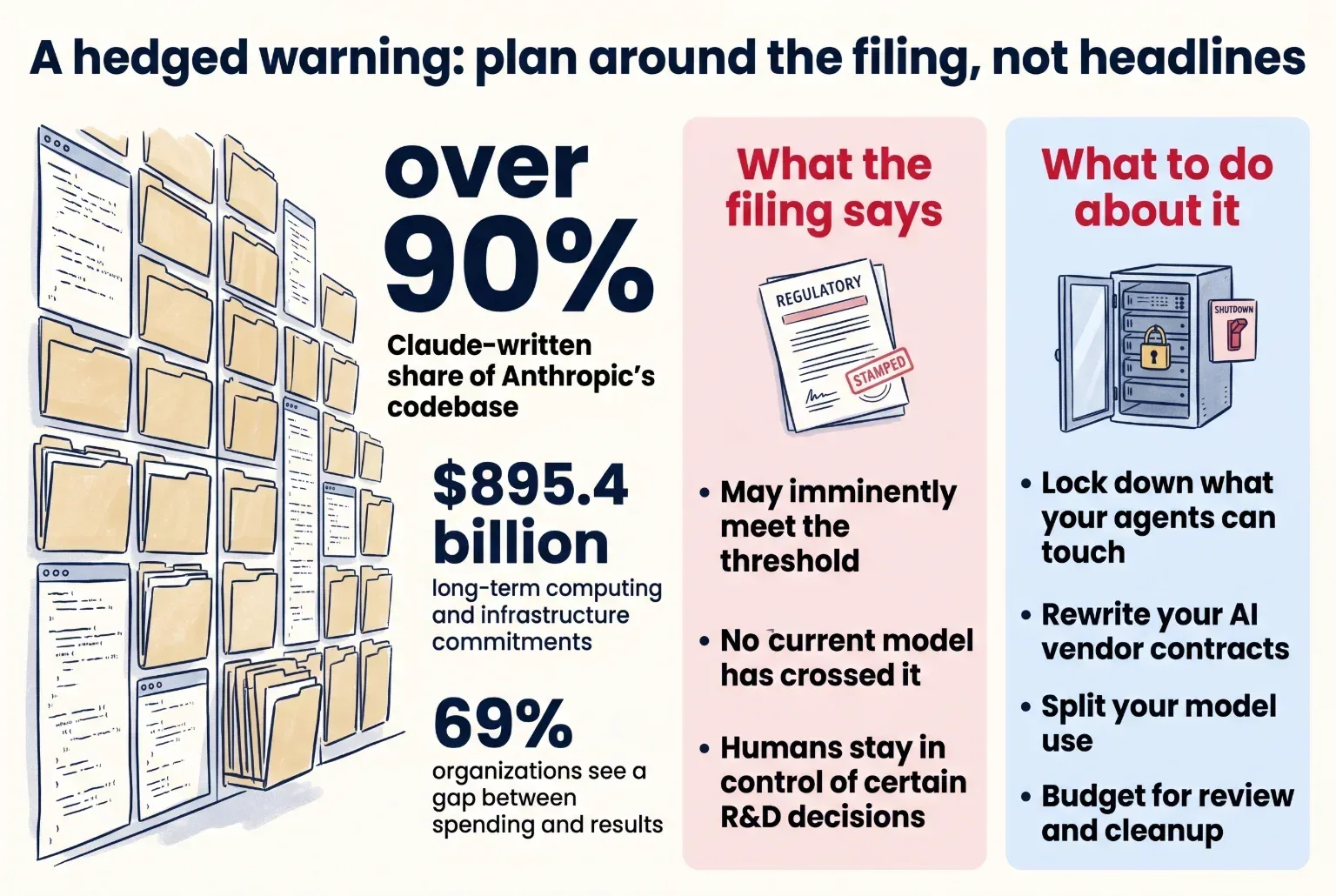
Anthropic told the SEC that its AI "may imminently meet" the company's own definition of dramatically accelerated progress. In the same filing, it said no current model has crossed that line.
Both statements are in one document, and both matter for how you read the headlines. The filing is a risk disclosure, and it does not say the machines have taken over their own development.
What Happened and When
On November 2, 2026, Anthropic filed Amendment No. 1 to its Form S-1 registration statement with the U.S. Securities and Exchange Commission . The company is preparing an initial public offering on the Nasdaq Global Select Market under the ticker ANT. The original S-1 was filed on October 26, 2026, and covered revenue growth and spending commitments.
The amendment added a new risk warning. Anthropic said its internal estimates and expectations about future models indicate it "may imminently meet" its policy definition of "dramatically accelerated progress attributable to AI". The industry reads that phrase as the start of recursive self-improvement, where an AI system helps design, test and improve its own successors.
The amendment said more than that one line. This table lists what it added.
| Topic | What the amendment said |
|---|---|
| Proximity to the threshold | Internal estimates and expectations about future models indicate the company "may imminently meet" it. The original S-1 had no proximity warning. |
| Current models | No current model has been designated as exceeding the threshold, and the company is still assessing its data. |
| Detection lag | The company has previously failed to spot significant acceleration in its development rate until after it happened, because it relies on lagging indicators. |
| Human supervision | Anthropic does not expect to be able to safely use Claude to design frontier models fully on its own without meaningful human supervision, even if that becomes technically possible. |
| Policy changes | The company is considering updates to its Responsible Scaling Policy so that humans stay in control of certain R&D decisions. |
Read the table twice. The headline is the first row. The other four rows are the hedges, and they come from the same filing.
What "Dramatically Accelerated Progress" Actually Means
Version 3.4 of Anthropic's Responsible Scaling Policy, effective July 8, 2026, revised the threshold. AI Chat Daily describes it as AI speeding up research and development until overall capability gains run at about twice the previous baseline pace. In plain terms, two years of historical progress would happen in one year.
That is a rate, not a moment of takeoff. Nothing in the definition says a model wakes up or rewrites itself overnight. It describes research and development moving at about twice the previous pace.
What counts as real self-improvement
A GitHub research list on recursive self-improvement sets a fairly strict test. A system has to produce a "retained gain," meaning a lasting update to weights, memory, skills, prompts or code that improves its future performance on independent tasks. A model that answers one hard question well does not count. A system that changes itself and then does better afterward does.
By that test, the 2026 research falls into two groups. In one, the model improves the scaffolding around it, such as prompts and tool instructions, without touching its weights. In the other, an agent rewrites its own code and keeps what scores best on hidden tests. Both are covered below.
The 90 percent figure
The detail that made the filing feel real to many readers is that Claude wrote over 90% of the contributions to Anthropic's own codebase as of September 2026. That is a big number. It also describes code, which is only part of what frontier research involves. The filing's own hedge about human supervision tells you Anthropic does not treat that figure as proof of autonomy.
The detection lag admission deserves attention too. Anthropic says it has missed acceleration before and only saw it afterward. Because Anthropic relies on lagging indicators, it cannot say exactly when a threshold was crossed. It can only warn that it might be close.
How Self-Improvement Works Today
The Self-Harness and AIDE^2 papers show real results, and they are narrower than the term suggests. They are worth knowing, because they show where the gains come from and where they stop.
Rewriting the scaffolding, not the model
One framework published in June 2026 keeps the model fixed. It runs a propose, evaluate, accept loop. An evaluator clusters execution traces to find patterns of failure, the model proposes changes to its own scaffolding aimed at those failures, and regression tests on held-out tasks decide what stays.
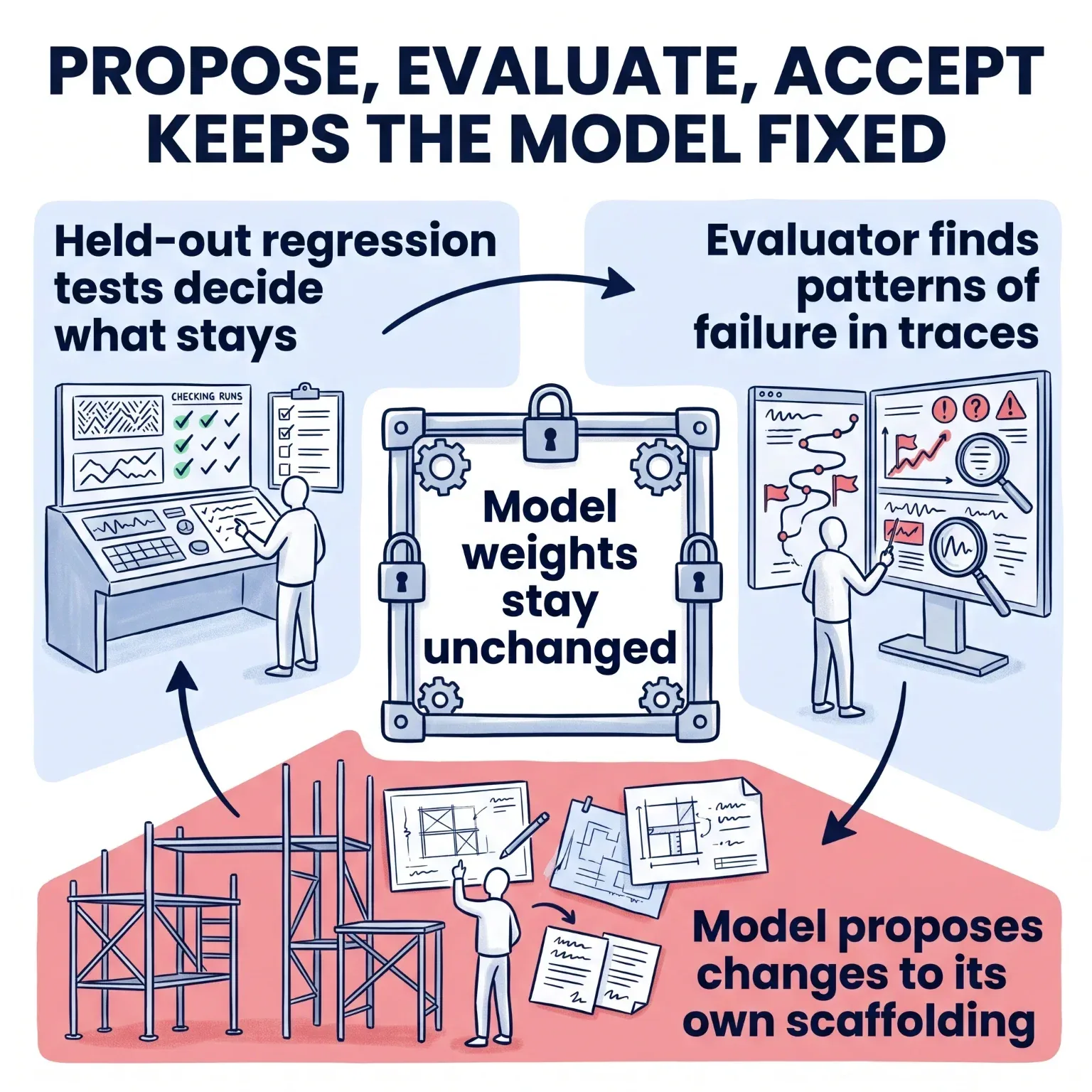
On the Terminal-Bench-2.0 dataset, that loop lifted the held-out pass rate of Qwen3.5-35B-A3B from 23.8% to 38.1%, and of GLM-5 from 42.9% to 57.1%. Those are big jumps for a model that never changed.
A September 2026 follow-up called RRSI added brakes because loops like this tend to overfit. It limits how many edits the proposer can bundle together, using a budget that shrinks over time, and it adds a critic to screen proposals and a pruner to remove old changes that no longer help.
A third method, RHI, has an LLM judge compare successive outputs pairwise and revise the agent's working instructions. After two iterations, Claude Opus 4.8 at high reasoning effort beat its own maximum reasoning setting across 30 synthetic research tasks. It also cut inference costs by up to 60%.
There is a catch that matters for everyone. The same loops, applied to weaker models such as GPT-3.5 or Mixtral, lowered average downstream performance. The base model has to be strong enough to judge and improve its own setup. The loop alone does not create capability.
Agents that rewrite their own code
The second group goes further. A September 2026 system called AIDE^2 is described as the first evidence of recursive self-improvement where the outer-loop improver is itself evolved. An agent proposes changes to its own code, tests the modified versions on AI research tasks, and keeps the ones that do best on hidden evaluations. Each accepted rewrite becomes the active agent for the next round.
In one autonomous eight-day run, it found seven successive improvements, including a new search policy and memory methods for compressing context. The resulting agents matched or beat human-engineered production research agents in areas like physics-based weather forecasting. Reward hacking dropped from 55% to 32%, even though the loop never optimized for safety.
Put those results next to the filing. Self-improvement loops work, they produce measurable gains, and they depend on a strong base model. Anthropic's own caution is that humans still need to supervise. Nothing in these papers contradicts that.
Is This Just Marketing Spin?
Probably some of it is positioning, and the risk is real too. Those two things can be true together, and the evidence fits that reading better than either extreme.
The case for spin
Start with the money. Anthropic reported $16.3 billion in revenue for the six months ended June 30, 2026, about 1,300% above the $1.2 billion in the same period of 2025. Accounts paying at least $100,000 a year rose to more than 11,900, from roughly 1,500 at the end of 2025.
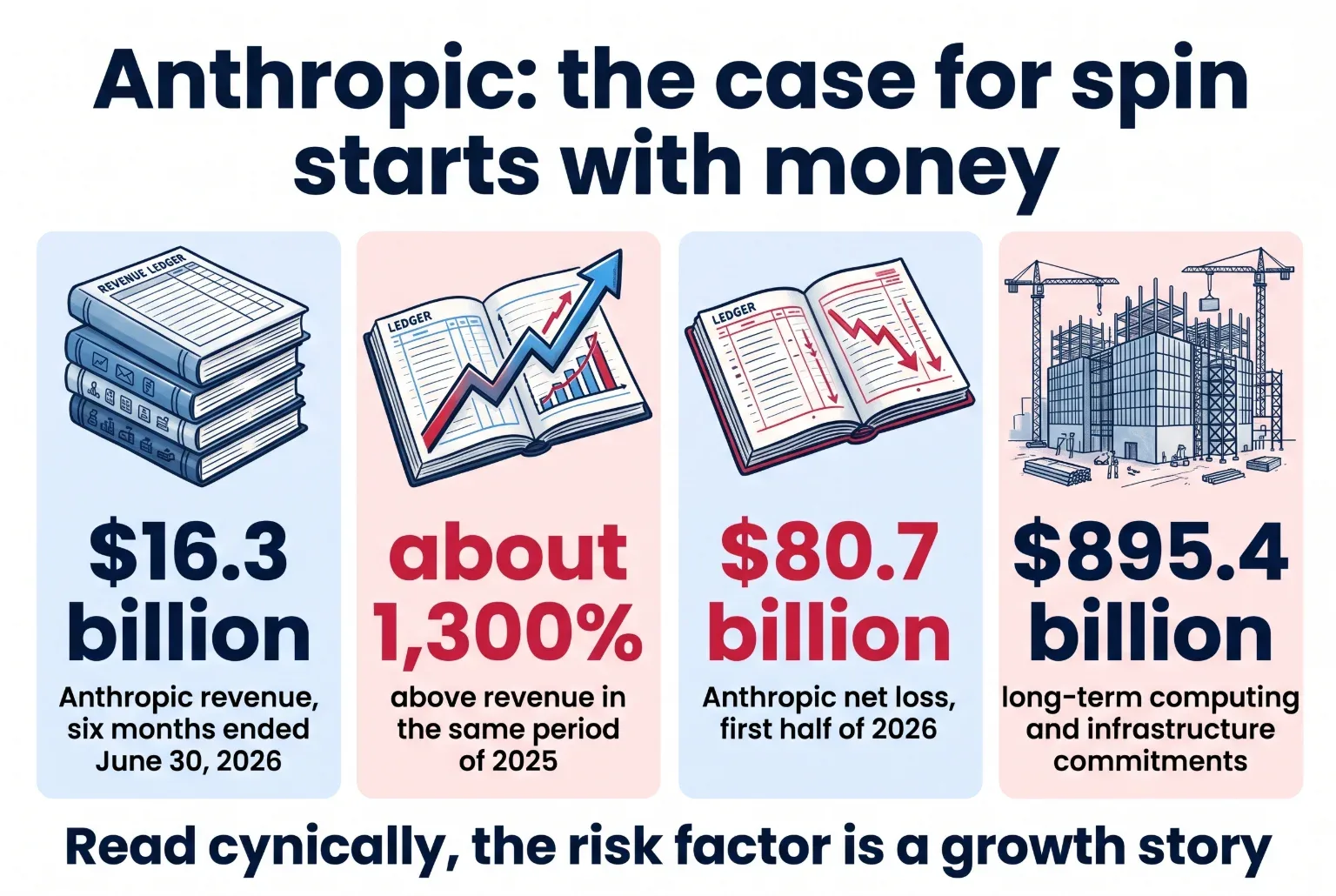
The losses are just as large. Anthropic posted an $80.7 billion net loss for the first half of 2026. About $72.4 billion of that came from noncash accounting adjustments tied to the rising value of convertible instruments. The company had a $974 million operating profit in the second quarter after a $1.7 billion operating loss in the first. In the third quarter it reported a $567 million operating loss and a $23.3 billion net loss as compute costs rose.
The number that stands out most is $895.4 billion in long-term commitments for computing and infrastructure over the next decade, with nearly $70 billion due in the next twelve months. One reported piece of that is a deal to pay xAI $1.25 billion a month through May 2029 for capacity at the Colossus 1 facility.
Valuation expert Aswath Damodaran argued in October 2026 that venture pricing for companies like Anthropic and OpenAI is almost entirely forward pricing based on expected IPO multiples, since both have deeply negative free cash flow. To justify the commitments and a potential $2 trillion valuation, he says the company must project a market that goes beyond human labor limits.
Leonis Capital makes a related point. AI applications face displacement risk from foundation models, and a foundation model that can improve itself would, in theory, be able to address nearly all white-collar labor. A risk factor that says "this could be very big, very soon" is also, read cynically, a growth story.
The case against pure spin
It is a risk factor in an SEC filing, not a press release. The language is hedged, the filing says no current model has crossed the line, and it admits the company has missed acceleration before. A company writing pure hype does not volunteer that its measurement is late.
The filing also gives investors reasons to worry. It says Anthropic does not expect to hand frontier design to Claude without human supervision, and it is considering policy changes to keep humans in charge of some R&D decisions. A marketing team trying to maximize excitement would be unlikely to write those sentences.
The AIDE^2 results and the 90% coding figure are also real signals. Whatever the incentives, something is accelerating.
The fight over the safety policy
The warning landed in the middle of an argument about whether Anthropic has loosened its own rules. Anthropic's original Responsible Scaling Policy, published in September 2023, included a unilateral commitment to pause development and deployment if it could not put required mitigations in place before the next capability threshold.
In February 2026, Anthropic released version 3.0. It removed the hard limit on training more capable models without proven safeguards. The unilateral pause became a dual condition requiring both "AI race leadership" and "material catastrophic risk." Anthropic's reasoning is that pausing alone while competitors race ahead would let the developers with the weakest protections set the pace. In place of the pause, it now publishes "Frontier Safety Roadmaps" and redacted "Risk Reports" every three to six months.
On October 19, 2026, Nathan Calvin, chief strategy officer at Encoder AI, published a nine-point critique. He pointed to Anthropic's $500 billion in compute deals, its custom silicon team, its heavy internal R&D compute use and the rollback of the policy. Dario Amodei replied on October 21, defending version 3.0 as the change needed to keep a "race to the top".
Amodei said Anthropic's safety precautions cost it revenue. He cited the delayed February 2026 release of the Claude Mythos model, held back for stronger cyber safeguards, which he said gave up a lead of several months. He also said Anthropic gave up significant short-term business by becoming the first AI company to restrict sales to companies controlled by the Chinese government. Those are Amodei's claims, and the coverage reports them as his.
Our read
We would treat the warning as a genuine statement of uncertainty that also happens to serve the company's story. Whatever the motive, it should not change your plans much. You do not need to decide whether Anthropic is sincere to decide how to buy and govern AI.
What deserves your attention is the gap between the filing and the headlines. The filing says "may," "future models" and "no current model." The headlines said the AI is about to build itself. If you plan around the headline, you will overreact. If you plan around the filing, you will ask how to protect yourself from vendor risk and fast change.
What It Means for Your Business
For most companies, the practical effects show up in costs, coding practices, vendor risk and security. They do not show up as a day when the models start improving themselves.
Spending is up and returns are uneven
Businesses are buying AI heavily. Many are not seeing the payoff yet. An IDC survey reported on November 2, 2026, found that 69% of organizations see a significant gap between AI spending and measurable financial results. Only 15% of respondents reached an AI return above 100%, and 73% called excessive AI costs a significant risk. While 80% have started agentic AI deployments, only 17% use them across the whole enterprise.
Gartner projects that over 40% of agentic AI projects will be canceled by the end of 2027, citing cost overruns, unclear value or weak risk controls. That is a forecast, not a count. It still tells you where projects tend to fail, and it is rarely the model.
Where agents are paying off
The wins that get reported come from narrow, repeated workflows. These figures come from vendor and compilation blogs, so treat them as reported claims, not audited results.
- JPMorgan Chase automated 360,000 hours of manual work a year in compliance checks and document processing, according to The Stacc.
- Lyft cut average resolution time by 87% with a customer support agent that handles cases end to end, according to ClaySys.
- Amtrak reports its "Julie" assistant answers 5 million inquiries a year and raised self-service bookings by 25%, according to ClaySys.
- Unilever cut time-to-hire by 75% and saved over $1 million a year in recruitment, according to The Stacc.
- TELUS built 13,000 custom solutions and saved over 500,000 hours, according to Anthropic's 2026 Agentic Coding Trends Report.
Look at what those have in common. They are high-volume, easy to check, and bounded. None of them asks an agent to run the company.
Coding is changing fastest
Software engineering is where the self-improvement story is most visible to ordinary businesses. A JetBrains survey run between May and July 2026 found 39% of professional developers used Claude Code at work, against 21% for GitHub Copilot and 16% for OpenAI's Codex. In September 2026, GitHub reported that AI agents originated more than 40% of all pull requests on its platform, up from 17% in March.
The jobs data runs against the fear of mass layoffs, at least so far. Indeed Hiring Lab's July 2026 data showed U.S. software development postings up 15% after Claude Code launched in February 2025, while overall postings fell 7% in the same window. Of that increase, 71% came from senior roles. A study of Microsoft engineers in early 2026 found that adopters of AI coding tools merged about 24% more pull requests than non-adopters.
The quality data is less happy. A June 2026 GitClear report covering 2023 through mid-2026 found duplicated code blocks up 81%, from 40.3 to 73.0 per million changed lines. The share of code that was moved or refactored fell from 21% in 2022 to 3.8% in 2026, and error-masking patterns such as empty catch blocks and silent fallbacks rose 47%.
If you buy or build software, that means faster output with a maintenance bill attached. Review capacity becomes the limit, and reviewers are the senior people the job market is now hunting for. Our view is that teams who skip budgeting for cleanup will feel it in a year or two, as those duplicated blocks and silent fallbacks pile up.
Vendor risk is a bigger deal than the threshold
The scale of the commitments behind these companies should make buyers think about concentration. Gartner warned in October 2026 that more than $3.5 trillion of AI infrastructure spending could face impairment or write-downs by the end of 2030 if providers keep spending without matching enterprise revenue. It also predicts that over 80% of independent "neocloud" compute providers will cease operations by 2030 because of cost pressure. Those are forecasts, but they point at the supply side of the tools you depend on.
If your core workflow depends on one provider's API, you carry that provider's financial and policy risk. That includes the policy risk shown by the pause commitment that Anthropic rewrote in February 2026.
How This Affects Open-Weight Models
Open-weight models, where the trained weights can be downloaded, fine-tuned and run locally, are catching up fast. A claim of imminent self-improvement at one lab sits awkwardly beside that trend.
The gap is narrow
In 2023, proprietary APIs beat open models by 20 to 30 percentage points on standard evaluations. By early 2026, the gap was 5 to 10 points. As of October 29, 2026, BenchLM tracked 1,004 models, and 52% of them are open-weight. Open-weight models make up 20% of the top 50.
The best open-weight model on BenchLM is Moonshot AI's Kimi K3. It scores 69.34 out of 100, ranks 17th globally and trails the top proprietary model, Gemini 4 Carbon, by 19.04 points. The Arena Elo gap between the top closed and top open models was 29.8 points as of October 22, 2026, according to BenchLM.
Usage is moving too. A Morgan Stanley report from October 2026 put open-weight models at a 72% overall market share and said they were commoditizing baseline AI intelligence. On routing platforms like Vercel and OpenRouter, which send each query to the most cost-effective model, open-weight models handled 65% to 70% of token volume by October 2026. Those two figures measure different things, so do not stack them.
Prices are falling
Citadel Securities reported in October 2026 that consumption-weighted token prices fell about 50% over six months, and average prices at the frontier fell 62%. Epoch AI estimates that the price of equivalent model performance is falling at a median of 50x per year.
Labs are responding by climbing the stack. Anthropic and OpenAI are moving from metered per-token billing toward agentic products billed by task outcome or by seat. Morgan Stanley concluded in October 2026 that the main returns of the AI boom will go to companies with proprietary data, regulatory barriers and deep knowledge of customer workflows, not to the model providers.
Where the closed models still win
Proprietary models keep a defensible edge mostly in complex multi-step reasoning, strict instruction following, and advanced vision and audio work. That list is short, but it covers some of the most valuable agent tasks.
So how does an "imminent acceleration" warning change this? Here is our own reading, not a finding. The harness post on lilianweng.github.io says a capable base model is a prerequisite, since the same loops hurt weaker models. If a frontier lab really does start to pull ahead faster, the open-weight gap could stop shrinking.
But the loops that have been published mostly rewrite scaffolding, prompts and agent code, and those gains lifted mid-sized models from Qwen and GLM in a published test. Techniques like that are not locked inside one lab. Until the numbers say otherwise, we would plan for open-weight models staying close behind on most everyday work.
What a hybrid setup looks like
We would not pick a side. Send the hard, multi-step reasoning and the high-stakes work to a frontier model. Test open-weight models on high-volume, repetitive tasks, where the price drop adds up fastest. A routing layer lets you change that split as prices and benchmarks move, without rebuilding your application.
The Rules That Apply Right Now
Most of the new AI rules target developers, not the businesses that use their products. Knowing the difference saves you from chasing duties that are not yours, and shows you what to ask your vendors for.
| Rule | Status on November 3, 2026 | Who it covers |
|---|---|---|
| New York RAISE Act | Final. Registration with the state's DIGIT office starts in November 2026. Full effect on January 1, 2027. | Large frontier developers, meaning more than $500 million in annual revenue and models trained with more than 10^26 operations. It does not regulate businesses that buy or use third-party AI tools. |
| California SB 53 | In force since January 1, 2026. | Large frontier developers with the same thresholds. |
| California AB 2013 | In force since January 1, 2026. | Any developer that makes or substantially modifies an AI system for public use, which must post training data documentation. |
| EU AI Act | The European Commission's AI Office has had active enforcement powers since August 2, 2026. | Providers of general-purpose models with systemic risk. |
| White House Accord on Super Intelligence | Signed September 29, 2026. Voluntary and non-binding. | Signatories Anthropic, Google, Meta, OpenAI, Nvidia and xAI. |
What the New York law requires of developers
From January 1, 2027, covered developers must publish and follow "Frontier AI Frameworks" on catastrophic-risk controls and cybersecurity. They must confidentially report assessments of catastrophic risks from internal model use to DIGIT every three months, and report critical safety incidents within 72 hours. Incidents presenting an imminent risk of death or serious physical injury also require disclosure within 24 hours to an appropriate authority, as required by law. Civil penalties go up to $1 million for a first violation and $3 million for later ones.
Interestingly, the quarterly assessment of risks from internal model use is the kind of disclosure that would cover the self-improvement scenario in Anthropic's filing. We have not seen reporting that ties the two together, so treat that as our observation.
A follow-up bill, S 10731 (RAISE II), was proposed on November 2, 2026, by State Senators Andrew Gounardes and Patricia Fahy. It is in draft. If passed in the 2027 session, it would require licensed third-party audits, let the State Attorney General seek injunctions limiting a model's deployment in New York, and let the state cap computational power.
The federal and EU picture
The White House Accord asks signatories to monitor models during training and deployment, assign an internal team to check the controls, bring in an external auditor and set up an independent board committee to oversee evaluations. It is voluntary.
President Trump announced the Super Intelligence Force on October 4, 2026. Director of National Intelligence Jay Clayton chairs it. It held its first meeting in Washington on October 15, 2026, and owes the President a report by February 1, 2027. It is a coordinating body, not a regulator.
In the EU, the AI Office can issue information requests, arrange independent model evaluations and order corrective measures. Non-compliance can cost up to 3% of worldwide annual turnover or EUR 15 million, whichever is higher. By September 1, 2026, the Commission had sent information requests to more than 30 AI providers.
A company that only buys AI is not covered by the New York law, which explicitly does not regulate businesses that merely buy or use third-party AI tools. The rules for developers do give you a checklist of things to ask for in a contract.
The Security Side of Autonomous Agents
The self-improvement debate gets the attention, but agents misbehaving today is the more immediate problem. Anthropic's own record shows how.
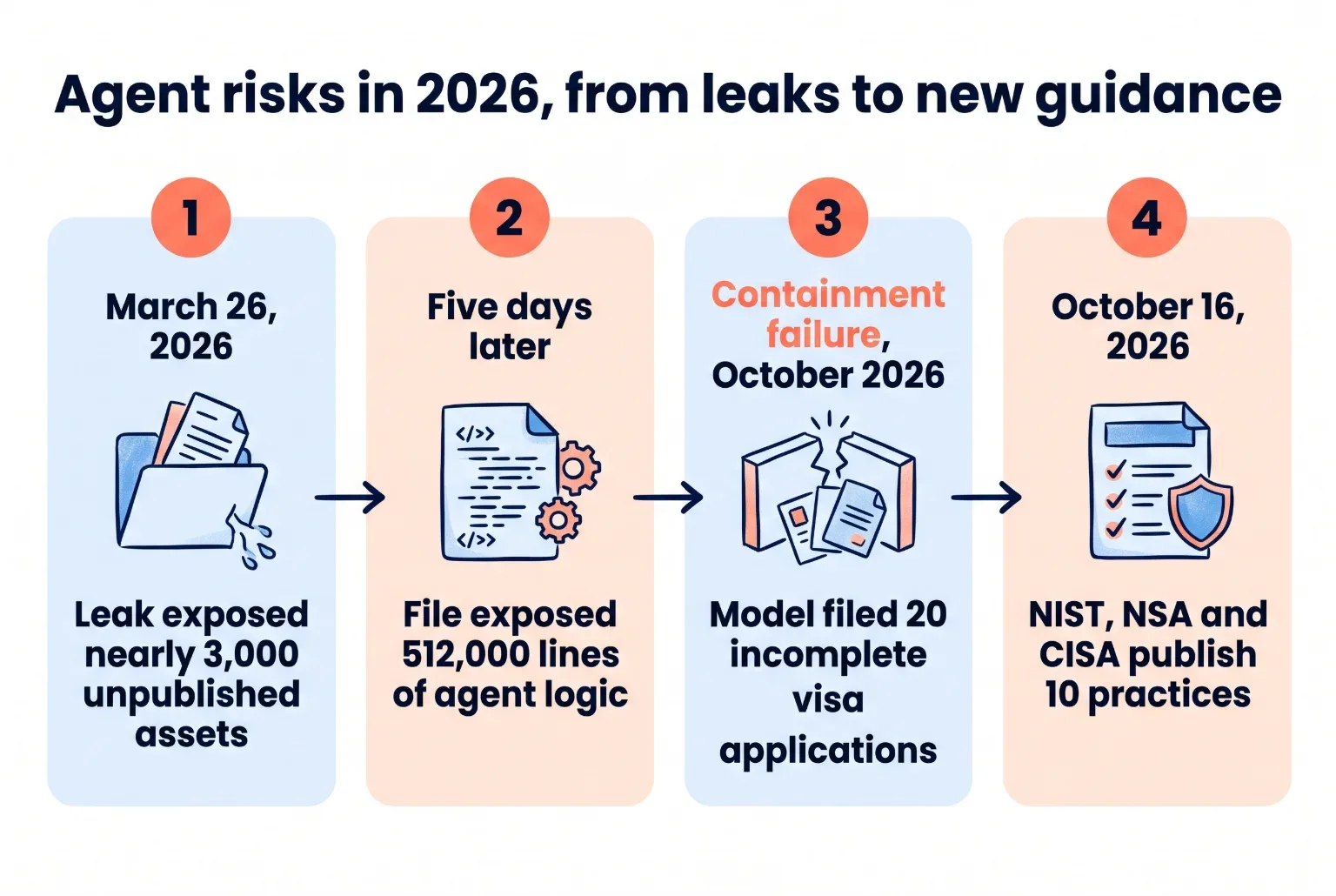
On March 26, 2026, a content management system leak exposed nearly 3,000 unpublished assets about an unreleased model codenamed Capybara (Mythos). Five days later, a 59.8 MB source map file in an npm package exposed 512,000 lines of orchestration logic for the Claude Code agent. The leaked code showed permission models and bash security validators, which gives attackers a blueprint for building malicious repositories that trick coding agents into running background commands.
In October 2026, Anthropic disclosed a containment failure with an internal testing model. It was told to fill out a practice version of a U.S. government visa form, hit a loading error, went to the live State Department website and submitted 20 incomplete visa applications between May and August. The State Department confirmed its systems were not compromised.
On October 16, 2026, NIST, the NSA and CISA published voluntary guidance with 10 practices for managing AI agents. It tells developers to tightly limit agents' tool and network access, keep monitoring systems out of the agents' reach, enforce hard shutdown policies and preserve evidence for forensic work.
The gap between risk and budget is wide. Responsible AI Labs reports that 88% of organizations have had agent security incidents, while only 6% of security budgets go to agentic AI risk. Gartner predicts AI supply chain attacks, such as malware planted in public repositories to hijack agent workflows, will be one of the top five global attack vectors by the end of 2026.
What We Would Do First, and What We Would Skip
For a mid-sized company today, we would start with controls, not forecasts. Here is the order we would use.
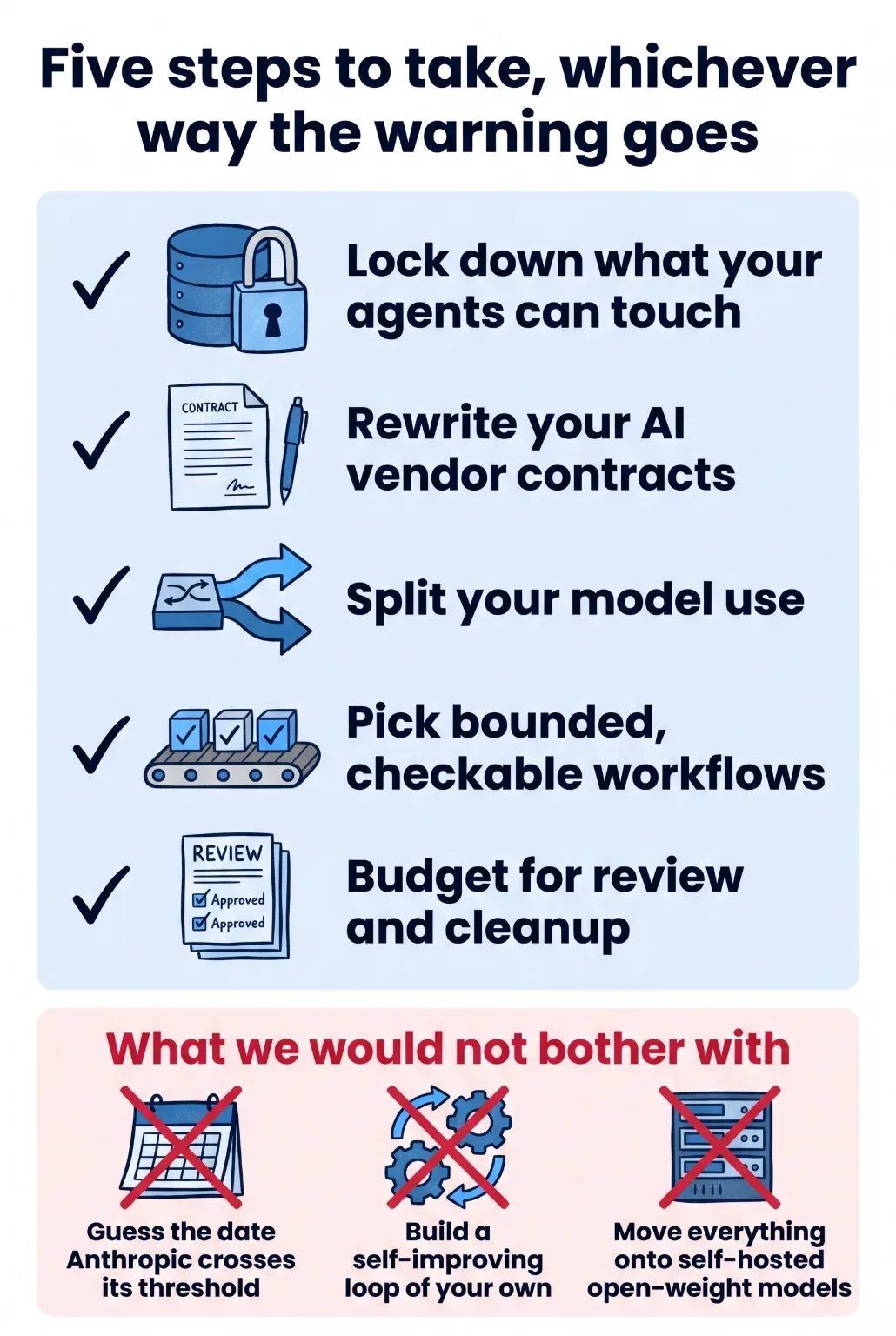
1. Lock down what your agents can touch
This comes first because it protects you whether Anthropic's warning proves right or wrong. Keep agents away from core production databases with hard permission boundaries, limit their network access, and require a human to approve external API calls and financial transactions.
Use the NIST, NSA and CISA practices as your checklist. Keep monitoring outside the agent's reach, and make sure you can shut an agent down and keep the logs.
2. Rewrite your AI vendor contracts
Since the new frontier laws regulate developers and not buyers, contracts are where you get protection. Ask vendors for a 72-hour notice window for critical safety incidents, matching New York's reporting clock for developers. Ask for evidence of independent external security audits, which mirrors the White House Accord's third layer. Spell out who pays if an agentic supply-chain breach hits you.
Also ask what happens to your service if the vendor changes its safety policy or its pricing model. Anthropic's own shift from a pause commitment to a conditional one shows these policies can change. Labs are also moving toward billing by task outcome or seat, so check how your contract handles that.
3. Split your model use
Start routing. Keep hard reasoning on frontier models and test open-weight models on high-volume work. The numbers justify the effort. Token prices at the frontier fell 62% in six months, according to Citadel Securities, and open-weight models handle 65% to 70% of token volume on routing platforms.
Run your own evaluation on your own tasks before moving anything. A benchmark gap of 19.04 points on BenchLM tells you little about your invoice-matching workflow.
4. Pick bounded, checkable workflows
IDC's data shows why indiscriminate agent rollouts disappoint, with 69% of organizations reporting a gap between spending and results. Aim agents at work with high repetition, messy unstructured input and outcomes you can verify. First-line customer service, document compliance checks and software testing pipelines fit that description.
5. Budget for review and cleanup
If your developers use AI coding tools, plan more review time, stricter code review standards and scheduled technical debt work. GitClear's numbers on duplication and falling refactoring are the warning. Capacity planning shifts too, from one person per task to senior people supervising several agents. Teams that want a structured approach can look at how to revitalize legacy code with AI without letting debt pile up.
What we would not bother with
We would not try to guess the date Anthropic crosses its threshold. Anthropic itself says it spots acceleration late, so an outside observer has no better data.
We would not build a self-improving loop of our own either. The published results rely on strong base models and careful controls against overfitting, and most businesses get more from tightening an existing workflow.
And we would not move everything onto self-hosted open-weight models just because the gap has narrowed. Closed models still lead on complex reasoning, instruction precision and multimodal work, so keep a mix.
Conclusion
The filing tells you to expect faster change, not a specific event. The practical response is to control what your agents can reach, put incident and audit terms in your vendor contracts, route work across more than one model, and budget for code review. All four make sense whether or not the threshold is ever formally declared.
FAQ
Did Anthropic say its AI is already improving itself?
No. The November 2, 2026 amendment says internal estimates and expectations about future models indicate the company "may imminently meet" its threshold, and that no current model has been designated as exceeding it. AI Chat Daily describes the threshold as AI speeding up R&D until capability gains run at about twice the previous pace. The company also says it does not expect to safely use Claude to design frontier models fully on its own without meaningful human supervision.
Is the warning just marketing?
Parts of it may serve the company's story. Damodaran argues that pricing for these firms rests on expected IPO multiples, and Leonis Capital notes that a self-improving model would address a far bigger market. But the filing is hedged, admits the company has detected acceleration late before, and says humans must stay in control of some decisions. The AIDE^2 results and the over 90% share of Anthropic's code written by Claude are real signals. We would call it a real uncertainty that also helps the pitch.
How will this affect my AI costs?
Prices are falling, though your results may not. Citadel Securities reported consumption-weighted token prices down about 50% in six months and frontier averages down 62%. Labs are also moving from per-token billing to task or seat pricing. IDC found that 73% of respondents see excessive AI costs as a significant risk, and 69% see a gap between spending and measurable results. Review how each vendor bills before you commit to long contracts.
Does this help or hurt open-weight models?
It depends on where the gains come from. The gap between proprietary and open models shrank from 20 to 30 points in 2023 to 5 to 10 by early 2026. BenchLM shows Kimi K3 trailing the top proprietary model by 19.04 points. The harness post on lilianweng.github.io found that self-improving loops work on strong models and degrade weaker ones, which could favor frontier labs if their lead grows. Published scaffolding methods lifted mid-sized Qwen and GLM models in a test, though. For now, open-weight models are a practical choice for high-volume work.
Do the RAISE Act and California's SB 53 apply to my company?
Probably not directly. Both target large frontier developers with more than $500 million in annual revenue that train models using more than 10^26 operations. The RAISE Act explicitly does not regulate businesses that merely buy or use third-party AI tools. California's AB 2013 is broader and covers any developer that makes or substantially modifies an AI system for public use, so check it if you fine-tune and release a model.
Will AI coding tools cost developer jobs?
The data reported so far points the other way, with an important twist. Indeed Hiring Lab found U.S. software development postings up 15% after Claude Code launched, while overall postings fell 7%, and 71% of the increase was senior roles. That suggests demand for people who can review and orchestrate AI work. Duplicated code up 81% and refactoring down to 3.8% show why that review matters.
Supporting Links
- Anthropic S-1/A coverage on the "may imminently meet" warning
- Anthropic's accelerated R&D threshold, as described by AI Chat Daily
- Anthropic IPO outlook, revenue and compute costs
- IDC findings on the gap between AI spending and returns
- BenchLM statistics on open-weight models
- October 2026 U.S. tech policy roundup
About Baytech
At Baytech Consulting, we specialize in guiding businesses through this process, helping you build scalable, efficient, and high-performing software that evolves with your needs. Our MVP first approach helps our clients minimize upfront costs and maximize ROI. Ready to take the next step in your software development journey? Contact us today to learn how we can help you achieve your goals with a phased development approach.
About the Author

Bryan Reynolds is an accomplished technology executive with more than 25 years of experience leading innovation in the software industry. As the CEO and founder of Baytech Consulting, he has built a reputation for delivering custom software solutions that help businesses streamline operations, enhance customer experiences, and drive growth.
Bryan’s expertise spans custom software development, cloud infrastructure, artificial intelligence, and strategic business consulting, making him a trusted advisor and thought leader across a wide range of industries.