In this article
- Why 90-Day MVPs Slip Before Anyone Writes Code
- Decide What the First Release Must Prove
- Choose What Goes In and What Waits
- Products That Started Small
- Write Requirements a Team Can Build From
- Pick a Build Approach That Fits the Product
- Budget the Build and the Year After
- A Build Sequence That Fits 90 Days
- Hold the Scope Line
- What to Measure After Launch
- Conclusion
- FAQ
- Supporting Links
- About Baytech
- About the Author
Most founders guess their MVP will take about ten weeks. It usually takes closer to nineteen.
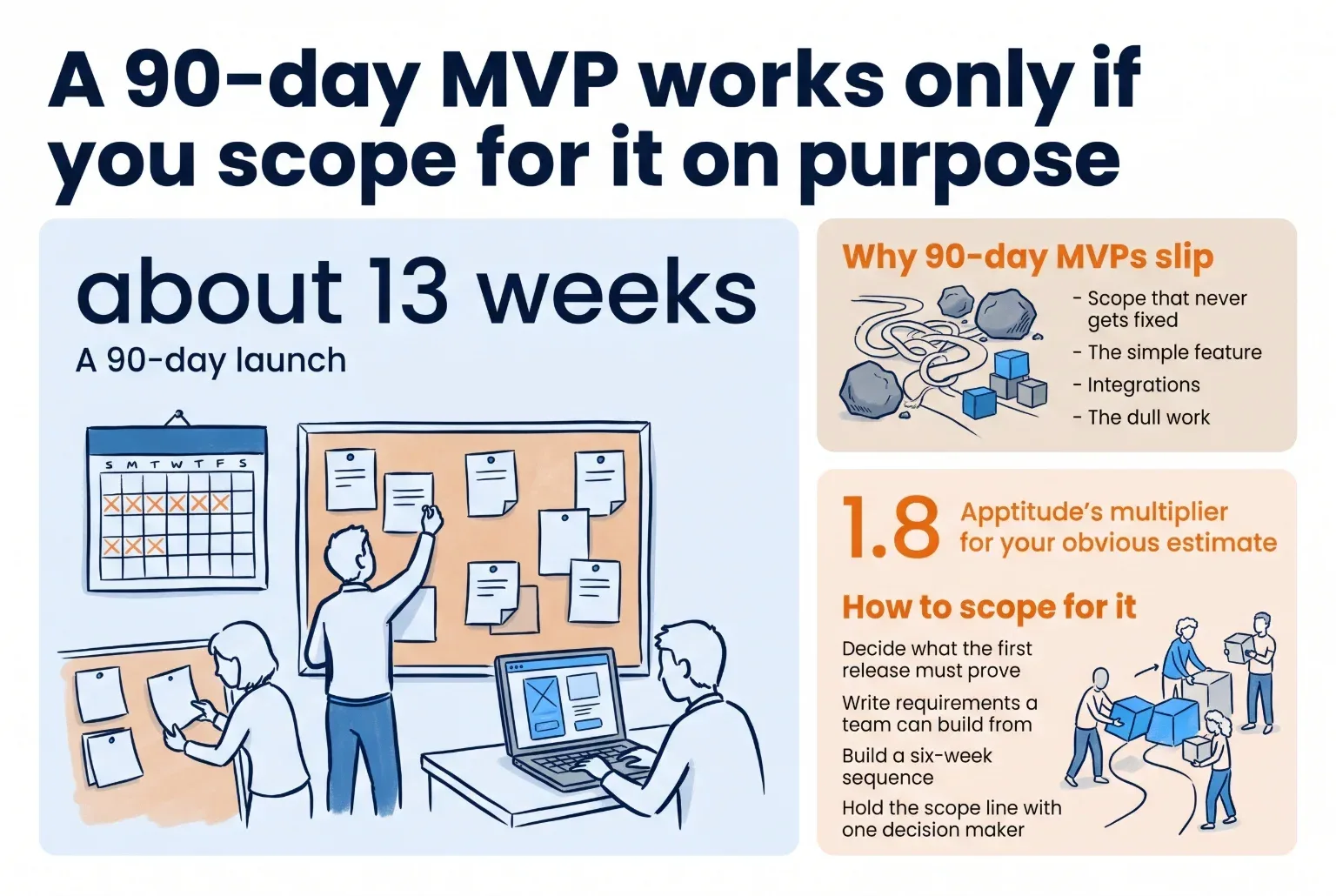
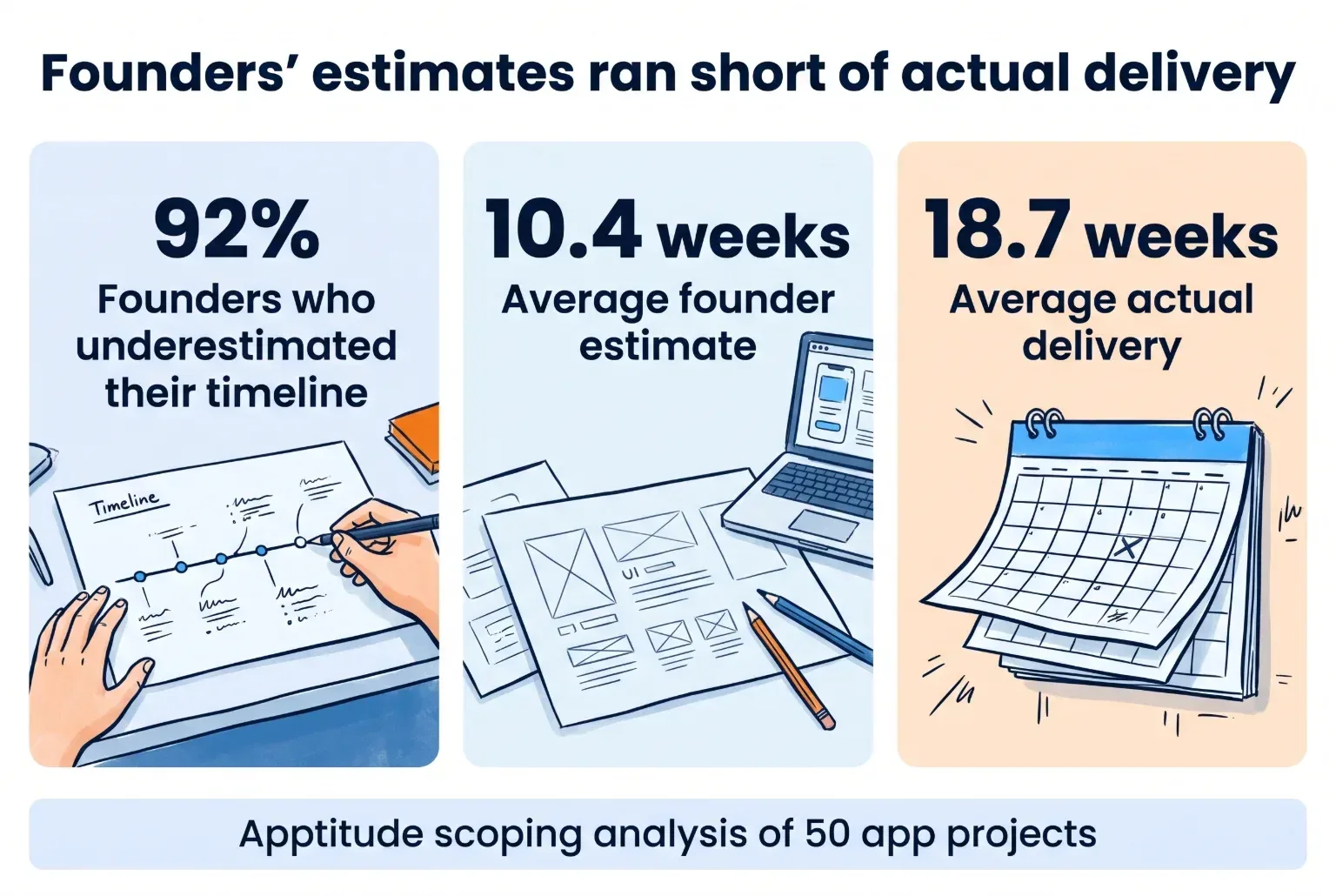
In a scoping analysis of 50 app projects, Apptitude found that 92% of founders underestimated their timeline. The average founder estimate was 10.4 weeks, and the average actual delivery was 18.7 weeks. Only four of the 50 projects shipped within two weeks of the founder's estimate. A 90-day launch is about 13 weeks, so it can be done, but only if you scope for it on purpose.
Why 90-Day MVPs Slip Before Anyone Writes Code
The gap between estimate and reality has a few repeat causes. Knowing them tells you where to cut.
The first is scope that never gets fixed. Conovo Technologies looked at more than 200 projects and found that the builds that launched on time were almost always the ones where the team decided what not to build before they started. Every feature added before launch delays learning and raises the cost of being wrong, because the team spends more money on assumptions no market has tested yet.
The second is the "simple feature." This showed up in 78% of the scoping sessions Apptitude analyzed. A "simple" chat feature typically takes three to five weeks, since it needs real-time infrastructure, message persistence, read receipts and media handling.
The third is integrations. In 42% of the scoped projects, at least one third-party integration was on the list, such as payments, maps, a CRM, EHR platforms or social media APIs. Connecting a well-documented API like Stripe, Twilio or Google Maps takes three to five days. A poorly documented one, common with enterprise and healthcare platforms, averages two to three weeks.
The fourth is the dull work. Apptitude says the "boring" tasks usually take 20% to 30% of total development time, and founders rarely put them in the plan.
Apptitude's practitioners advise multiplying your "obvious" estimate by 1.8. Run that backward. If your honest guess is seven weeks, the 1.8 multiplier puts you at about 12.6 weeks, right at the edge of a 90-day window. If your guess is ten weeks, you need to cut scope before you start.
Decide What the First Release Must Prove
An MVP is a test. Atlassian describes it as the simplest version of a product that lets a team validate an idea and gather feedback with minimal effort. Start from the thing you need to find out, then list features.
A 2017 study from the Hawaii International Conference on System Sciences gives the MVP two goals. One is to learn as much as possible and cut uncertainty with the fewest resources. The other is to break down the customer's needs so the full product can be built in modular pieces later. The same study found that firms do better iterating moderately rather than radically in any one release.
Market maturity changes the bar. In a new market, an MVP only has to show that the problem exists. In a crowded category it has to do much more, unless you come at the market from a different angle.
Product leaders quoted by SuperMe give three useful scoping filters:
- Jiaona Zhang scopes from the problem inward. She cuts features until one or two are left, then builds those well enough that the test means something.
- Nikhyl Singhal scopes by audience first and by features second.
- Lane Shackleton writes a thesis, then cuts every feature that does not help confirm or kill it.
One more rule from the same collection: if a risk is not a concern for customers, it does not belong in the MVP.
Mid-size companies have an extra layer. An MVP inside a larger company has to prove a business case while still respecting security, procurement, legacy systems and approval paths. Attract Group suggests starting enterprise scope from one question, what must be true for the business to keep investing. Build the "thin slice," the smallest working path from a user action to a business outcome. Treat the pilot as a controlled release, and end with a decision meeting rather than a demo.
Choose What Goes In and What Waits
Everyone agrees on cutting scope. The hard part is deciding what to cut when every feature has an advocate.
Curiosum lists several prioritization methods:
- 80/20 rule. Roughly 20% of features deliver 80% of the benefit.
- MoSCoW. Every feature goes into Must, Should, Could or Won't (for now).
- Kano model. Features are sorted into Basic expectations, Performance (more is better) and Delighters.
- RICE. A score of Reach x Impact x Confidence x Effort, popularized by Intercom.
- User-story mapping. A visual workshop, popularized by Jeff Patton, that lays out the whole user journey.
We would start with MoSCoW and a story map, and skip the rest for a first release. That is our view, not a finding. MoSCoW is quick and forces a "Won't" column. Adevs says defining scope this way takes one week and costs nothing if you lead it yourself, or $2,000 to $5,000 with a consultant.
The payoff can be large. Adevs describes a healthcare scheduling platform that used MoSCoW to cut its budget from $120,000 to $55,000 and its timeline from eight months to 3.5 months. The same guide shows how a food delivery app grows as you move down the list:
| Scope | Budget | Timeline |
|---|---|---|
| Must-Have features only | $40,000 | 3 months |
| Plus Should-Have | $65,000 | 5 months |
| Plus Could-Have | $95,000 or more | 7 or more months |
Only the first row fits inside 90 days. Adevs notes that development cost rises faster than the feature count does.
Keep a "not yet" list. Conovo's advice is that good ideas do not get rejected, they get parked where everyone can see them until after launch. People stop arguing for a feature when they can see it has a place in line.
Products That Started Small
The early versions of well-known products were narrow.
Slack
The first Slack prototype was built around three lists on screen: Channels, Messages and Members. The team grouped consecutive messages from the same author to make the list feel like conversation, and added a visual gap after five quiet minutes. They wrote code to pull links out of messages and fetch enough metadata to show a title, description, source and often an image.
That prototype was the centerpiece of the board demo in early February, one month after development started. The team began using Slack internally on February 14, 2013. Alpha testers at other companies were asked to quit email for a week and run their internal communication through Slack. Onboarding was somewhat manual, with no sophisticated signup flow or user education yet.
The team guessed Slack might scale to teams of about 100, or 150 at most. Rdio, one of the first companies to test it, had over 300 employees. That led to a Mute feature, which lets people join a channel but dims it and turns off its notifications. The feature came from real use, not from a roadmap.
Red Badger and Dr Brauer
Red Badger built an operational MVP for a client, Dr Brauer, in 10 working days. The team was a delivery lead, a tech lead, two software engineers and a product designer. Design and development ran at the same time rather than as an assembly line, which removed waiting between handoffs. The client had the product in hand in just over two weeks, to test with his own clients.
YouTube and Coda
At YouTube, a test with a tiny skip button in one arm and a giant one in the other gave directional data within weeks. At Coda, Lane Shackleton's team spent about a month on a core thesis document before most of the customer research, then put it in front of users as paper prototypes.
Low-code examples
Adevs also cites a real estate listing platform that used Bubble and launched its MVP in six weeks for $8,000. An internal employee onboarding tool built with Retool cost $12,000, against $45,000 quoted for custom development.
Write Requirements a Team Can Build From
Good requirements settle ordinary questions without another meeting. José Salcido's template says a good MVP requirements document is short enough to review in one sitting and specific enough to settle ordinary questions. It tells a builder what the first release must let someone do, which boundaries matter, and what evidence shows the work is done.
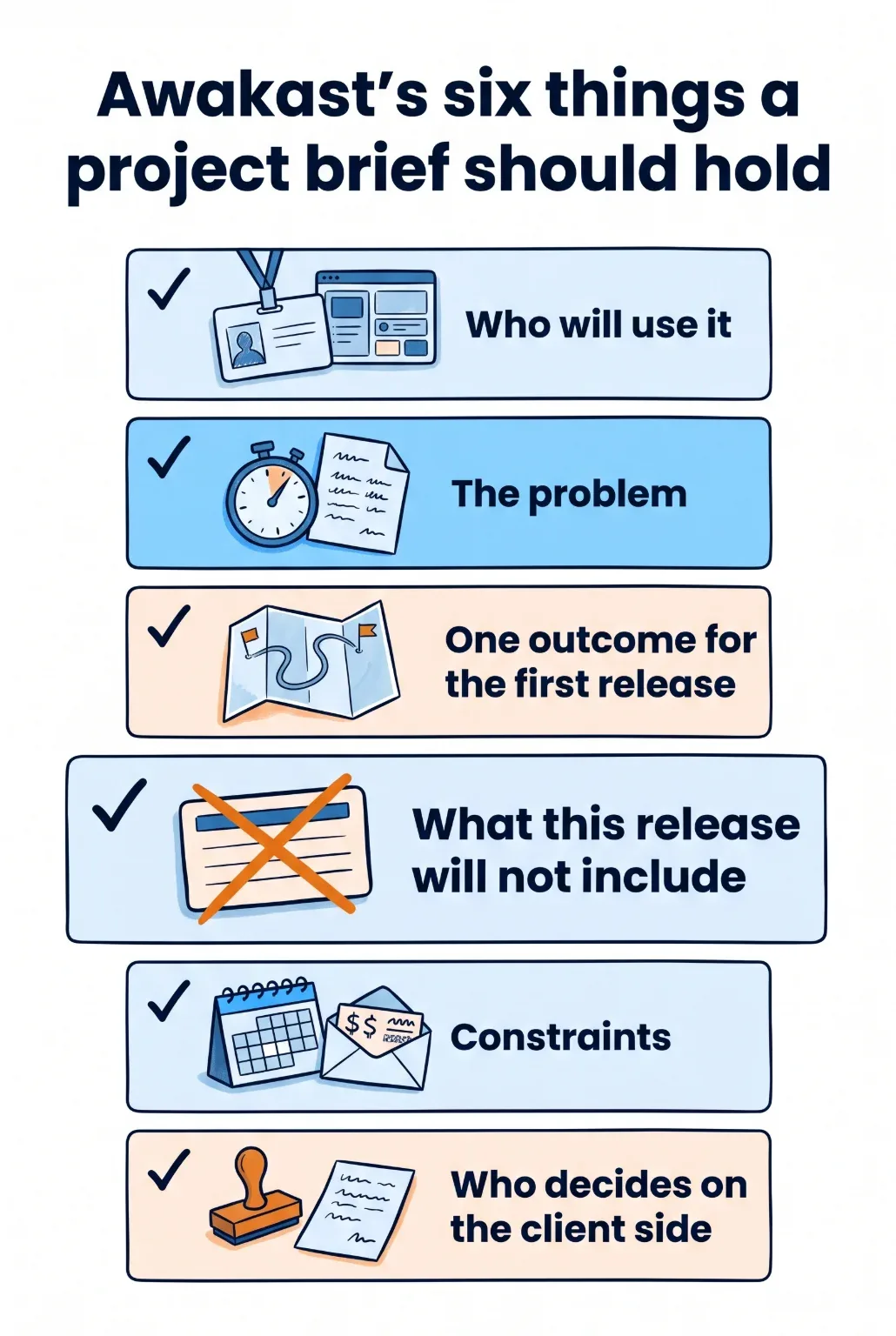
Awakast lists six things a project brief should hold:
- Who will use it. One group to start with, such as "coworking members," not "anyone who books rooms".
- The problem. What costs those users time today, or what goes wrong.
- One outcome for the first release. What a user can do from start to finish without help from the team. If describing it takes several sentences joined by "and," you probably have two products.
- What this release will not include. Awakast says this list protects the budget more than the feature list does.
- Constraints. Date, budget or cap, required integrations and the data already on hand.
- Who decides on the client side. One person who accepts releases and settles scope questions.
Write non-goals as plain sentences. A line like "social sign-in is not part of this release" keeps a familiar feature from slipping into the build by assumption. Record edge cases only when they could block the core job, create a real risk or change the estimate. Put speculative variations on a separate follow-up list. Then walk the document through with the person who will do the work before building starts.
Kevin Yien, quoted by SuperMe, writes constraints into the product requirements document before design starts: one named segment, one surface, and a short list of principles.
The technical spec
The product document covers the "what." Context Ark describes a technical spec as the "how," with six parts:
- Architecture overview
- Tech stack, with frameworks, libraries and versions
- Database schema
- API specification, with endpoints, payloads and errors
- Component inventory
- Integration points, such as external services and webhooks
Numbers belong in the spec. Context Ark's examples include API responses under 200ms at p95, a maximum of 100 projects per user, uploads capped at 10MB and a rate limit of 100 requests per minute.
The detail pays off in estimates. A 2025 LeadDev survey of 1,200 engineering teams, as cited by the Vibe Coder Blog, found that specs with data model, integration and scale information produced estimates within 20 percent of actual time 67 percent of the time. Specs missing those sections hit that mark only 23 percent of the time.
If you start from an AI-built prototype, the same blog says turning it into a spec takes four to eight hours for a typical MVP. Spend 30 minutes using the prototype while engineering watches, then audit it for gaps. Product managers most often miss error states. The gap that costs the most is auth and permissions, because retrofitting authentication and authorization is expensive. Finish with a one-hour joint design review with engineering before implementation begins.
Pick a Build Approach That Fits the Product
The platform choice changes both timeline and budget. Beyond Labs compares three approaches:
| Approach | Fits | Technical debt risk | Platform lock-in |
|---|---|---|---|
| No-code | Internal dashboards, simple workflows, early experiments | High | Extreme |
| Low-code | Internal enterprise workflows, admin tools, regulated environments | Medium to High | High |
| AI-assisted custom development | Core, revenue-driving products and long-lived platforms | Managed | Low |
No-code breaks down on custom business logic, performance-sensitive systems, security and compliance, and scaling past platform limits. Low-code struggles with deep customization and complex domain logic, and its license fees compound in ways that are not obvious in year one. AI-assisted development works inside coding, testing and refactoring while still producing a fully owned custom codebase.
Adevs says that for operational software your own team will use, such as a CRM, inventory tool or workflow automation, Airtable, Retool or Bubble can deliver 80% of the functionality at 20% of the cost. It puts low-code upfront costs at $5,000 to $25,000, against $40,000 to $150,000 for custom. If the product is the thing you sell, the table points toward custom code. If it is a tool for your staff that you need soon, low-code deserves a hard look.
Arrowbin puts AI automation MVPs at two to three weeks to a prototype, then three to six more weeks for production. A full SaaS platform past the MVP stage typically takes five to nine months.
Budget the Build and the Year After
Ranges vary a lot by source, so treat them as rough. Adevs gives an average MVP cost of $15,000 to $150,000. Arrowbin says a lean MVP that does one workflow well usually costs $5,000 to $30,000, while a polished, launch-ready one lands between $40,000 and $120,000.
Arrowbin's formula is: (weeks x team size x weekly rate) + launch costs + year-one running costs. It suggests setting aside roughly 15% to 20% of the build cost each year to run the MVP. Its typical split across the budget is:
- Development, about 50%
- UX/UI design, about 15%
- QA and testing, about 15%
- Discovery and scope, about 10%
- Project management, about 10%
Discovery is the smallest line, and it is the one that decides the other four. If the plan has no money for it, the scope will get decided during the build, which is the most expensive time to decide it.
A Build Sequence That Fits 90 Days
The firm apbld says it has shipped 77 platforms, runs three of its own products and operates over 700 tenant databases. It lays out a six-week sequence for a typical SaaS or consumer product with no unusual technical risk:
- Week 0 (three days). Planning only, with no code. Write the transaction, the acceptance criteria and the out-of-scope list with dates. Decide the tenancy boundary and pick auth, payments, hosting and the component library.
- Week 1. Set up the deploy pipeline, auth and schema, plus a page that says hello in production. Start any third-party approval that has a queue.
- Weeks 2 to 4. Build the transaction one acceptance criterion at a time, deploying every day.
- Week 5. Bring in real data. Handle imports, edge cases, error states and whatever breaks when someone who did not build it tries it.
- Week 6. Add instrumentation on the transaction, write a short manual runbook for what you left manual on purpose, and get one real user.
Six weeks against a 90-day window leaves slack. That slack is where the 1.8x estimate error, a slow API approval and the "boring" 20% to 30% will land. We would not give the slack back by adding scope. A second, more traditional view comes from Adevs: wireframes and user flows take two to three weeks and $3,000 to $8,000, and core MVP development takes six to 12 weeks and $25,000 to $80,000.
Start the queue-based work early. Week 1 in apbld's plan includes starting any third-party integration approval that has a wait, which fits Apptitude's finding that poorly documented APIs eat two to three weeks.
Legacy systems
For mid-size companies, an old system often sits behind the MVP. CodexSmith says to inventory ownership, not interfaces. First learn what the existing system still owns and which workflows depend on it. Then decide, entity by entity, which system may create or change the canonical record. Do not connect everything on day one. Begin with one entity type, one direction of authority, a small volume and outcomes you can observe.
Deployment basics
Automate the release path early. Apbld says a deploy pipeline set up on day one costs a day at the start and saves a week per month afterward. Axonbuild says a startup with one application does not need a dedicated DevOps hire. Its basic tool chain is a git host, a CI runner, a hosting platform, an error tracker and an uptime check.
Cadence's 2026 default for startups is GitHub Actions for CI and the host's auto-deploy for CD, on hosted runners. It says to skip CircleCI and Buildkite until you pass 30 engineers. It also advises turning on branch protection for the main branch, requiring passing checks and one approving review and blocking force-pushes. On the client side, Awakast says the code repository should belong to the client, with a named person as owner rather than an invited collaborator.
Hold the Scope Line
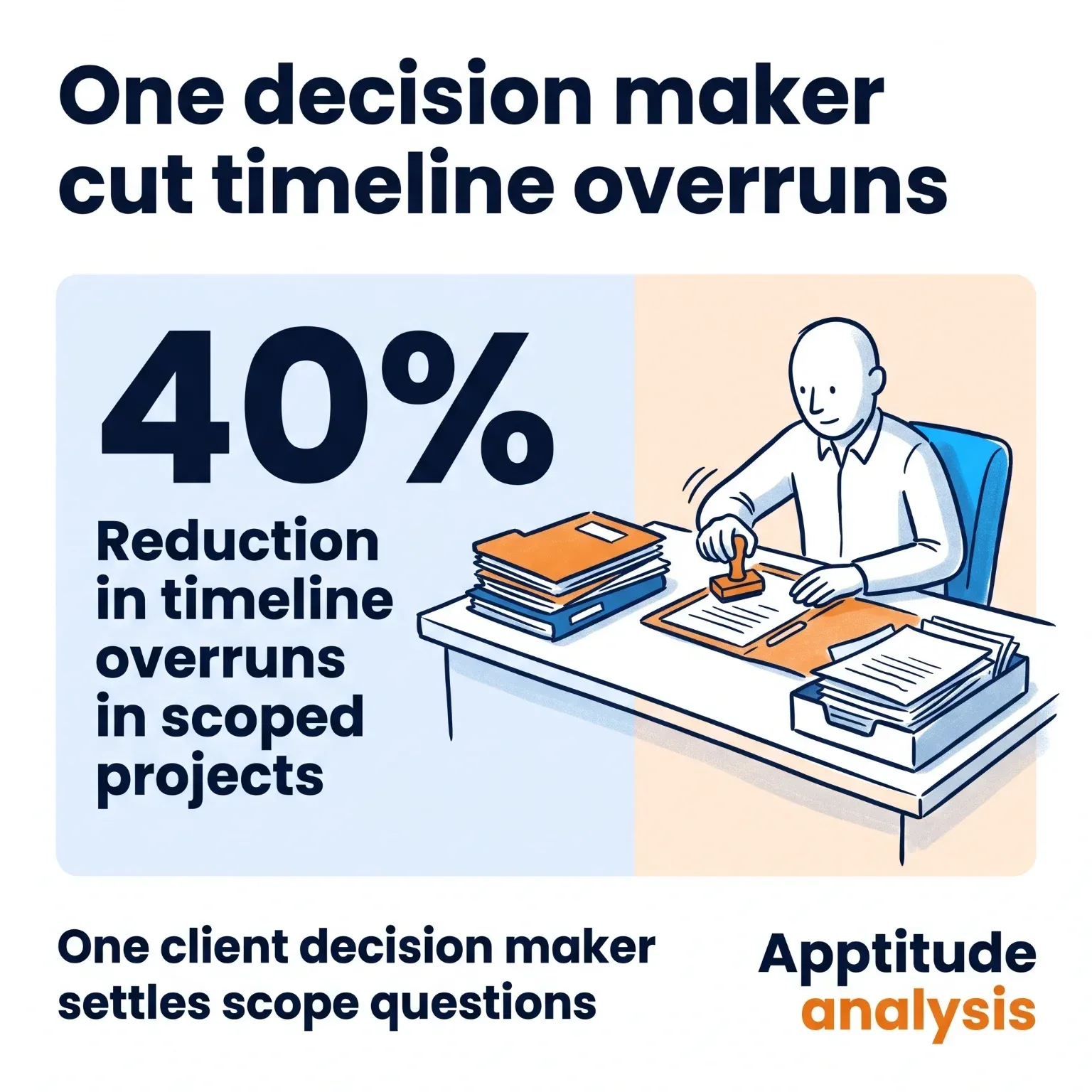
Scope creep is the likeliest thing to push you past day 90, and one habit helps most. Apptitude's analysis found that having one decision maker on the client side who accepts releases and settles scope questions reduced timeline overruns by 40% in scoped projects.
Awakast adds a few practices:
- Ask for a working, numbered release every week, along with the checks it should already pass.
- Track acceptance in one table with nine columns: requirement, check, release, who checked and when, what was expected, what happened, evidence, decision and recheck.
- Ask any vendor how they will verify your acceptance criteria at the quote stage. A team that cannot answer is probably not planning to build them.
- Treat an undefined performance problem as a gap in what was agreed, not as a defect or a scope change.
When a request arrives mid-build
Apbld suggests first checking whether an off-the-shelf service can do 80% of the request for under $200 a month. If not, a flat "no" is rarely the best answer. Alex Debecker says not to say no on the spot. Reject a request that does not help the product reach its strategic goal, back resource-based rejections with facts like ROI, potential Total Addressable Market and a resource breakdown, and remember that some technical constraints make a request pointless. New features also add complexity and can slow deployments.
Product Intuition describes a structured "maybe," which explains what it would take to become a yes. One version asks the stakeholder to build a business case strong enough to displace existing roadmap commitments. A "Wizard-of-Oz" experiment can gauge a feature's value before anyone builds it.
Put changes through a written process. ONES describes a change request that starts when someone proposes work that could alter an agreed capability, exclusion or delivery commitment. One person owns the final decision, and reviewers supply evidence and constraints. A meeting comment, an informal message or an unassigned idea does not change the agreed scope. ONES gives an example of an appointment-booking MVP. The first release covers publishing availability, viewing open times and confirming a booking, and it excludes payment processing, automated reminders and multi-location reporting. Adding payments would need a formal change request.
What to Measure After Launch
Codevelo says a successful MVP validates four hypotheses. A real problem exists and users look for a solution. The product shows clear value. Users will engage repeatedly. There is early potential to make money.
Pick three to five core KPIs tied to your main hypothesis. The ones Codevelo lists:
- Activation. How many users reach the product's core value for the first time.
- Retention. Often the single most important MVP success metric.
- Customer acquisition cost. Total marketing spend divided by customers acquired in the period.
- Churn. The share of users who stop using the product over time.
Separate leading indicators, which are early signals that predict performance, from lagging ones, which confirm outcomes that already happened. A 2022 systematic mapping study in Information and Software Technology found that practitioners lean on end-user validation such as usability tests and A/B testing.
Set stop criteria before you launch. Nikhyl Singhal advises naming the five to ten users, the one assumption, and the result that would make the team stop, all written as behaviors. His example is six of ten users coming back on their own by week three. Conovo makes a related point about the value of early contact: a live MVP with five real users teaches a team more than a perfect specification.
Conclusion
If we were starting your 90 days tomorrow, we would do three things first. We would write the out-of-scope list with dates, name the one person who accepts releases, and set the "obvious" estimate against the 1.8x multiplier before promising anything. Then we would cut until one outcome is left.
We would not spend week one choosing among prioritization frameworks, and we would not hire a DevOps person for a single app. We would also not build chat, payments or a second user group into the first release without a written change request. The slack in a 13-week window is for the work nobody plans, and the stop criteria are for the day after launch.
If you want a second set of eyes on your scope before you commit to a date, talk with Baytech Consulting.
FAQ
Is a 90-day MVP realistic?
It can be, with a narrow scope. Apbld lays out a six-week sequence for a typical SaaS or consumer product with no unusual technical risk, and Red Badger delivered an operational MVP for Dr Brauer in 10 working days. Against that, Apptitude's 50 projects averaged 18.7 weeks of actual delivery, with founders guessing 10.4. The projects that stay on schedule cut scope first.
How much does an MVP cost?
Adevs gives an average range of $15,000 to $150,000. Arrowbin says a lean MVP that handles one workflow usually costs $5,000 to $30,000 and a polished, launch-ready one $40,000 to $120,000. Arrowbin also suggests budgeting 15% to 20% of the build cost each year to run it.
Should we use no-code, low-code or custom development?
It depends on what the product is. Beyond Labs says no-code fits throwaway tools, prototypes and early experiments, and low-code fits internal workflows and regulated environments. For core, revenue-driving products it points to AI-assisted custom development, which carries low platform lock-in. Adevs notes low-code can cost $5,000 to $25,000 against $40,000 to $150,000 for custom.
What belongs in an MVP requirements document?
Awakast lists six items: the users, the problem, one outcome for the first release, what the release will not include, constraints, and one decision maker on your side. Salcido adds that the document should be short enough to review in one sitting. Add non-goals, and record edge cases only when they could block the core job, create real risk or change the estimate.
How do we say no to a feature request without a fight?
Do not refuse on the spot. Check whether an off-the-shelf service covers 80% of it for under $200 a month. Park good ideas on a visible "not yet" list, or give a structured "maybe" that says what it would take to become a yes. If the change would alter an agreed capability or exclusion, make it a formal change request with one owner.
What should we track after launch?
Three to five KPIs tied to your main hypothesis. Codevelo lists activation, retention, customer acquisition cost and churn, and calls retention often the most important. Set stop criteria as user behaviors before launch, such as six of ten users coming back on their own by week three.
Do we need a DevOps hire for the MVP?
Axonbuild says a startup with a single application does not need a dedicated DevOps hire. It names a git host, a CI runner, a hosting platform, an error tracker and an uptime check as the basic tool chain. Cadence's 2026 default is GitHub Actions plus the host's auto-deploy.
Supporting Links
- What 50 app scoping sessions showed about timelines
- Why MVPs keep slipping past launch dates
- MVP development for enterprises
- How to budget for MVP development
- Building the Slack MVP
- Delivering a lean digital product in two weeks
- MVP Requirements Document Template for Founders — José Salcido
- Writing technical specs from an AI-built MVP
About Baytech
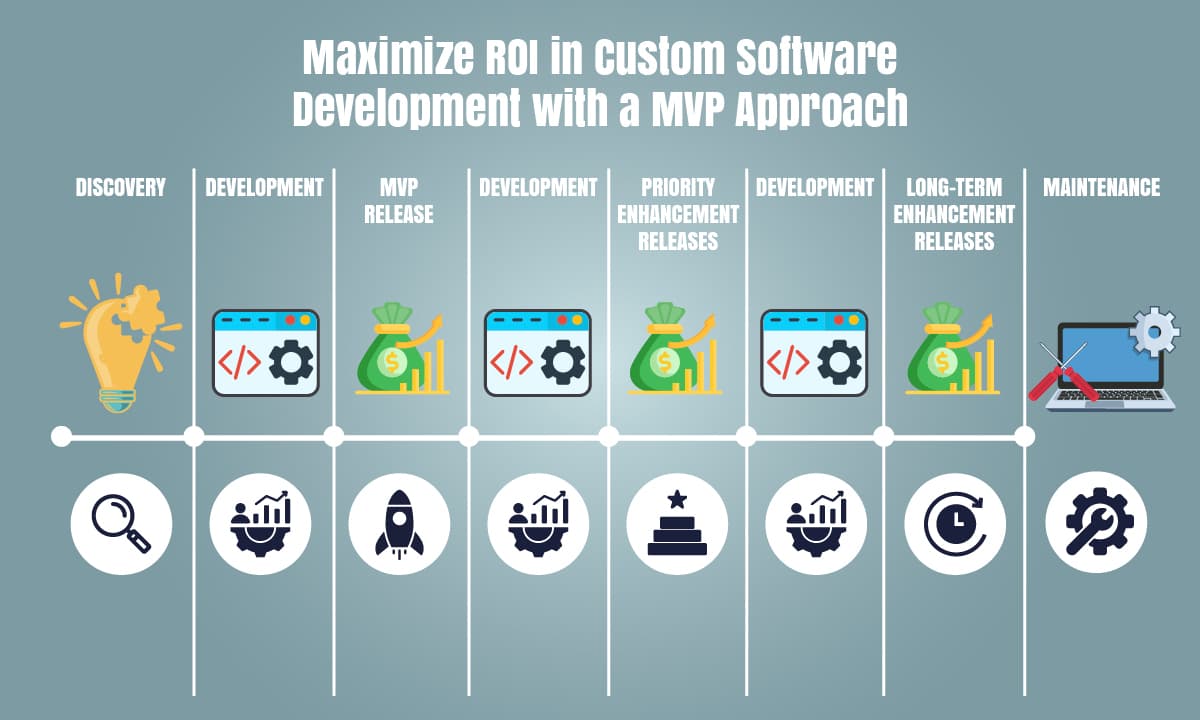
At Baytech Consulting, we specialize in guiding businesses through this process, helping you build scalable, efficient, and high-performing software that evolves with your needs. Our MVP first approach helps our clients minimize upfront costs and maximize ROI. Ready to take the next step in your software development journey? Contact us today to learn how we can help you achieve your goals with a phased development approach.
About the Author

Bryan Reynolds is an accomplished technology executive with more than 25 years of experience leading innovation in the software industry. As the CEO and founder of Baytech Consulting, he has built a reputation for delivering custom software solutions that help businesses streamline operations, enhance customer experiences, and drive growth.
Bryan’s expertise spans custom software development, cloud infrastructure, artificial intelligence, and strategic business consulting, making him a trusted advisor and thought leader across a wide range of industries.